
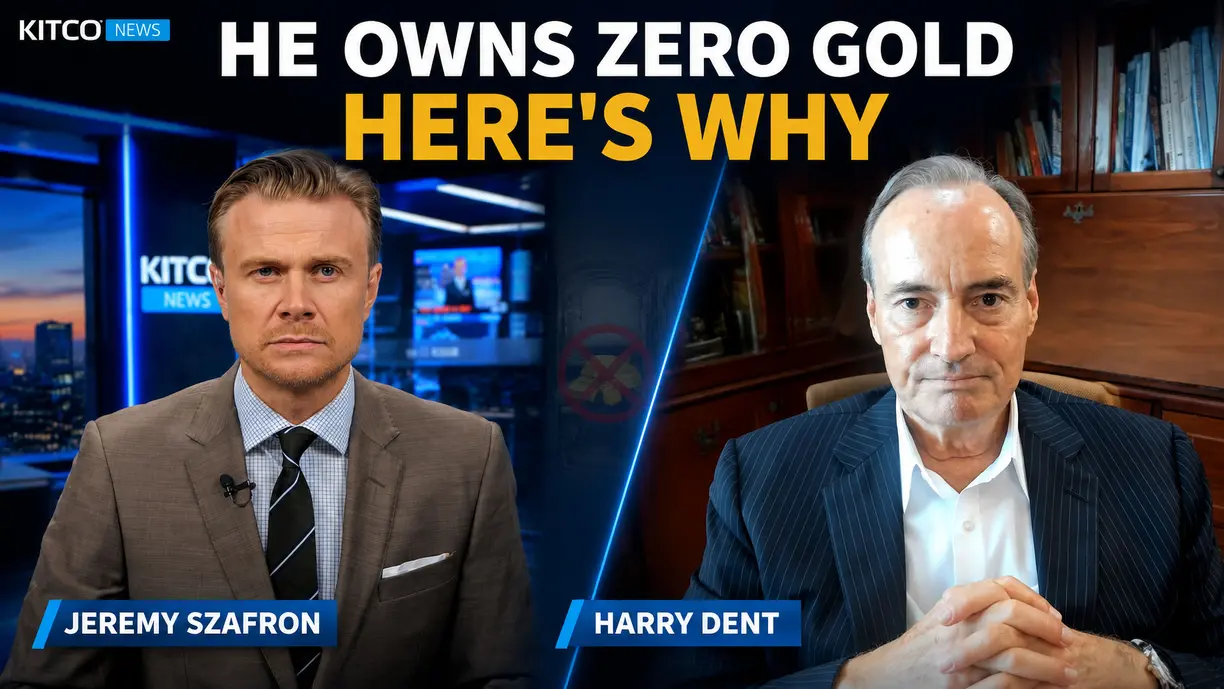
(Kitco News) - Harry Dent has spent decades warning about bubbles. Now he's acting on one. He's selling his own house, and he doesn't own any gold.
"I'm selling my main house, 'cause that's the one that's gonna get hit the most," Dent told Kitco News anchor Jeremy Szafron. "I sold my vacation home years ago."
Dent is the founder of HS Dent and the author of The Sale of a Lifetime. He first made his name in 1993 with The Great Boom Ahead, which forecast the long rally of the 1990s. Today he believes the run in markets since March 2009 is "the greatest, longest bubble in history," and that stocks, real estate, gold and silver all inflated together. In his view, the only safe place left is long-term U.S. Treasuries.
When Dent appeared on Kitco in March, he said he would reassess his forecast if a crash hadn't begun by the end of summer. He did, and he's sticking with it. Markets are "still creeping up, but they are losing momentum," he said. "This still looks like a top."
"I know it sounds crazy," he added, "but I'm telling you, this is the one time you need to protect yourself."
Sell the house with the most equity
Dent's housing advice is the part that surprises people most. He said people often come up to him after his presentations asking whether to sell the vacation home they still owe money on. He tells them to sell the one they've paid off instead.
"You should sell the house, whether it's vacation or not, that you have the most equity in, 'cause that's where you're gonna take the most actual loss," he said.
His reasoning is that if prices crash on a heavily mortgaged home, the bank takes much of the loss. A borrower can even walk away if they have to. That isn't free: walking away from a mortgage can wreck a borrower's credit, and in some states lenders can pursue the remaining balance.
The housing market is already flashing warnings. Contracts to buy existing homes fell 7.3% in September to the lowest level since the National Association of Realtors began tracking them in 2001. Economists surveyed by Bloomberg had expected a 0.5% dip. Redfin says 14.5% of September home deals fell through, the highest rate on record outside the start of the pandemic.
Prices haven't cracked yet, though. Existing-home prices are still up 1.3% from a year earlier, according to the NAR. Goldman Sachs estimates more than 95% of homeowners with a mortgage are paying less than today's rates, which gives most of them little reason to sell.
Dent thinks that standoff won't last. Freddie Mac's average 30-year mortgage rate was 7.40% in mid-October, up from 6.27% a year earlier. "This 7.5% rate should have already caused real estate to react," he said, "and I think it's going to."
His bigger warning is about how long the damage lasts. "Real estate will not see these values again for 20, 30, 40, maybe 50 years," he said.
The reason, he says, is demographics, the subject he's built his career on. Younger generations aren't big enough to buy all the homes baby boomers will sell over the next two decades. "It's the dying of the baby boomers that'll kill real estate," Dent said. He expects large suburban homes to be hit first.

Zero gold, for now
For Kitco's audience, the most startling answer may have been his own portfolio. Asked whether he holds any gold, Dent said simply: "No gold."
His reasoning is that gold joined the bubble too. The metal traded around $4,150 an ounce on Oct. 20, about 26% below its record of roughly $5,590 set in late January, according to CBS News. Dent expects it to fall much further.
"Gold is not a safe haven here, mark my words on this, because it has bubbled so much it has to correct at least 60 to 70%," he said. He sees it returning to its 2015 to 2016 lows.
Central banks aren't selling. China's central bank added about 740,000 ounces of gold in September, its biggest month in about three years, according to official data from the People's Bank of China. Dent wasn't impressed. "You wanna talk about the dumbest money on Earth? China," he said, pointing to the country's long property slump.
For gold holders, the forecast isn't all bad news. Dent believes the metal's best days come after the crash, driven by demand from India.
"Gold is gonna see the biggest rally in its history after this crash," he said. He puts that run between 2028 or 2029 and as late as 2070.
Dent explains why India drives that rally at about 51:20 in the interview above.
Stocks, and his plan to profit
Dent expects the first leg down in stocks to be fast and deep. He's targeting the post-COVID lows of late 2022, which he says would mean a drop of about 54% for the S&P 500 and about 66% for the Nasdaq. Eventually, he believes, the full decline could reach 80% to 90%, like 1929 to 1932.
Some of the big money is already moving. The Nasdaq 100 fell 5.5% in the week ended Oct. 16, its worst week since April 2025, according to the Financial Times. In the five trading days through Oct. 15, hedge funds cut their tech positions at the fastest pace in Goldman Sachs data going back to 2016, Bloomberg reported.
"The smart money's already selling here," Dent said.
Plenty of investors don't see a bubble. S&P 500 companies have posted seven straight quarters of double-digit profit growth, according to Bloomberg. But Dent points to the Buffett indicator, which compares the value of the stock market with the size of the economy. He puts it at about 238%, "the highest ever," and says it marks "the worst time to buy stocks in history."
He plans to bet against stocks for the first drop only, using a fund built to move three times the opposite of the Nasdaq 100 each day. "I would buy SQQQ, 'cause it's triple short," he said. "If I just catch that, I can retire off of it."
Those funds are designed for short-term trading. Because they reset every day, they can lose money over longer stretches, even when the market falls, according to their issuer, ProShares.
The only safe haven
For everyone else, Dent's advice is to move into the safest bonds there are. He prefers long-term U.S. Treasuries, which he says yield about 5% to 5.5%, because the government can always print the money to pay them back.
"These bonds are undefaultable, and that's why they will be the safe haven," he said.
He expects long-term rates to drop sharply in a downturn, which would push those bond prices up. He forecasts that TLT, a popular fund that holds Treasuries maturing in 20 years or more, could rise "100% plus."
After that, he sees a long stretch of falling prices. "Deflation is gonna be the only trend we see for the next 10 to 12 years," he said.
He doesn't think the Federal Reserve can stop it. The Fed raised rates in September and will make its next decision on Oct. 28. "They don't realize how sensitive this bubble is," Dent said.
Once it's over, he plans to reinvest in artificial intelligence, crypto and India, which he calls "the next China" from 2029 to 2065.
His case for getting defensive now comes down to the odds as he sees them.
"If I'm wrong, you lose another five, 10, 20% gains," Dent said. "If I'm right, you miss losing 50 to 80% of your entire financial assets, real estate, stocks, everything."