

(Kitco NewsWire) – Spot gold and silver prices were sharply lower in early U.S. trading Friday, extending Thursday's heavy losses as renewed Middle East tensions pushed crude oil prices higher and reinforced expectations that the Federal Reserve will maintain restrictive monetary policy. Gold failed to attract sustained safe-haven demand despite growing geopolitical risks and weakness in global equities, while silver faced additional pressure from concerns about industrial activity and elevated borrowing costs. At the latest available morning price reading, spot gold was trading near $4,026.56 an ounce, down 2.40% on the quoted session, while spot silver was trading near $53.801, down 6.40%. Gold was heading toward a weekly loss of more than 3.5%, with both metals remaining under heavy selling pressure.
Market positioning remains dominated by persistent inflation pressure and expectations for further monetary tightening. September consumer prices rose 0.6% on the month and 3.7% annually, while producer prices increased 1.3% and 6.3%, respectively. Interest rate futures indicate that the Fed is widely expected to leave rates unchanged at its Oct. 27-28 meeting, although traders continue to assign approximately a 78% probability to at least one additional increase by December. Thursday's sharp technology-led equity selloff encouraged demand for government bonds, producing a substantial decline in Treasury yields. However, the benchmark 10-year yield rebounded toward the 5.0% area Friday as renewed energy-price increases revived inflation concerns. The combination of firm rate expectations, rising crude prices and continued liquidation pressure has limited gold's ability to benefit from geopolitical uncertainty or intermittent declines in yields.
The Federal Reserve remains in its premeeting communications blackout, shifting attention toward Friday's preliminary October manufacturing and services purchasing managers' indexes at 9:45 a.m. EDT and the final University of Michigan consumer sentiment survey at 10 a.m. EDT. The business activity reports will provide fresh evidence on economic growth, employment conditions and input-price pressures, while the consumer survey will offer another assessment of inflation expectations.
The Strait of Hormuz and U.S.-Iran situation remains a significant source of volatility in global energy markets, with renewed attacks on commercial shipping and threats against regional oil infrastructure raising concerns about additional supply disruptions. Maritime traffic through the strategic waterway has slowed following attacks involving tankers operated by major Gulf energy companies, while negotiations between Washington and Tehran remain stalled over sanctions, maritime access and broader security arrangements. Reports concerning possible further U.S. and Israeli military action against Iranian targets have added to market uncertainty, although no new operation has been confirmed. The latest escalation has reinforced concerns about the reliability of oil exports through the Persian Gulf, despite producers' continued efforts to reroute shipments through alternative infrastructure. Brent crude briefly climbed toward $115.00 a barrel, its highest level in approximately five months, while WTI moved above $100.00.
For gold, the renewed escalation creates competing influences. The threat of additional military confrontation and disruptions to energy supplies supports defensive demand, but higher crude prices also increase the risk of persistent inflation and additional Fed tightening. This has limited the metal's traditional response to geopolitical uncertainty, with investors directing some defensive flows toward U.S. government bonds. Silver has suffered considerably greater selling pressure as the precious metals decline coincides with concerns that higher energy costs and restrictive monetary policy could weaken manufacturing activity. The sharp divergence between geopolitical risk and bullion performance underscores the current importance of interest rate expectations, liquidity and portfolio positioning.
Global equity markets were weaker before the U.S. open, extending Thursday's technology-led selloff as investors reassessed artificial intelligence investment spending, corporate financing requirements and elevated valuations. S&P 500 futures declined approximately 0.3%, while Dow futures were down around 0.7% and Nasdaq futures slipped approximately 0.1%. The declines followed Thursday's 2.60% drop in the Nasdaq Composite and 1.21% loss in the S&P 500. European equities were also under pressure amid higher energy prices and weaker regional business activity readings, while Asian markets remained volatile as technology shares continued to struggle. Concerns about France's fiscal position and elevated European borrowing costs added to the cautious tone. Strong demand for government bonds during the previous session contrasted with continued weakness in precious metals, reflecting divergent reactions to inflation and financial-market risks.
The key outside markets see Nymex WTI crude oil prices higher and trading near $101.10 a barrel, while Brent crude was near $114.72. The yield on the benchmark 10-year U.S. Treasury note is trading near the 5.0% area following Thursday's sharp decline and Friday's partial rebound. The U.S. dollar index is firmer, trading near 101.76, with safe-haven demand and expectations for restrictive Fed policy continuing to support the greenback. (Kitco Global Index shows how much of today's gold move is the dollar versus the gold market itself.)
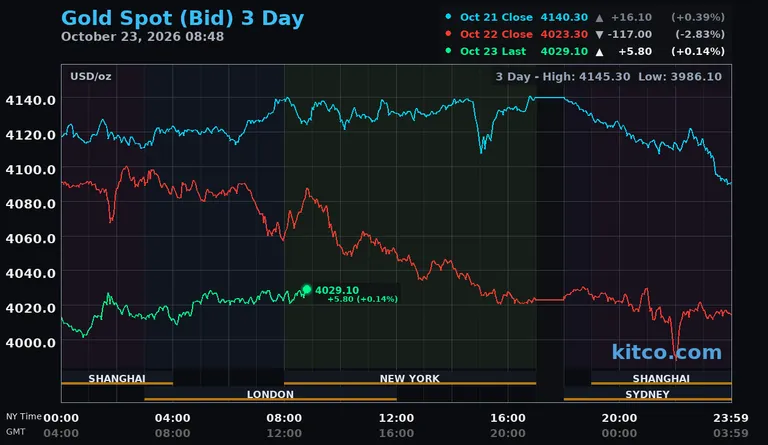
Technically, spot gold bulls' next upside price objective is to push prices back above the $4,075.00 to $4,080.00 resistance zone, with a sustained move targeting $4,200.00 and then $4,250.00. Bears' next near-term downside price objective is a break below the $3,963.00 to $3,946.00 support zone, with deeper downside targets at $3,890.00 and then $3,500.00. First resistance is seen at $4,075.00 and then at $4,080.00. First support is seen at $3,963.00 and then at $3,946.00.
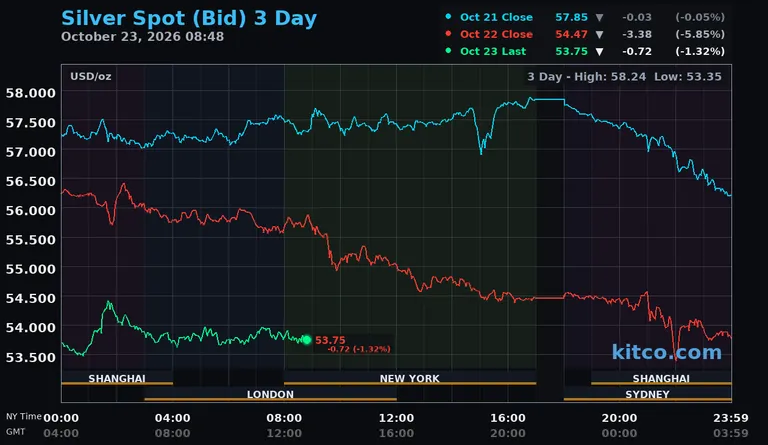
Spot silver bulls' next upside price objective is to drive prices back above the $54.530 to $55.770 resistance zone, with a move above that area targeting $58.090 and then $60.000. The next downside price objective for the bears is a break below $53.460, with deeper downside targets at $52.410 and then $51.390. First resistance is seen at $54.530 and then at $55.770. Next support is seen at $53.460 and then at $52.410.
See live precious metals prices for gold, silver, platinum and palladium — in USD, CAD and 12 more currencies.

