

(Kitco NewsWire) – Spot gold and silver prices were lower in early U.S. trading Tuesday, as persistent expectations for additional Federal Reserve tightening and uncertainty surrounding Middle East energy supplies continued to weigh on precious metals. Gold slipped below the $4,000.00 level during the morning session, while silver suffered heavier losses as concerns about industrial demand compounded the impact of restrictive interest rate expectations. Renewed diplomatic efforts involving Iran helped ease some immediate fears of another major escalation, although crude oil prices remained elevated. At the time of writing, spot gold was trading near $3,994.60 an ounce, down $21.60, or 0.54%, while spot silver was trading near $52.750, down $1.090, or 2.03%.
Market positioning remains focused on a likely Federal Reserve pause Wednesday, followed by the possibility of additional tightening before year-end. September consumer prices increased 0.6% on the month and 3.7% annually, while producer prices climbed 1.3% and 6.3%, respectively. Interest rate futures indicate that the Fed is widely expected to leave its benchmark rate unchanged at 3.75% to 4.00% when its Oct. 27-28 meeting concludes. However, traders continue to assign approximately a 73% probability to at least one additional increase by December, reflecting persistent inflation concerns despite evidence of slowing housing activity. The benchmark 10-year Treasury yield was trading near 4.98% Tuesday morning, below recent highs, as softer crude prices and demand for government bonds provided some relief. Gold nevertheless remained under pressure, reflecting the influence of restrictive monetary policy expectations and continued weakness in precious metals positioning.
U.S. durable goods orders increased 1.8% in September to $345.4 billion, exceeding expectations for a 1.5% gain and following an upwardly revised 0.1% increase in August. Excluding transportation, orders rose 0.5%, slightly below expectations for a 0.6% increase, while transportation equipment orders climbed 4.6%. Tuesday's remaining economic calendar includes August home-price indexes at 9 a.m. EDT, followed by October consumer confidence, September new-home sales and the Richmond Fed manufacturing survey at 10 a.m. EDT. The Federal Open Market Committee announces its interest rate decision Wednesday at 2 p.m. EDT, followed by Fed Chair Kevin Warsh's news conference at 2:30 p.m. EDT. Thursday brings the advance third-quarter gross domestic product report, September personal consumption expenditures inflation figures and weekly initial jobless claims at 8:30 a.m. EDT. Softer activity and inflation readings could temper December rate hike expectations and support gold through lower Treasury yields and a weaker dollar, while stronger data would reinforce the prospect of restrictive monetary policy.
The Strait of Hormuz and U.S.-Iran situation remains a significant source of uncertainty in global energy markets, although renewed diplomatic engagement has reduced some immediate concerns about another military escalation. Saudi Arabia, Turkey and Pakistan held talks with Iranian officials in Tehran Monday aimed at easing regional tensions and preventing renewed hostilities. The parties agreed to continue discussions on strengthening cooperation and regional security, although no settlement between Washington and Tehran has been announced. The broader confrontation remains unresolved, with continuing Houthi attacks against Saudi Arabian targets and persistent threats to commercial shipping complicating efforts to restore normal energy flows through the Strait of Hormuz. The risk of renewed military operations and disruptions to Gulf oil exports continues to support an elevated geopolitical premium in crude prices despite the latest diplomatic contacts.
Oil prices initially declined Tuesday as hopes for continued negotiations reduced immediate supply fears, before recovering as renewed Houthi activity reinforced concerns about the security of regional energy infrastructure. Brent crude futures were trading near $116.24 a barrel in the latest verified European morning reading, while WTI was near $102.07. For gold, diplomatic efforts and the prospect of lower crude prices offer some relief from energy-driven inflation concerns, but the absence of a confirmed U.S.-Iran settlement leaves geopolitical risks elevated. Higher oil prices continue to complicate the Federal Reserve's inflation outlook, potentially offsetting safe-haven demand for bullion. Silver remains more vulnerable to concerns about manufacturing activity and industrial consumption, particularly if elevated energy costs and restrictive monetary policy further weaken economic growth.
Global equity markets were generally firmer before the U.S. open as investors assessed corporate earnings and positioned for Wednesday's Federal Reserve announcement. Dow and S&P 500 futures gained approximately 0.2%, while Nasdaq futures advanced around 0.4%, supported by renewed interest in selected technology and artificial intelligence-related shares. Better-than-expected corporate results helped offset continuing concerns about elevated financing costs and technology-sector valuations. European markets remained sensitive to corporate earnings, energy prices and regional monetary policy developments, while Asian trading reflected mixed sentiment toward technology shares and global economic growth. Investors are also preparing for policy announcements from the European Central Bank and Bank of Japan later this week, adding to uncertainty about the direction of global interest rates and currencies.
The key outside markets see Nymex WTI crude oil futures higher and trading near $102.07 a barrel, while Brent crude was near $116.24. The yield on the benchmark 10-year U.S. Treasury note is trading near the 4.98% area. The U.S. dollar remains supported by expectations for restrictive Federal Reserve monetary policy, although the direction of Treasury yields and the dollar will remain sensitive to Wednesday's interest rate decision and Thursday's inflation figures. (Kitco Global Index shows how much of today's gold move is the dollar versus the gold market itself.)
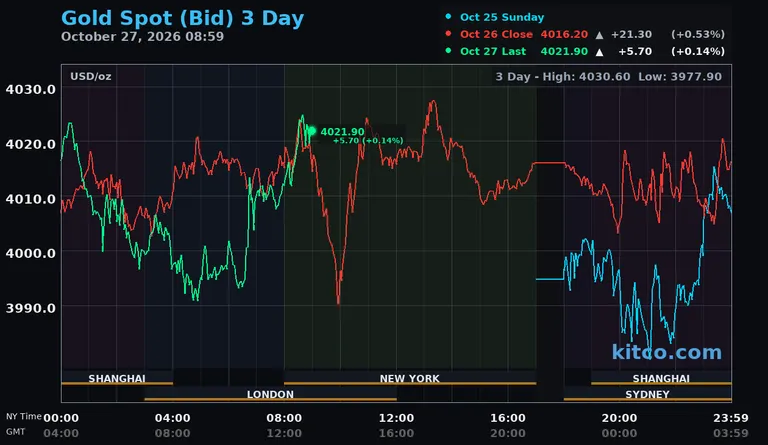
Technically, spot gold bulls' next upside price objective is to push prices back above the $4,015.00 to $4,039.00 resistance zone, with a sustained move targeting $4,079.00. Bears' next near-term downside price objective is a break below $3,975.00, with a deeper downside target at $3,959.00. First resistance is seen at $4,015.00 and then at $4,039.00. First support is seen at $3,975.00 and then at $3,959.00.
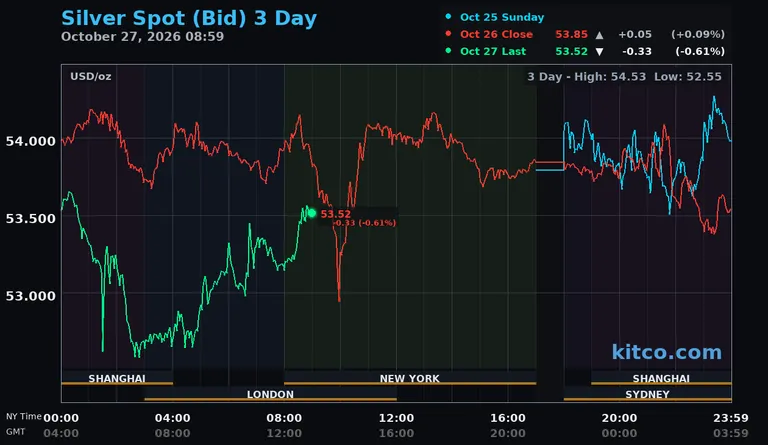
Spot silver bulls' next upside price objective is to drive prices back above the $54.460 to $55.770 resistance zone, with a sustained recovery through that area needed to improve the near-term technical outlook. The next downside price objective for the bears is a break below $52.410, with a deeper downside target at $51.390. First resistance is seen at $54.460 and then at $55.770. Next support is seen at $52.410 and then at $51.390.
See live precious metals prices for gold, silver, platinum and palladium — in USD, CAD and 12 more currencies.

