
(Kitco NewsWire) - Spot gold prices were lower and spot silver prices were modestly higher in late U.S. trading Wednesday, as a stronger U.S. dollar and expectations for additional Federal Reserve interest rate increases continued to pressure bullion following Tuesday's hotter-than-expected inflation report. Gold surrendered its early gains and fell below $4,000.00 an ounce, while silver attracted some buying interest despite the restrictive monetary policy outlook. Rising crude oil prices, renewed uncertainty surrounding the Strait of Hormuz and a broad recovery in global equity markets provided competing influences on precious metals. Spot gold was trading near $3,983.20 an ounce, down $48.60, or 1.21%, while spot silver was trading near $51.560 an ounce, up $0.149, or 0.29%, on the session..
Tuesday's U.S. consumer price index showed headline inflation increasing 0.4% in October, exceeding expectations for a 0.3% gain, while core prices rose 0.3%, also above forecasts. Shelter costs increased 0.3%, food prices advanced 0.5% and energy prices rose 0.7%, indicating persistent price pressure across several categories. The Bureau of Labor Statistics did not publish annual October inflation rates because comparable observations for October 2025 were unavailable following the federal government shutdown. The inflation surprise followed Friday's stronger-than-expected employment report, which showed 165,000 new jobs in October, a decline in unemployment to 4.1% and monthly average hourly earnings growth of 0.4%. The combination of resilient employment and persistent inflation has strengthened expectations for further Fed tightening.
Market positioning remained focused on the possibility of a larger interest rate increase at the Fed's Dec. 8-9 meeting. Wednesday's futures-market assessments indicated approximately an 87.1% probability of a 25-basis-point increase and a 12.9% probability of a 50-basis-point move, leaving additional tightening effectively fully priced. The U.S. dollar index climbed approximately 0.7% toward 102.90, approaching its highest level since April 2025 and adding to pressure on dollar-denominated gold. The benchmark 10-year Treasury yield had briefly exceeded 5.00% Tuesday as investors responded to the inflation figures. U.S. Treasury markets were closed Wednesday for Veterans Day, leaving Tuesday's bond-market levels as the latest regular-session reference. Thursday's weekly jobless claims and Friday's October producer price index, both scheduled for 8:30 a.m. EST, will provide the next tests of Fed expectations. Softer producer inflation could ease pressure on gold, while another upside surprise would reinforce the case for additional tightening.
The Strait of Hormuz and U.S.-Iran situation remained unsettled Wednesday as Tehran rejected suggestions that formal negotiations with Washington were underway. Iranian security chief Mohsen Rezaei said Iran would not allow enriched nuclear material to leave the country and maintained that the United States must address Tehran's conditions before negotiations and a reopening of the strategic waterway can proceed. President Donald Trump has recently downplayed the likelihood of additional major military strikes, while Qatar continues its mediation efforts. However, restrictions on commercial shipping remain unresolved, and reports of further attacks on vessels have reinforced concerns about Gulf energy supplies. The diplomatic impasse pushed crude oil prices higher Wednesday and maintained an underlying geopolitical risk premium. For gold, continued regional uncertainty supports defensive demand, but higher energy costs also risk reinforcing inflation expectations and the prospect of further Fed tightening.
Crude oil prices settled higher Wednesday as the Iranian comments reduced expectations for an imminent diplomatic breakthrough. Brent crude futures gained $1.27, or 1.39%, to settle at $92.76 a barrel, while Nymex WTI crude advanced $0.49, or 0.57%, to $86.53. Both benchmarks rebounded from two-month lows reached Tuesday as traders reassessed the risks to petroleum exports and commercial shipping through the Strait of Hormuz. The recovery was relatively modest compared with the substantial declines recorded earlier in November, but the unresolved confrontation leaves energy markets vulnerable to further supply disruptions and geopolitical developments.
North American equity markets finished higher Wednesday as renewed buying in artificial intelligence-related companies and semiconductor shares helped Wall Street recover from Tuesday's inflation-driven decline. The Dow Jones Industrial Average gained approximately 0.5% to close at 52,486.49, while the S&P 500 advanced 1.3% to 7,619.38. The Nasdaq Composite outperformed, rising 1.6% to 25,466.19, while the Russell 2000 increased approximately 0.9% to 2,846.26. Strong quarterly results from cloud computing company CoreWeave helped revive interest in artificial intelligence-related investments, supporting a technology-sector rebound despite continuing concerns about elevated valuations and borrowing costs.
Canada's S&P/TSX Composite Index also finished higher Wednesday, advancing 241.27 points, or 0.67%, to close at 36,411.72. Gains in technology, energy and financial shares supported the benchmark, with Canadian technology companies benefiting from the recovery in U.S. artificial intelligence-related stocks. Higher crude oil prices also helped energy producers, while gold miners faced pressure from bullion's decline. The advance partially reversed Tuesday's 0.76% loss, reflecting improved North American equity sentiment despite the stronger dollar and restrictive interest rate outlook.
European equity markets closed broadly higher Wednesday as technology shares and stronger corporate earnings supported buying interest. The pan-European Stoxx 600 advanced 0.72% to finish at a record 663.04, while Germany's DAX gained 1.20% to 26,662.77. France's CAC 40 rose 0.66% to 8,332.87, and the U.K.'s FTSE 100 climbed 0.78% to 10,835.47. Italy's FTSE MIB advanced 0.37% to close at 51,946.54. Siemens Energy was among the strongest German performers after providing an encouraging revenue outlook, while broader gains reflected improving confidence in corporate earnings despite persistent inflation concerns and elevated U.S. interest rate expectations.
The key outside markets see Nymex WTI crude oil futures higher after settling at $86.53 a barrel, while Brent crude futures finished at $92.76. The benchmark 10-year U.S. Treasury yield last traded near the 5.00% area Tuesday, with the cash Treasury market closed Wednesday for Veterans Day. The U.S. dollar index climbed toward 102.90, approaching its highest level since April 2025. (Kitco Global Index shows how much of today's gold move is the dollar versus the gold market itself.)
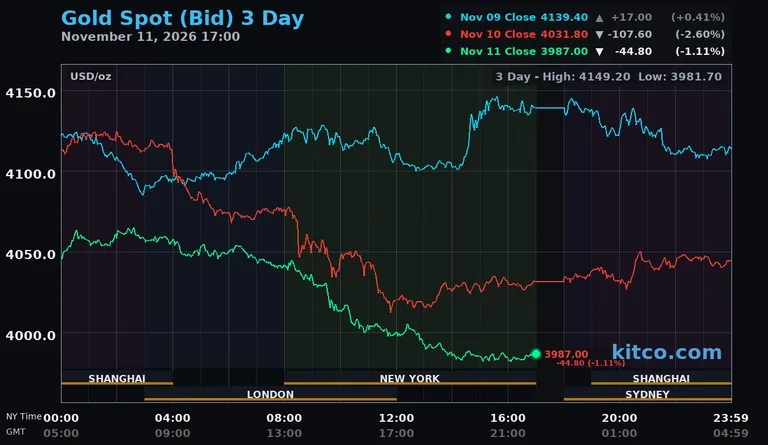
Technically, spot gold bulls' next upside price objective is to push prices back above the $3,987.96 to $4,020.00 resistance zone, with a sustained move targeting $4,064.71 and then $4,115.78. Bears' next near-term downside price objective is a sustained break below $3,987.96, with deeper downside targets at the $3,910.00 to $3,890.00 support zone. First resistance is seen at $3,987.96 and then at $4,020.00. First support is seen at $3,910.00 and then at $3,890.00.
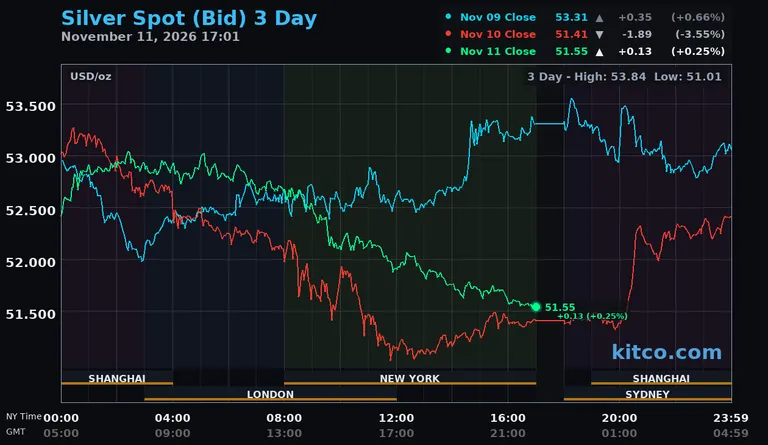
Spot silver bulls' next upside price objective is to drive prices back above the $52.124 to $53.119 resistance zone, with a sustained breakout targeting $53.710 and then $55.360. The next downside price objective for the bears is a break below $51.090, with deeper downside targets at $50.586 and then the $48.000 to $47.000 support zone. First resistance is seen at $52.124 and then at $53.119. Next support is seen at $51.090 and then at $50.586.
See live precious metals prices for gold, silver, platinum and palladium — in USD, CAD and 12 more currencies.