

(Kitco NewsWire) - Spot gold and silver prices were sharply lower in late U.S. trading Wednesday, extending their recent losses as a stronger U.S. dollar, expectations for further Federal Reserve interest rate increases and broad commodity-market selling weighed on precious metals. Gold dropped to its lowest level since September 2025, breaking below $3,750.00 an ounce, while silver suffered even heavier losses as concerns about industrial demand and tighter financial conditions compounded the selling. The release of hawkish minutes from the Fed's October meeting reinforced expectations for additional monetary tightening, while renewed U.S.-Iran military tensions failed to generate meaningful safe-haven demand. Spot gold was trading near $3,722.60 an ounce, down $125.90, or 3.27%, while silver was trading near $44.930 an ounce, down $2.340, or 4.95%, on the session. Gold traded as low as $3,719.10 during the day, while silver touched $44.640.
Wednesday's U.S. economic data highlighted growing weakness in the housing market despite a rebound in residential construction. October housing starts increased 9.9% to a seasonally adjusted annual rate of 1.309 million units, exceeding expectations for 1.25 million. However, building permits declined 7.4% to 1.295 million units, substantially below expectations for 1.38 million, suggesting weaker construction activity ahead. Pending home sales fell 4.7% in October, considerably worse than expectations for a 2.0% decline, reaching their lowest level since the series began in 2001. Contract signings were 16.7% lower than a year earlier, reflecting the impact of elevated mortgage rates on residential demand. The reports followed Tuesday's figures showing retail sales increased just 0.2% and industrial production declined 0.4% in October. The combination of deteriorating housing demand, slower industrial activity and persistent inflation highlighted the increasingly difficult policy environment facing the Federal Reserve.
Market positioning remained strongly tilted toward additional Federal Reserve tightening following Wednesday afternoon's release of the minutes from the Oct. 27-28 Federal Open Market Committee meeting. Nearly all policymakers anticipated an interest rate increase in December, while some officials had favored tightening at the October meeting and two raised the possibility of a larger 50-basis-point increase. A substantial majority expressed concern that inflation could remain elevated even as energy costs decline and the effects of tariffs and artificial intelligence-related investment moderate.
The latest futures assessment indicated approximately a 95% probability of a 25-basis-point increase at the Dec. 8-9 meeting, with markets also positioning for additional tightening in early 2027. The benchmark 10-year Treasury yield eased approximately 3.6 basis points to 5.065%, while the two-year yield finished near 4.798%. However, the dollar index strengthened toward 103.82, its highest level since April 2025, maintaining pressure on precious metals. Investors now turn to Thursday's weekly jobless claims and Philadelphia Fed manufacturing survey at 8:30 a.m. EST for further evidence about labor-market conditions and economic momentum. Softer economic figures could provide some relief to Treasury yields, although the Fed's persistent inflation concerns continue to limit expectations for a sustained recovery in bullion.
The Strait of Hormuz and U.S.-Iran situation remained highly unstable Wednesday as Iranian forces expanded attacks against U.S. military installations and regional allies following American strikes on a missile facility on Iran's Qeshm Island. Kuwait said its air defenses intercepted Iranian drones targeting the Ali Al Salem air base, while Bahrain reported additional aerial attacks as military exchanges intensified despite ongoing diplomatic efforts. The escalation followed renewed attacks on commercial vessels, including an Abu Dhabi National Oil Company vessel that left one crew member missing and 11 injured. Another tanker near Oman was struck and caught fire, while a separate attempted boarding was reported off Yemen. The continuing U.S. naval blockade of Iranian ports and unresolved disputes over sanctions and maritime security remain significant obstacles to a comprehensive settlement. However, recovering Middle Eastern petroleum exports and expectations for a global oil surplus have reduced the immediate supply premium in crude prices. For gold, the unresolved confrontation maintains underlying defensive demand, but Wednesday's sharp decline indicated that expectations for higher U.S. interest rates, dollar strength and broader asset liquidation were dominating the market's response to geopolitical risk.
Crude oil prices fell sharply Wednesday as larger-than-expected increases in U.S. petroleum inventories reinforced expectations for a global supply surplus, offsetting concerns about renewed military escalation in the Persian Gulf. Nymex WTI crude futures declined $2.75, or 3.2%, to settle at $83.26 a barrel, their lowest closing level since late August. Brent crude futures fell $1.19, or 1.3%, to finish at $91.95. The U.S. Energy Information Administration reported that commercial crude inventories increased by 3.4 million barrels to 417.8 million barrels during the week ended Nov. 13, compared with expectations for an increase of just 58,000 barrels. Gasoline inventories rose 5.2 million barrels to 215.9 million barrels, while distillate stocks increased 1.6 million barrels to 104.9 million barrels. The inventory increases reinforced concerns that recovering Middle Eastern production and stronger global supply growth could outpace demand, despite continuing security threats to commercial shipping. Lower energy prices could help moderate inflation expectations, although Wednesday's weakness in precious metals indicated that expectations for further Federal Reserve tightening remained the more immediate market influence.
North American equity markets finished mixed Wednesday as renewed selling in industrial and financial shares offset gains in selected technology companies following stronger-than-expected Nvidia earnings. The Dow Jones Industrial Average declined 561.25 points, or approximately 1.1%, to close at 50,198.17, while the S&P 500 lost 0.2% to finish at 7,323.63, extending its losing streak to five sessions. The Nasdaq Composite advanced 0.4% to 24,429.88, and the Russell 2000 gained 0.5% to 2,714.31. Nvidia initially rallied following results that exceeded expectations but later reversed its gains, highlighting continued uncertainty surrounding artificial intelligence investment and technology valuations. The broader market remained sensitive to expectations for additional Federal Reserve tightening, while weakness in oil, metals and other cyclical commodities weighed on industrial and resource-related companies. Treasury securities benefited from defensive demand, but lower yields provided little support to gold as investors continued reducing exposure to precious metals.
Canada's S&P/TSX Composite Index also declined sharply Wednesday as plunging gold, silver and crude oil prices pressured the resource-heavy Toronto market. The index fell more than 1.5% during the session, trading near 34,680 in the afternoon after closing Tuesday at 35,315.30. The materials sector declined more than 5% during the morning as precious metals producers faced renewed selling following gold's drop to a 14-month low and silver's decline below $45.000 an ounce. Energy producers also weakened alongside crude oil, while selected financial companies contributed to the broader decline. The Canadian benchmark reached its lowest level in more than four months, reflecting the combined impact of weaker commodity prices, restrictive monetary policy expectations and deteriorating investor appetite for cyclical assets.
European equity markets finished lower Wednesday, extending Tuesday's sharp losses as mining and energy companies declined amid broad weakness in commodity prices. The pan-European Stoxx 600 fell 1.03% to close at 644.05, its third consecutive daily decline and lowest finish since Nov. 6. Germany's DAX declined 1.19% to 25,736.24, while France's CAC 40 lost 0.85% to 8,146.83. The U.K.'s FTSE 100 fell 1.30% to 10,551.17, reflecting the pressure on London's commodity-heavy benchmark from falling metals and energy prices. Mining shares were among the weakest sectors, with copper producers and diversified mining companies under pressure as concerns about industrial demand and tighter financial conditions intensified. Selected semiconductor companies initially benefited from Nvidia's stronger earnings and guidance, but the gains were insufficient to offset losses in materials, energy and other cyclical industries.
The key outside markets see Nymex WTI crude oil futures sharply lower after settling at $83.26 a barrel, while Brent crude finished at $91.95. The benchmark 10-year U.S. Treasury yield declined toward 5.07%, while the two-year yield finished near 4.80%. The dollar index strengthened toward 103.82, adding to pressure on gold and silver despite declining Treasury yields and renewed geopolitical tensions. The combination of persistent Federal Reserve tightening expectations, weaker industrial commodity prices and broad portfolio repositioning reinforced the bearish near-term outlook for precious metals. (Kitco Global Index shows how much of today's gold move is the dollar versus the gold market itself.)
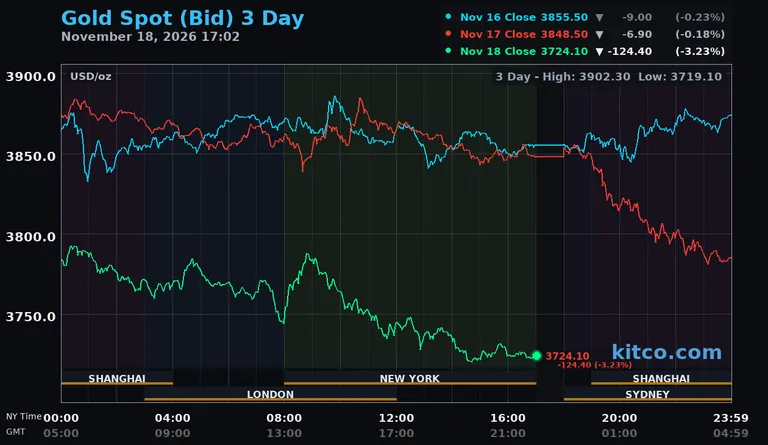
Technically, spot gold bulls' next upside price objective is to push prices back above the $3,750.00 to $3,780.00 resistance zone, with a sustained recovery targeting $3,802.00 and then $3,826.81. Bears' next near-term downside price objective is a break below $3,719.10, with deeper downside targets at $3,650.00 and then $3,630.00. First resistance is seen at $3,750.00 and then at $3,780.00. First support is seen at $3,719.10 and then at $3,650.00.
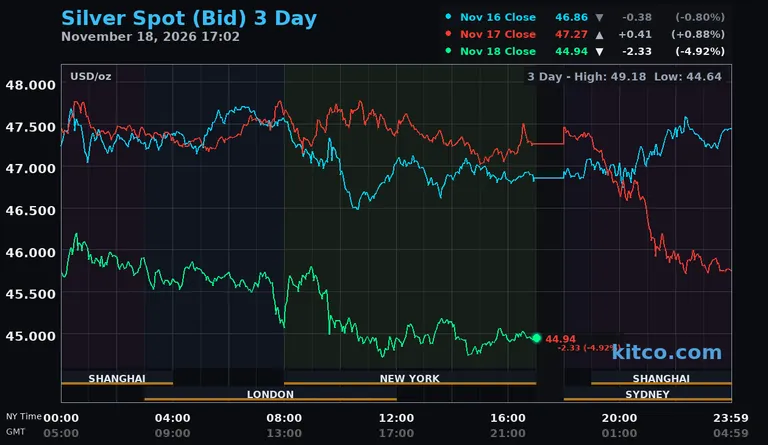
Spot silver bulls' next upside price objective is to drive prices back above the $45.000 to $45.740 resistance zone, with a sustained recovery targeting $46.590 and then $46.866. The next downside price objective for the bears is a break below $44.640, with deeper downside targets at $44.000 and then $41.000. First resistance is seen at $45.000 and then at $45.740. Next support is seen at $44.640 and then at $44.000.
See live precious metals prices for gold, silver, platinum and palladium, in USD, CAD and 12 more currencies.

