
(Kitco NewsWire) - Spot gold prices were modestly lower and silver prices were slightly higher in early U.S. trading Thursday, as investors assessed weaker-than-expected U.S. labor market and manufacturing data against persistent expectations for additional Federal Reserve interest rate increases. Gold remained near its lowest level since September 2025 following Wednesday's sharp decline, while silver stabilized after its recent selloff. Renewed attacks on commercial vessels in the Strait of Hormuz provided limited support for bullion as monetary policy expectations and dollar strength continued to dominate sentiment. At approximately 8:49 a.m. EST, spot gold was trading near $3,714.80 an ounce, down $9.30, or 0.25%, while silver was trading near $45.060 an ounce, up $0.117, or 0.26%, on the session. Gold had traded as low as $3,693.10 overnight, while silver touched $44.430.
Thursday morning's U.S. economic data indicated some deterioration in labor market conditions and a sharp slowdown in regional manufacturing activity. Initial claims for unemployment benefits increased to 203,000 during the week ended Nov. 14, exceeding expectations for 197,000 and rising from the previous week's upwardly revised 202,000. Continuing claims increased to 1.763 million, above expectations for 1.710 million, suggesting that unemployed workers are experiencing greater difficulty finding new positions. The Philadelphia Fed's November manufacturing index declined to 6.3 from 20.9 in October, substantially below expectations for a roughly unchanged reading and its lowest level in six months. The index remained positive, indicating continued expansion, although at a considerably slower pace. The weaker reports followed Wednesday's housing data showing October housing starts increased 9.9% to an annualized 1.309 million units, while building permits declined 7.4% to 1.295 million and pending home sales fell 4.7%. The combination of softer employment indicators, weaker manufacturing activity and deteriorating housing demand highlights slowing economic momentum, although persistent inflation continues to complicate the Federal Reserve's policy outlook.
Market positioning remains strongly tilted toward another Federal Reserve interest rate increase at the Dec. 8-9 meeting, following Wednesday's release of the minutes from the central bank's Oct. 27-28 policy meeting. Nearly all policymakers anticipated that additional tightening would likely be appropriate in the coming months, while some officials raised the possibility of a larger increase if inflation remained elevated. The latest published futures assessment indicated approximately a 90% probability of a 25-basis-point increase in December, with a 10% probability of a 50-basis-point move. The benchmark 10-year Treasury yield remained near the 5.1% area after declining Wednesday, while the dollar held near its strongest level since April 2025. Thursday's weaker economic figures could encourage some reassessment of the Fed's tightening trajectory, although the central bank's inflation concerns continue to limit expectations for a near-term policy reversal. Investors will also assess additional Federal Reserve commentary Thursday and Friday's final November University of Michigan consumer sentiment survey at 10 a.m. EST for further evidence about consumer confidence and inflation expectations.
The Strait of Hormuz and U.S.-Iran situation remains highly unstable Thursday as additional attacks on commercial shipping and renewed military exchanges threaten the security of petroleum exports through the strategic waterway. Iranian military authorities claimed that several tankers, including vessels carrying crude oil and liquefied petroleum gas, were damaged or set ablaze after striking naval mines, although the latest claims have not been independently confirmed. The incidents followed Iranian drone attacks against U.S. military installations in Bahrain and American retaliatory strikes on Iran's Qeshm Island. Preliminary shipping estimates indicate that crude flows through the strait have declined to approximately 8.5 million barrels per day, roughly half their prewar levels, while total regional petroleum exports remain substantially below earlier volumes. The continuing U.S. naval blockade of Iranian ports and stalled diplomatic negotiations maintain significant risks of further escalation. For gold, the unresolved confrontation supports underlying defensive demand, although expectations for restrictive U.S. monetary policy and concerns about inflation from another sustained oil-price increase have limited the metal's response to geopolitical developments.
Crude oil prices were modestly higher Thursday following Wednesday's sharp decline, as renewed concerns about Middle Eastern shipping security offset expectations for a global petroleum surplus. Brent crude futures traded near $92.19 a barrel, up approximately 0.26%, while Nymex WTI crude was near $83.31, up 0.06%, in morning dealings. Both benchmarks fell sharply Wednesday after the U.S. Energy Information Administration reported that commercial crude inventories increased by 3.4 million barrels to 417.8 million barrels during the week ended Nov. 13, compared with expectations for an increase of just 58,000 barrels. Gasoline inventories rose 5.2 million barrels, while distillate stocks increased 1.6 million barrels. The inventory increases reinforced expectations that recovering petroleum supply could exceed demand despite disruptions to shipping through the Strait of Hormuz. Lower energy prices could help moderate inflation expectations, although continued underlying U.S. price pressures remain the more immediate consideration for Federal Reserve policy.
Global equity markets were mixed Thursday as technology shares recovered from recent losses while mining and energy companies remained under pressure. Wednesday's U.S. session saw the Dow Jones Industrial Average decline 1.11% to 50,198.17 and the S&P 500 lose 0.23% to 7,323.63, while the Nasdaq Composite gained 0.42% to 24,429.88. Canada's S&P/TSX Composite also came under pressure as falling precious metals and crude oil prices weighed on resource-related shares. European markets finished lower Wednesday, with the Stoxx 600 declining 1.03%, Germany's DAX falling 1.19% and the U.K.'s FTSE 100 losing 1.30%. European equities were modestly higher in Thursday morning trading, supported by technology and industrial shares, while Asian markets were mixed. U.S. stock index futures also pointed toward a firmer opening, although concerns about elevated artificial intelligence valuations and restrictive monetary policy continued to influence investor sentiment. Mining shares remained vulnerable to further weakness in precious and industrial metals prices.
The key outside markets see Nymex WTI crude oil futures modestly higher and trading near $83.31 a barrel, while Brent crude was around $92.19. The U.S. dollar remained near its recent 19-month high, while the benchmark 10-year U.S. Treasury yield was trading near the 5.1% area. Thursday's weaker U.S. economic figures offered some potential relief from expectations for aggressive Federal Reserve tightening, although persistent inflation concerns and the dollar's recent strength continued to constrain precious metals. (Kitco Global Index shows how much of today's gold move is the dollar versus the gold market itself.)
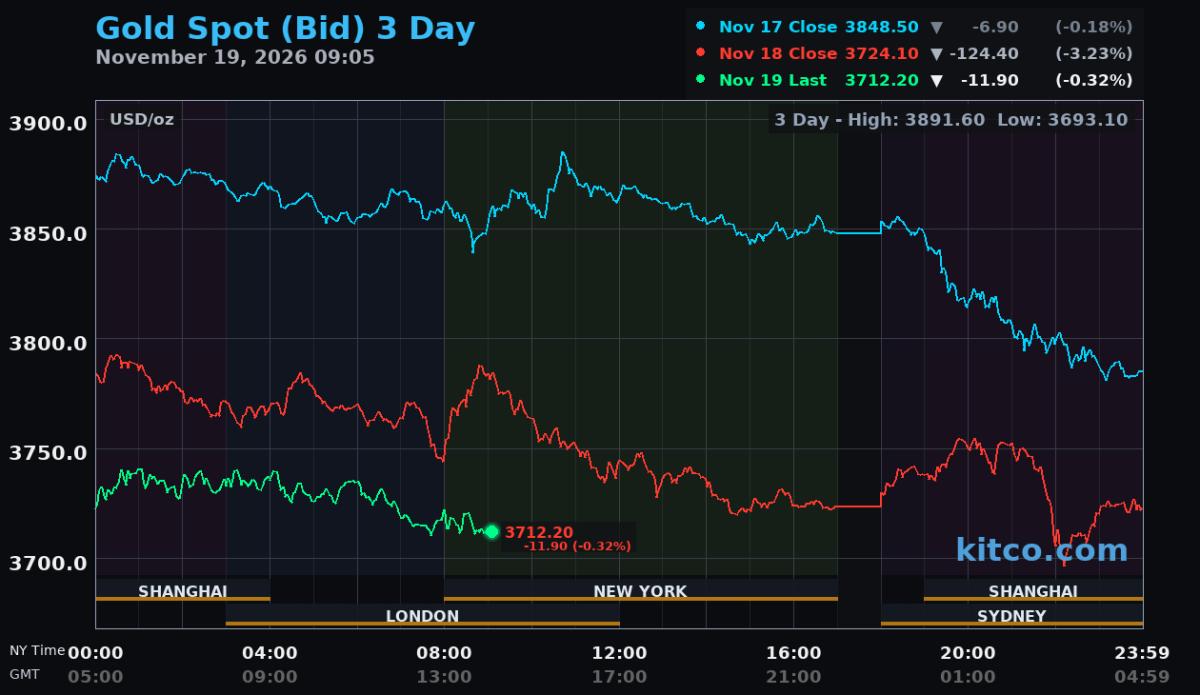
Technically, spot gold bulls' next upside price objective is to push prices back above the $3,755.00 to $3,791.00 resistance zone, with a sustained move through the upper boundary needed to improve the near-term bearish technical outlook. Bears' next near-term downside price objective is a break below $3,707.00, with a deeper downside target at $3,678.00. First resistance is seen at $3,755.00 and then at $3,791.00. First support is seen at $3,707.00 and then at $3,678.00.
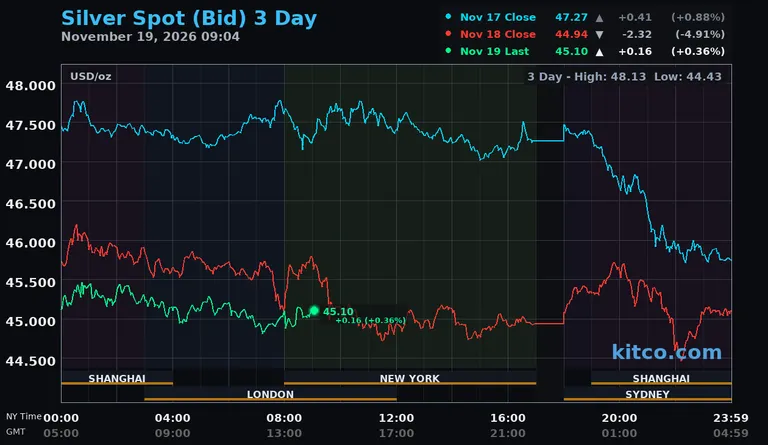
Spot silver bulls' next upside price objective is to drive prices back above the $45.700 to $46.060 resistance zone, with a sustained move through the upper boundary needed to strengthen the recovery. The next downside price objective for the bears is a break below $44.900, with a deeper downside target near $44.500. First resistance is seen at $45.240 and then at $45.700. Next support is seen at $44.900 and then at $44.500.
See live precious metals prices for gold, silver, platinum and palladium, in USD, CAD and 12 more currencies.