
Strengths
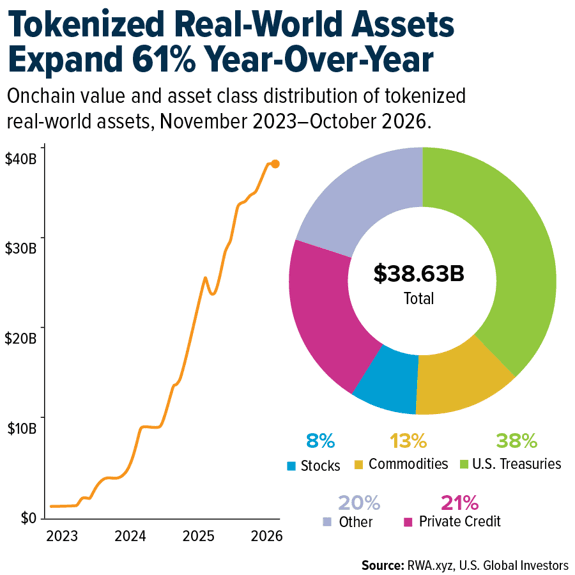
- Securitize announced plans to tokenize shares of 12 major U.S. companies, including Apple, NVIDIA, Tesla and Microsoft, on the Solana blockchain. Each token will be backed one-for-one by underlying shares, preserving shareholder rights, including dividends and voting. Trading will initially take place on Securitize’s platform, with Jump Trading providing liquidity and transactions settling in USDC. Potential expansion to the New York Stock Exchange’s planned digital trading platform and the OKX-ICE tokenized securities venue could accelerate institutional adoption of blockchain-based financial infrastructure, subject to regulatory approvals.
- Standard Chartered, a London-headquartered international banking group with a strong presence across Asia, Africa and the Middle East, plans to introduce custody services for select cryptocurrencies, stablecoins and tokenized real-world assets in Singapore by the end of 2026, subject to regulatory requirements. The offering will complement existing financing and securities services and expand the bank’s digital asset custody operations across the UAE, Luxembourg and Hong Kong. The move highlights growing institutional demand for regulated digital asset infrastructure and the integration of blockchain-based assets into traditional banking.
- The CoinDesk 20 Index surged 52.7% in the third quarter (Q3) of 2026, while Bitcoin gained 42.7%, significantly outperforming the S&P 500 (+2.03%), Nasdaq (+0.85%) and gold (+3.84%). The rebound was supported by improving liquidity, easing geopolitical tensions and renewed institutional demand. U.S. spot Bitcoin ETFs attracted $6.36 billion in net inflows during the quarter, reversing $4.67 billion in outflows in Q2 and highlighting renewed investor interest in digital assets.
Weaknesses
- U.S. spot Bitcoin ETFs recorded $487.1 million in net outflows on October 7, the largest single-day withdrawal since June 25, according to SoSoValue. The reversal follows approximately $2.65 billion in net inflows during September, bringing October’s cumulative flows to negative $165.6 million. Year-to-date net inflows have narrowed to $717 million, signaling weaker investor appetite and raising concerns about Bitcoin’s near-term price outlook.
- Bitwise CEO Hunter Horsley acknowledged that the firm’s spot Dogecoin ETF (BWOW) failed to attract sufficient investor interest, highlighting the gap between cryptocurrency users and traditional ETF investors. Launched on the NYSE in November 2025, the fund is scheduled to cease trading after October 14. As of October 7, it held just $725,870 in assets under management, with approximately $51,480 in trading volume during September. The closure highlights the challenges of translating cryptocurrency popularity into sustainable demand for regulated investment products.
- TD Cowen maintained its $260 price target and Buy rating on Strategy (MSTR), despite raising its Bitcoin price forecasts to $109,000 by year-end 2026 and $280,000 by 2029. Analysts warned that capital structure expansion, preferred-stock obligations and cash reserve building could dilute the benefits of rising Bitcoin prices for common shareholders. Strategy holds approximately 848,000 BTC, with $4.5 billion in unrealized gains, but Bitcoin exposure per common share has become less robust as financing obligations increase, highlighting challenges facing corporate Bitcoin treasury strategies.
Opportunities
- Grayscale said the SEC’s generic listing standards now cover approximately 15 cryptocurrencies, opening the door to more investment products. The firm’s Zcash ETF (ZCSH) attracted more than $1 billion in its first 30 trading days, ranking among the top 1% of ETF launches over the past decade by first-month asset gathering. Grayscale also filed to tokenize two covered-call funds focused on Bitcoin and Ether, highlighting further opportunities for digital asset innovation and institutional access.
- Samsung plans to integrate USDC transfers into Samsung Wallet and Samsung Pay through Solana, allowing eligible U.S. Galaxy users to send cross-border payments starting in late October. The service will support transfers to bank accounts in more than 60 countries, with local currency conversion. Bastion will power the service, with Coinbase providing custody infrastructure. The move could expand mainstream adoption of stablecoins and blockchain-based payments.
- Decentralized exchange Orca and lending platform Loopscale merged to form Formation, a platform combining trading, lending and investment infrastructure to finance emerging industries such as AI, energy, robotics and defense. Orca has processed more than $550 billion in trading volume since 2021, while Loopscale has facilitated over $2 billion in loans and attracted more than $150 million in deposits. Formation plans to launch new asset issuance tools and investment strategies over the next 12 months, working with Securitize, Figure and Shinhan Asset Management to expand tokenized financing and access to regulated U.S. capital markets.
Threats
- The European Securities and Markets Authority (ESMA) directed national regulators to ensure crypto platforms phase out stablecoins that do not comply with the Markets in Crypto-Assets (MiCA) framework by January 8, 2027. The guidance affects major tokens such as Tether’s USDT and PayPal’s PYUSD, which lack MiCA authorization. Platforms must stop purchases and trading of noncompliant tokens while allowing limited services to unwind existing positions. The restrictions could disrupt stablecoin liquidity, raise compliance costs and reshape crypto trading across the European Union.
- Ethereum researcher Justin Drake warned that rapid advances in artificial intelligence could, in a worst-case scenario, undermine the cryptographic signatures protecting Bitcoin and Ethereum wallets within months, before quantum computing becomes a practical threat. Bitcoin held in addresses with exposed public keys could be vulnerable, as could Ethereum-based stablecoins and tokenized assets. Although no practical attack has been demonstrated, the warning highlights cybersecurity risks and the potential need for faster blockchain security upgrades.
- The National Football League joined state governments, tribal groups and former regulators in urging the U.S. Supreme Court to clarify whether sports prediction markets fall under federal or state jurisdiction. Platforms such as Kalshi and Polymarket argue that the Commodity Futures Trading Commission (CFTC) has exclusive oversight, while opponents say state gambling laws should apply. Conflicting court rulings have heightened uncertainty, potentially increasing compliance costs and limiting industry expansion.
