
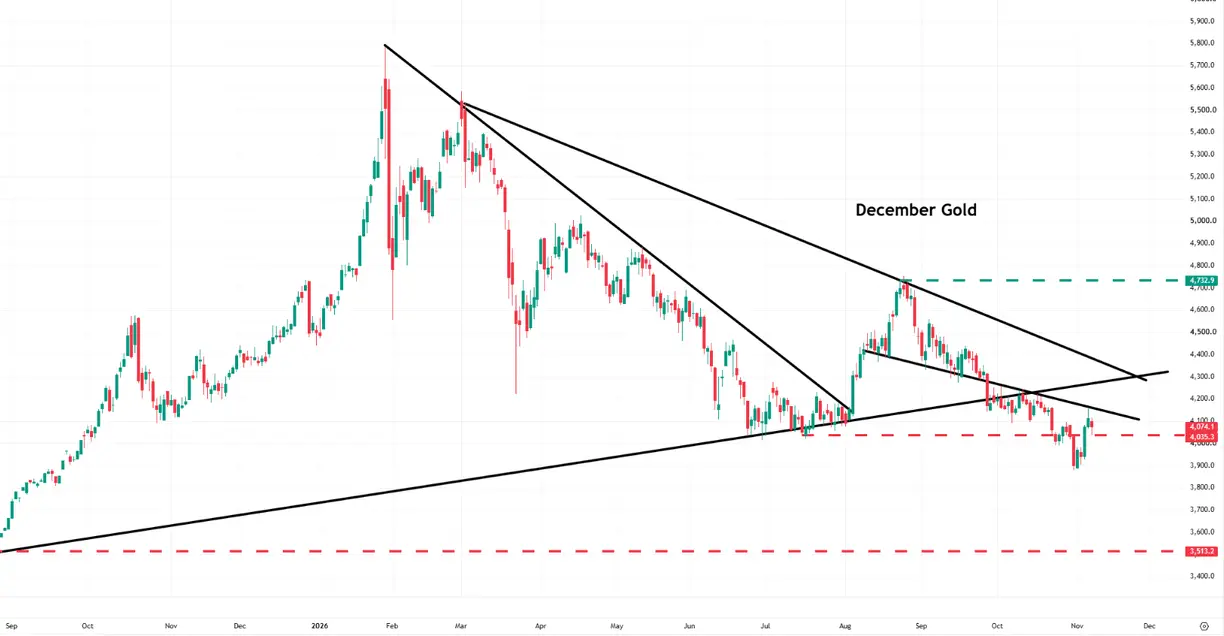
(Kitco Commentary) - Gold has had a tough few weeks. After stalling in the $4,150 area, prices have slipped back toward $4,070 as the dollar jumped on a strong jobs report and traders braced for one more Federal Reserve hike in December. On the surface, that looks like bad news for metals. Underneath, the bond market is telling a very different story, and I believe it may be setting up one of the better buying opportunities in gold this cycle.
If you want to know when we think the market turns, register for Navigating the Week Ahead, our weekly newsletter. Every week we lay out the levels, catalysts and trades we’re watching, so you’re positioned before the move instead of chasing it. Sign up here.
Daily Gold Chart
The 2-year Treasury yield follows the Fed, and right now it’s pricing in a central bank that isn’t finished. Inflation has run hot, the labor market just surprised to the upside, and a December hike appears very much on the table. The 30-year bond is telling a completely different story. Long-term yields have started rolling over even as the Fed talks tough. When long-term rates fall while the Fed is still tightening, investors are saying growth is going to slow, and that tightening into a slowdown sets up a recession.
Here’s how I see it playing out. Elevated inflation finally catches up with the consumer in 2027. Paychecks don’t stretch as far, spending slows, and GDP starts to come down. At that point the Fed will likely realize it has made a policy mistake, capitulate, and pivot to cutting rates. That pivot is what matters for gold. In past cycles, gold has often found its low around the time the market became convinced the Fed was near its final hike. Once traders believe the tightening is done, the dollar loses one of its biggest supports and gold tends to find its footing.
There’s another piece to this. Money is already moving into bonds, and that buying is helping push long-term yields lower. But there’s a limit to how low yields can go before investors look for something else. Once the return on bonds gets too thin, that money will seek an alternative, and that’s where gold comes in. Gold has lagged while bonds took the lead. When the rotation starts, gold could snap back quickly and play catch-up.
This won’t be a straight line. Next week’s inflation report could come in hot, and a strong print could push gold a bit below the $4,000 mark first. I’m not trying to call the exact bottom, but I think that area is where gold starts making its turn. From there, prices could work back toward $4,500 to $4,800 as the market starts pricing in rate cuts. You don’t need to catch the exact low. Build a position in pieces on weakness, or use defined-risk call spreads with a few months of time, so you know your maximum risk up front and the trade has room to work. For traders who want to position early, Micro Gold futures (10 ounces) and 100-oz Silver futures allow smaller sizes and scaling in at levels. Defined-risk options such as deferred-month call spreads let you position for a turn while capping your potential loss. To receive more information on trading the 100-ounce Micro Silver futures, sign up here.
