
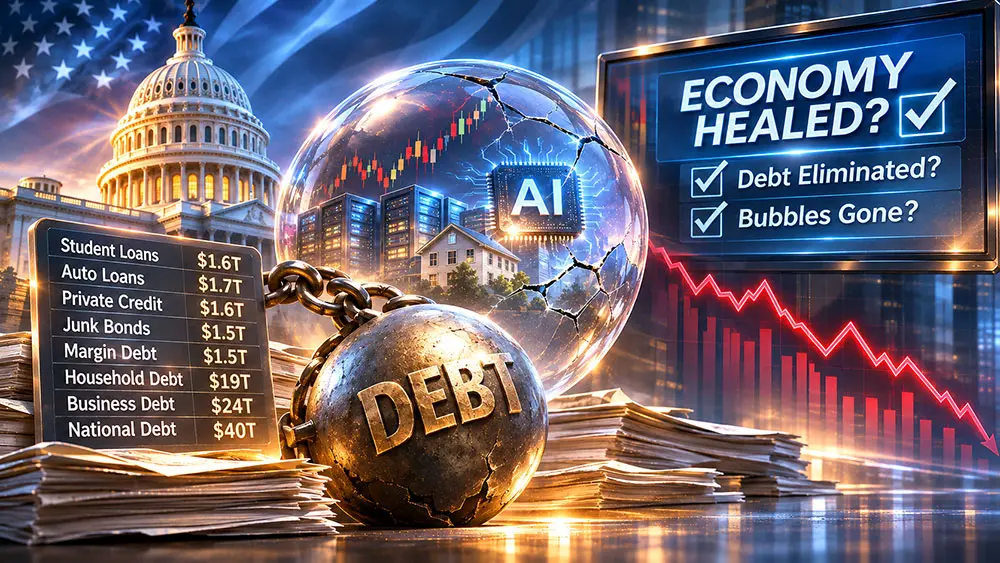
(Kitco Commentary) - The votes are counted, the confetti has been swept up, and the talking heads have declared the economy healed. Debt? Eliminated. Bubbles? Gone. If you believe that, please read no further.
For everyone else, let me be clear: the election fixed the political scoreboard, not the balance sheet. I believe the Democratic sweep virtually ensures that economic growth will falter by the time 2027 rolls around. Allow me to show how we got into this predicament and why the comeuppance is both inevitable and imminent.
Start with the Fed, which supplied negative real interest rates 90% of the time from 2008 through 2022. When money is free, it gets spent on everything, including things that make no sense. Add the recent AI borrowing frenzy, and you have the largest credit bubble in history. The tab:
- $1.6 trillion in student loans
- $1.7 trillion in auto loans
- $1.6 trillion in private credit
- $1.5 trillion in junk bonds
- $1.5 trillion in margin debt
- $19 trillion in household debt
- $24 trillion in business debt
- $40 trillion in national debt
That same debt orgy inflated equities and real estate at the same time, a first in recorded history. But all credit bubbles eventually burst. Stocks and real estate follow. And it is happening now.
The evidence is already in. Alphabet, A.K.A. Google, posted negative free cash flow of $9.07 billion last quarter and missed on both revenue and earnings. Long-term debt exploded to $125.1 billion from $21.6 billion a year earlier, an increase of about 479%. And the company's response? Raise 2027 capex to over $300 billion. Nothing says fiscal discipline like borrowing more to spend more on a payoff nobody can identify. The stock is down 20% in a month.
ServiceNow, a cloud platform that automates digital workflows, plunged 27% last Thursday after its sales projections disappointed and raised fresh doubts about AI demand. Intel dove 30% the same day on an ugly earnings report. These aren't rounding errors. They are the first casualties of the AI debt binge.
The Trump administration has taken stakes in 41 private companies in all so far. Aren't we glad Washington is borrowing money to lose it in the stock market? The government is a wonderful investor, isn't it? Should those positions sour, don't be shocked when the Fed feels “compelled” to print money and buy stocks to bail out the Treasury.
Of course, the deep state of Wall Street will tell you not to worry. They'll point to strong Q2 earnings growth and rosy EPS forecasts for next year. They'll wave their forward P/E ratios around as proof the market gets cheaper with every selloff. The only problem is that their denominator is pure hype and hope.
Here is the salient problem: the glaring lack of return on AI debt and the sharply rising borrowing costs associated with its funding must crimp AI investment. The issue is that spending has been responsible for 50% of GDP growth, 80% of earnings growth, and nearly 100% of the wealth effect. Pull that thread and see what's left of the sweater. Nor will the election help. The mid-term blue tsunami swept in a number of governors who campaigned on a moratorium on data center construction. So much for paving the way for more AI investment. Remove the AI debt-fueled investment bubble and all that is left is the battered consumer who has been in a recession since 2022.
Let's also be honest about what happened. Voters did not hand Democrats the keys because they want everyone to work well with Trump. This was a wholesale rejection of the tariffs and the Iran war that battered the middle class. But the unwanted ancillary consequence of repudiating those failures is that a huge swath of the country is now controlled by people who are not champions of capitalism. There is a clear proclivity towards bigger government in the House, the Senate, and the statehouses. Trading one set of economic mistakes for another is not a recipe for peace and prosperity. I expect chaos.
So, what's an investor to do? Not what Wall Street tells you. Buy-and-hold is a fine philosophy right up until the moment it isn't. The great reconciliation of asset prices has begun. Investors who have been lulled into thinking markets only go up need a plan to navigate their portfolios safely through this reality check. That means an active process, one that can tell the difference between a credit market that is merely wobbling and one that is breaking, and the discipline to act before the major averages do.
Our hope is in the Lord. Not in a tsunami of Donkeys.
