

The crypto ecosystem was thrown into a flux on Wednesday after the X account for the Securities and Exchange Commission (SEC) was compromised, with the hacker posting a message that looked as though it came from SEC Chair Gary Gensler saying that a spot Bitcoin ETF had been approved for trading in the U.S.
Not long after, Gensler posted on his personal X account that the tweet was fake, but by that time, the news had spread across the ecosystem and was reflected in a price whipsaw for Bitcoin.
Data provided by TradingView shows that the announcement led to a surge in volatility as the one-hour candle for BTC spiked to a high of $47,910, and then plunged to $44,705, before ultimately climbing back above support at $45,500.
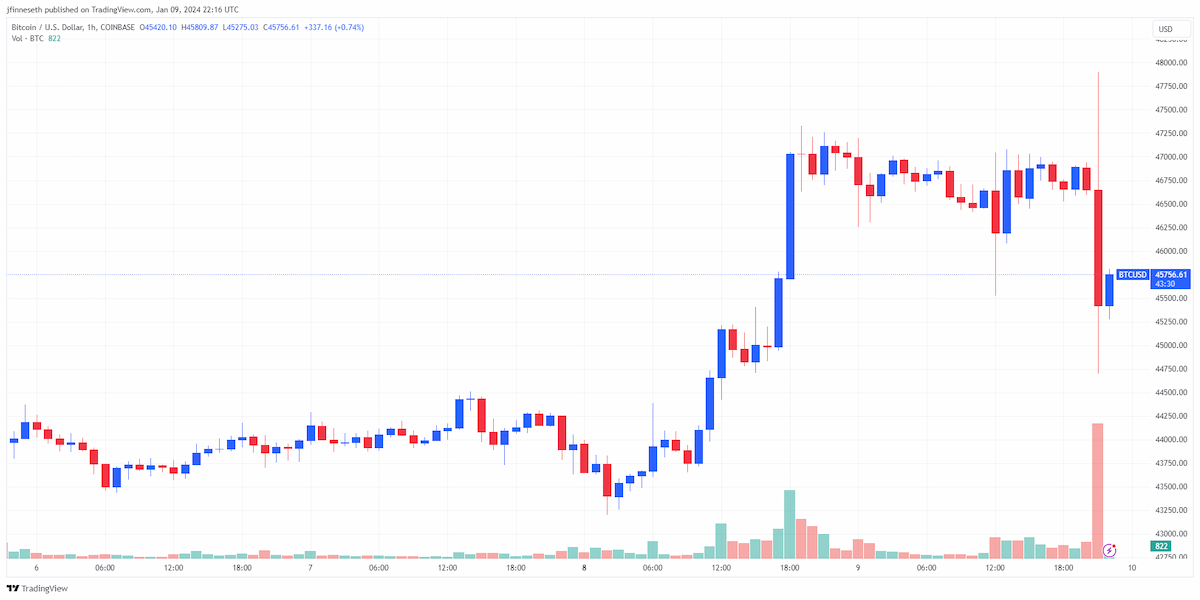
BTC/USD Chart by TradingView
Stocks showed weakness on Wednesday amid the focus on Bitcoin, and traders seemed content to sit on the sidelines ahead of Thursday’s Consumer Price Index report, which will provide greater insight into the chances of a rate decrease in early 2024.
The S&P and Dow were in the red at the market close, finishing down 0.15% and 0.42%, respectively, while the Nasdaq gained 0.09%.
While the debate around whether the approval of a spot BTC ETF will be a “buy the rumor, sell the news” continues, especially following the market’s reaction to the fake SEC tweet, analysts at K33 say a sharp sell-off is less likely following the “liquidation cascade on Jan. 3,” which they said “drastically improved the state of the market,” making the potential impact of long liquidations less off a threat.
The rapid sell-off resulted in a 12% decline in notional open interest in Bitcoin perpetual contracts between Jan. 2 and Jan. 6., they noted, and funding rates are now in a neutral state, which indicates less froth in the market.
“Following the deleveraging of last week, the market is more robust to handle profit realization on the ETF announcement,” they said.
“CME premiums remain high, near 20%, but have been trading in a far healthier uptrend than what we witnessed on the yearly open,” the analysts said. “Both premiums and OI will likely be significantly reduced after the ETFs are approved. Rotation from futures-based ETFs, accounting for 43% of CME’s OI, to spot ETFs will be reflected in closed CME longs.”
“We expect volumes to climb higher over the coming week, but also fast-paced adjustments in traders’ risk profiles,” they added. “If there is one week in 2024 where you should be particularly tuned in, this is it.”
According to Juan Aranovich, economist and analyst at Ryze Labs, "The approval of a spot Bitcoin ETF is anticipated to influence Bitcoin’s price significantly.”
“Analysts have mixed opinions; some argue that the initial impact might be overestimated, expecting initial inflows to be a few hundred million dollars, mostly recycled money,” Aranovich said. “Others foresee a more substantial effect, suggesting the necessity for ETF issuers to purchase tens of billions of dollars of Bitcoin to meet institutional demand, potentially causing a supply shock, especially given the recent decrease in Bitcoin held on exchanges.
“Furthermore, if the BTC ETF gets approved, there might be significant increases in the infrastructure, meme coins, and application projects related to the BTC ecosystem,” he said. “Sentiments regarding the approval of BTC are likely to quickly permeate throughout the entire Bitcoin ecosystem.”
“However, if the BTC ETF is not approved, the tokens of related ecosystem projects might experience even more severe declines,” he warned.
Aranovich suggested that speculative trading and adjustments in investor portfolios could lead to an increase in market volatility in the short term should an ETF be approved. Longer-term, an approval “could lead to broader institutional acceptance and integration of Bitcoin into diversified investment portfolios.”
“This transition is mirrored in the gold market, where the introduction of gold ETFs significantly increased gold’s accessibility and investment,” he said. “Drawing from the gold ETF experience, a Bitcoin ETF might also bring in substantial additional demand, potentially amounting to nearly $30 billion in the first year.”
“The value of assets managed by exchange-traded funds globally currently stands at an impressive $9.6 trillion,” Aranovich said. “Should investment advisors decide to allocate a modest 2% of their client's portfolios to Bitcoin, this strategic move would elevate the value of the spot Bitcoin ETF market to an estimated $192 billion in the long term. This projection underscores the significant potential impact that even a small shift in asset allocation toward Bitcoin could have on the market.”
“The potential uptick in Bitcoin's price, leading to a virtuous cycle of investment and innovation, aligns with a broader narrative of growth and mainstream acceptance,” he concluded.
Altcoins hit hard by Bitcoin ETF fakeout
Altcoins largely trended down as a result of the ETF fakeout, with all but two dozen tokens in the top 200 recording losses on the day.
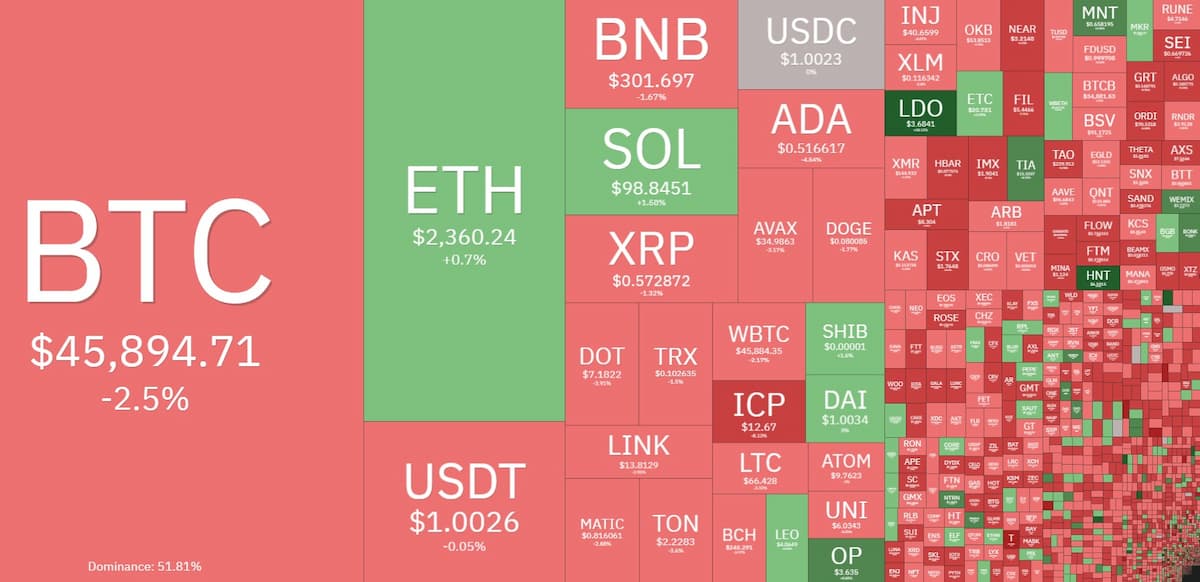
Daily cryptocurrency market performance. Source: Coin360
Helium (HNT) was the biggest gainer with an increase of 19.23%, followed by a gain of 12% for Bonk (BONK), and 11.35% for Neutron (NTRN). Klaytn (KLAY) was the biggest loser after falling 28.5&, while Threshold (T) lost 14.4%, and GMT (GMT) declined 14.3%.
The overall cryptocurrency market cap now stands at $1.69 trillion, and Bitcoin’s dominance rate is 52.9%.
