

The crypto market remained in consolidation mode on Tuesday as traders looked to rebalance their portfolios and position themselves ahead of the next price run-up in the ongoing bull market. The Bitcoin (BTC) halving – which is now less than 100 days away according to CoinMarketCap’s halving tracker – is widely expected to be the catalyst for the next breakout.
Stocks traded lower following the long holiday weekend as traders continued to digest the recent CPI and PPI numbers while awaiting this Wednesday's retail sales report, hoping that the data will increase the likelihood of an interest rate cut by the Federal Reserve in early 2024.
The CME FedWatch Tool shows that investors expect the Fed to hold rates steady at the Jan. 31 meeting, but say there is a 65% chance of a rate cut at the meeting on March 20.
At the closing bell, the S&P, Dow, and Nasdaq were all in the red, down 0.37%, 0.62%, and 0.19%, respectively.
Data provided by TradingView shows that Bitcoin experienced a brief sell-off near midday, dropping from support at $42,800 to a daily low of $42,038 before bulls managed to push it back above $43,200, where it trades at the time of writing.
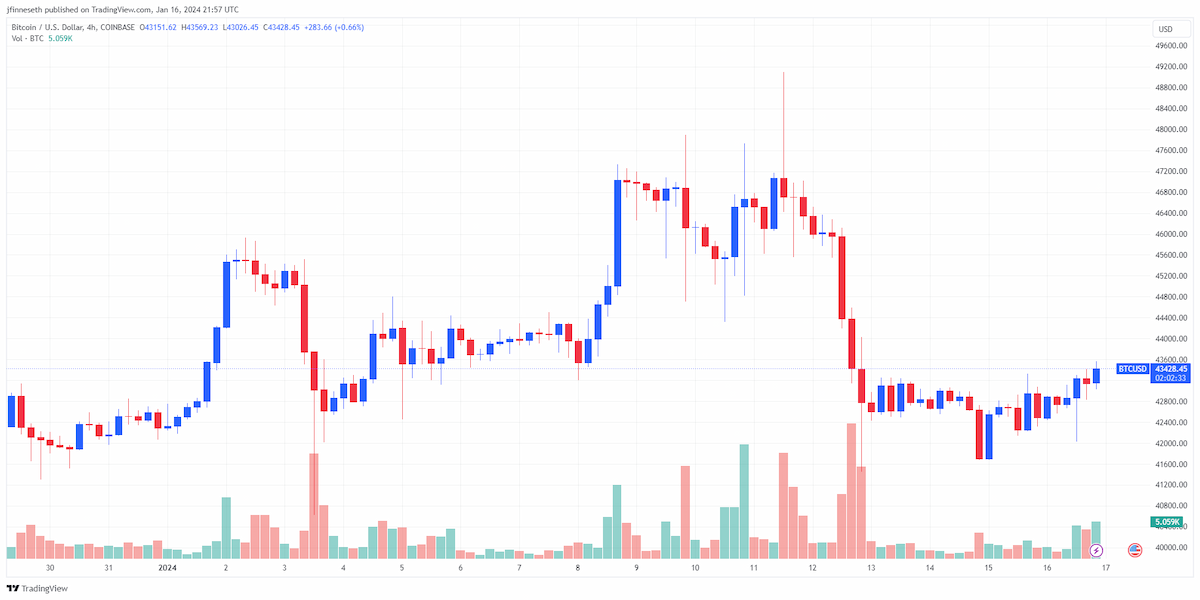
BTC/USD Chart by TradingView
“January Bitcoin futures prices [were] a bit firmer in early U.S. trading Tuesday after two sessions of solid losses that have somewhat dented bullish momentum,” according to Kitco senior technical analyst Jim Wyckoff.
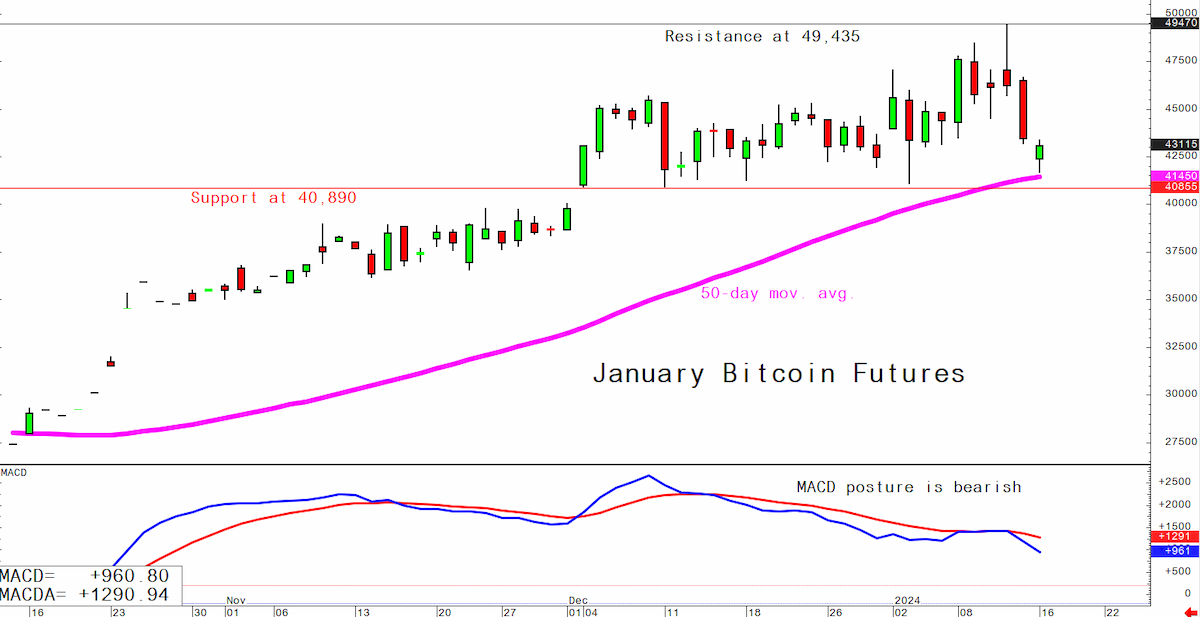
Bitcoin futures 1-day chart. Source: Kitco
“Bulls still have the firm overall near-term technical advantage but need to show fresh power soon to keep alive a price uptrend on the daily bar chart,” Wyckoff said. “Bulls do not want to see BTC prices fall below the technical support line seen on the chart, which would at least temporarily negate the price uptrend.”
While many in the crypto ecosystem are looking ahead to the halving as the next event to bring momentum to the market, analyst Justin Bennett tweeted the “unpopular opinion” that “Bitcoin cycles [follow] economic data, not halvings.”
“How else do you explain BTC following a legacy economic measure like the Purchasing Manager's Index (PMI) for the last 10 years?” Bennet questioned.
“The halvings are a critical component of the tokenomics that make Bitcoin an incredible long-term hold. But economic data rules all in determining cycle tops and bottoms,” he said. “Economic data > the halvings!”
“With that in mind, notice what's occurred with PMI since the start of 2023. It's flatlined, which we haven't seen with previous cycle lows for Bitcoin, at least not to this extent,” he said.
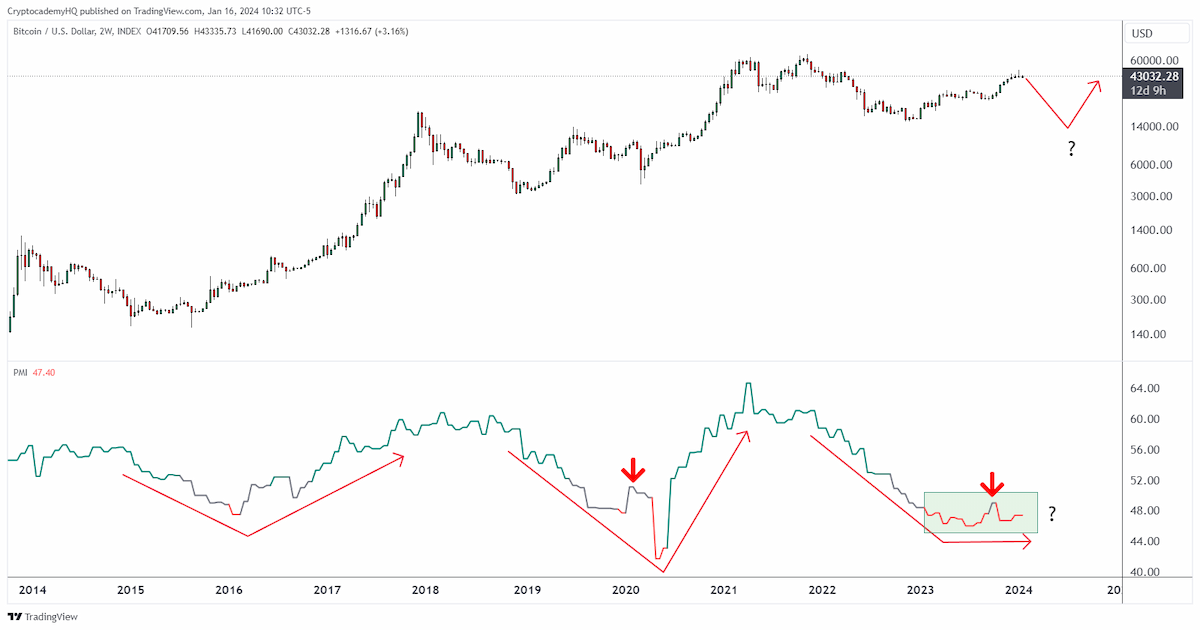
BTC/USD 2-week chart. Source: X
“Economic measures like PMI flatlining while BTC rallies are cause for concern or at least an extra dose of caution,” he said. “Sure, it could catch up to risk assets. But do you really want to play a game of buying into premium, hoping that economic data eventually supports your investment? I sure don’t.”
“Bottom line: The foundation has cracks; if they aren't patched up soon, it's only a matter of time before the house crumbles,” Bennett concluded.
Crypto analyst Mac warned that in the near term, Bitcoin could dip as low as $38,000, and at best, will trade sideways near support at $40,000.
I have been observing $BTC price action carefully over the past week
Retrace to $40,000 and possibly $38,000 is very possible here
Either $45,000-> $40,000 or sideways and $40,000 from here
Stay safe pic.twitter.com/Jyq62q9F12— Mac ? (@MacnBTC) January 16, 2024
Altcoins mixed as traders rebalance their portfolios
Altcoins traded mixed on Tuesday, with a slight majority of tokens in the top 200 recording gains.
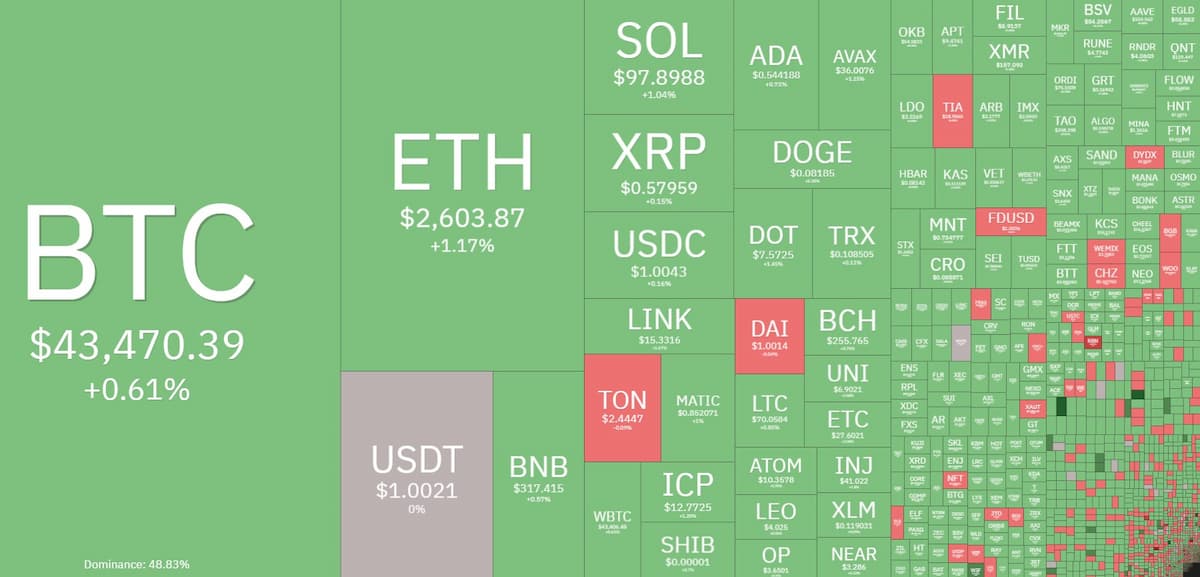
Daily cryptocurrency market performance. Source: Coin360
Pendle (PENDLE) led the gainers with an increase of 22.34%, followed by a 17% gain for Chiliz (CHZ), and a 14.5% increase for Klaytn (KLAY). Flare (FLR) led the losers with a decline of 9.45%, while Sui (SUI) lost 8.72%, and Xai (XAI) fell 8%.
The overall cryptocurrency market cap now stands at $1.7 trillion, and Bitcoin’s dominance rate is 49.8%.
