
(Kitco News) - Environmental, social, governance (ESG) initiatives are further delaying mining projects while critical metals are in high demand, creating tension within the mining industry, says Matt Watson, founder of Precious Metals Commodity Management LLC.
The other problem is that metals necessary for the green transition are difficult to process, namely nickel, cobalt and rare earths.
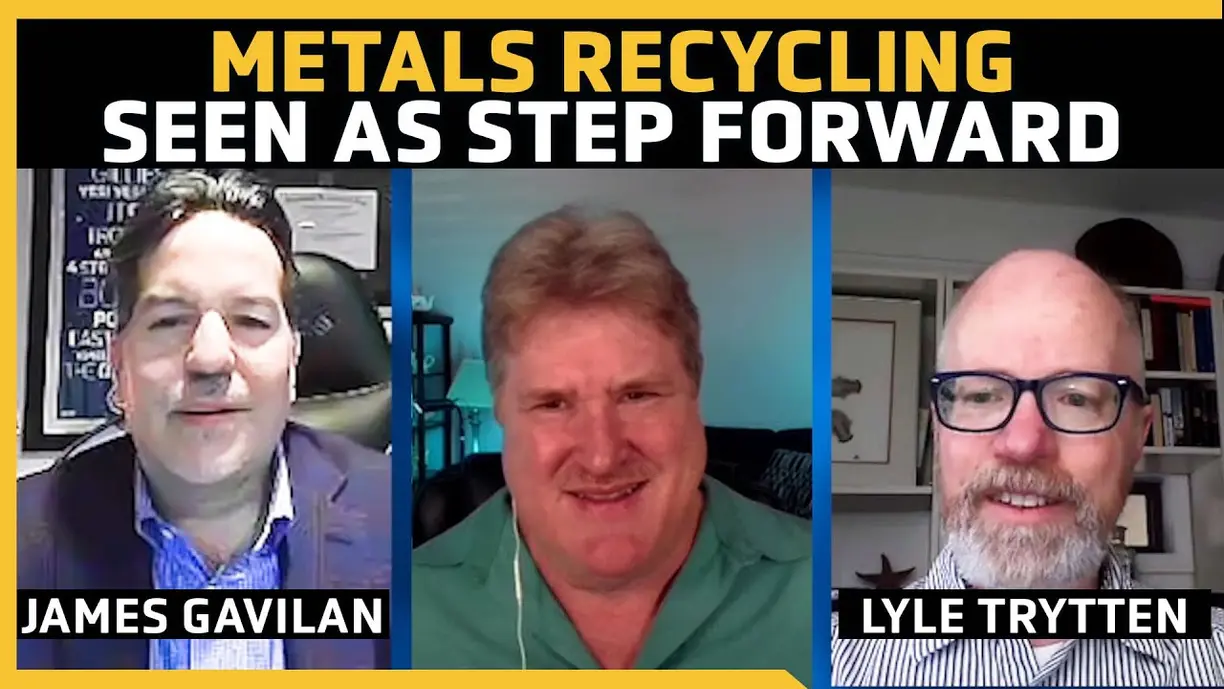
On April 3, Watson recorded an episode of Green Rush with guests James Gavilan, principal of Gavilan Commodities, and Lyle Trytten, president of Trytten Consulting Services. The subject was ESG in the context of scaling responsibly mined minerals.
Watson pulled up a chart from the U.S. Geological Survey showing we will use all our nickel and cobalt reserves by 2050. It takes up to 17 years to develop a mine, longer if ESG criteria must be met.
“They're adding to the timelines, and unfortunately, I think we're getting into a genre of metals that are dirty,” he said, cueing up nickel processing expert Lyle Trytten.
There are two types of nickel deposits — sulfide and laterite. Sulfides tend to be in North America and Europe, whereas laterite nickel deposits are clustered around the equator. Indonesia is by far the largest nickel producer. Nickel mined there is processed using high-pressure acid leaching (HPAL), which generates less air pollution than traditional smelting but creates fine tailings (2-10 microns) that are difficult to dispose of.
Trytten said sulfide deposits are easier to handle from a pollution perspective, but “the reality is that we need nickel from a variety of sources. We're not going to bring it all from the sulfide deposits that we have in North America and Europe.” That means that, one way or another, the industry must deal with tailings.
“They're a necessary evil, and you're in these areas that have high rainfall, high seismic risks, and steep topographies,” he said. “There are no good answers, there's a succession of bad answers.”
Gavilan said his clients are seeking security in mineral supply, and that is shining a spotlight on problematic mining jurisdictions like Indonesia. He pointed to the recent explosion at a Chinese-owned nickel plant on Indonesia’s Sulawesi Island that killed 13 workers.
“This type of mining in Indonesia and other areas helps make the case greater when we look at clients that are operating in better jurisdictions,” he said.
Cobalt mining in the Democratic Republic of Congo has come under scrutiny due to the use of child labor, environmental degradation, and civil unrest.
Trytten said there are also no good answers regarding mining in the DRC, “except driving through the supply chains to understand where things come from, how they are developed, mined, processed, etc., what the full supply chain looks like and having that actually visible right down to the customer level.”
Gavilan steered the conversation towards the subject of artisanal mining, noting that 20 to 30 percent of metals production comes from this small-scale, often unregulated sector. “How do we actually provide innovation and technology for them to mine in a responsible manner, to have real contracts with real producers that have pockets to fund these things?” he asked.
About rare earths mining, Watson stated, “There are plenty of rare earths in the earth’s crust, but the problem with them is that they are freaking filthy, the filthiest thing I think I know on the periodical table.”
He noted only one of the 17 rare earth elements, scandium, is being recycled. China dominates the processing of rare earths but at a huge cost to the environment. Some 2,000 tons of toxic waste is produced for every ton of rare earth element. At the Bayan-Obo rare earths mine in Mongolia, the tailings are dumped into a six-mile-diameter, unlined lake, that is next to a city of 2.3 million.
“Where in the world are we standing up and saying, ‘I refuse to accept those Chinese REEs for these reasons?’” Watson asked.
Gavilan noted there are groups looking at extracting rare earth elements from the platinum group metals (PGM) recycling circuit. Trytten added, “A really exciting area is waste re-processing rare earths,” for example, from HPAL nickel processing and from coal mine ash.
“We should all be paying a premium for recycled metals,” Watson agreed.
The panel discussion concluded on the topic of whether end users are willing to pay more for minerals mined and processed cleanly. “You hit the nail on the head,” Gavilan told Watson. “That is the driver. Are people willing to pay more for this better result down the road?”
Answering his own question, Gavilan gave the example of Pandora, a jewelry company that announced earlier this year it would source only recycled gold and silver.
“We're seeing finally a hardcore example of a major player, a large silver consumer, saying ‘hey look, we're paying money for this higher-valued material,” he said.
Listen to Kitco Mining's Green Rush to understand and profit from a once-in-a-century event: the clean energy transition. Each week, host Matt Watson, founder of Precious Metals Commodity Management, will take a deep dive into a metal that will underpin our new electrified world. Green Rush explores the vital role of nickel, copper, lithium, cobalt, silver, platinum group metals, rare earth elements and other metals that power the batteries driving our sustainable future
Subscribe: Green Rush on YouTub
____________________________________________________________________
Green Rush is brought to you by Revival Gold. Revival Gold is one of the largest, pure gold, mine developers in the United States. The Company is advancing engineering and economic studies on the Mercur Gold Project in Utah and mine permitting preparations and ongoing exploration at the Beartrack-Arnett Gold Project located in Idaho.
Revival Gold is listed on the TSX Venture Exchange under the ticker symbol "RVG" and trades on the OTCQX Market under the ticker symbol "RVLGF". The Company is headquartered in Toronto, Canada, with its exploration and development office located in Salmon, Idaho.
____________________________________________________________________

Subscribe to Green Rush podcast on YouTube Music.
Listen to this podcast on Buzzsprout Apple Podcasts Amazon Music Spotify |