
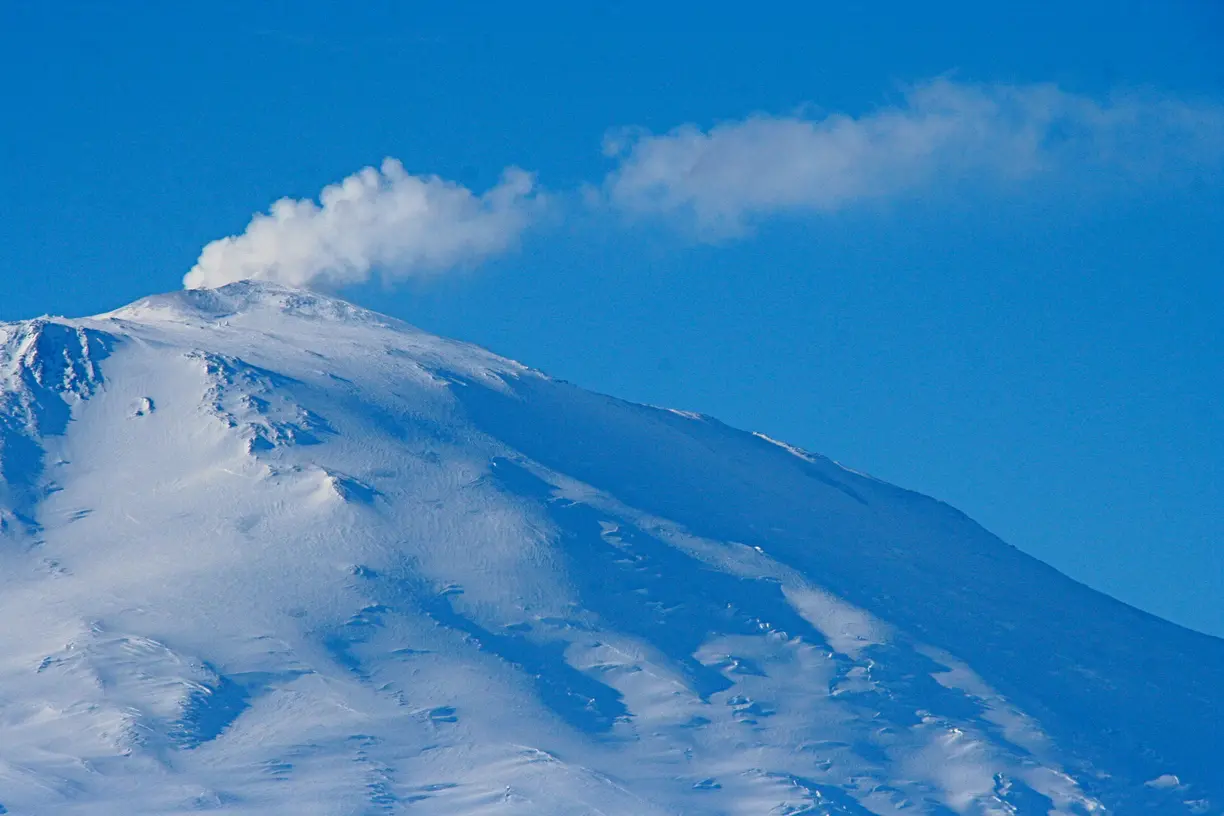
(Kitco News) – The world’s southernmost volcano is doing its part to supply burgeoning global demand for gold, but if you think profitable mining is difficult these days, good luck breaking even in the volcanic bullion business.
Mount Erebus is the tallest active volcano on the continent of Antarctica, with a peak 3,794 meters, or 12,448 feet, above sea level. While Antarctica is home to well over 100 volcanoes, only eight or nine of them are considered to be active, and only three have erupted in recent history.
Mount Erebus, named after the personification of darkness in Greek mythology, is the most active of the three. The volcano has been erupting since at least 1972, and it regularly pumps out powerful jets of gas and steam. Remarkably, scientists have discovered that these gaseous emissions contain microscopic crystals of metallic gold measuring no larger than 20 micrometers each.
They estimate that Mount Erebus spews out approximately 2.8 ounces of pure gold over the course of the average day, worth a tidy $6,500 at today’s prices. This means that Mount Erebus produces 1,022 ounces of gold per year, for a total of 52,122 ounces since 1972, worth over $121 million at current spot prices.
While it would be convenient if Mount Erebus deposited its bounty of bullion on its slopes, this is unfortunately not the case. Instead, the gold particles are blown as far as 1,000 kilometers (621 miles) away from the volcano. Depending on the force of the gas jets and the direction of the wind, this could mean 1,000 km in any direction, with much of it falling into the southern oceans.
Alas, it looks like Mount Erebus won’t be displacing Nevada Gold Mines or Muruntau at the top of the gold production list anytime soon.
