

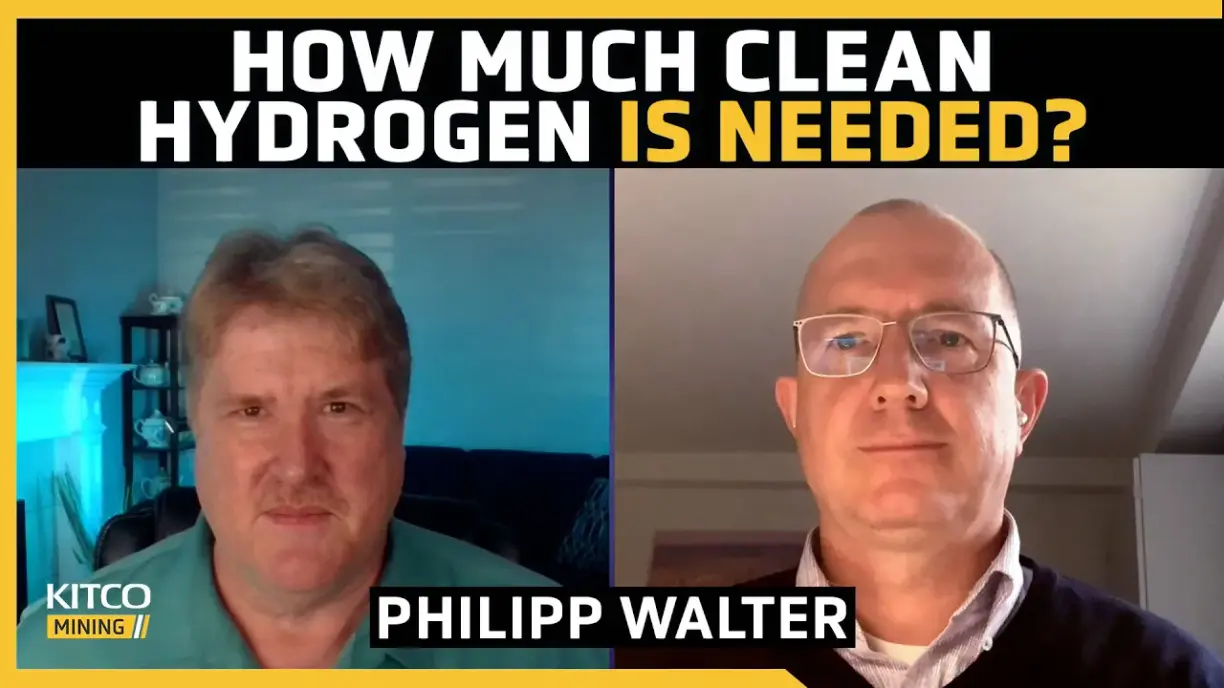
(Kitco News) - Green Rush host Matt Watson says "an awesome amount" of material will be needed for clean hydrogen applications, but guest Phillip Walter believes technology will provide solutions.
On April 17, Watson recorded an episode of Green Rush with Walter, Executive VP of Business Line Hydrogen Systems for Heraeus, a major precious metals processor. The topic was the hydrogen economy and platinum group metals (PGMs).
Walter said PGMs and hydrogen belong together because they have a unique position in geochemistry. Applications include electrocatalysts to produce hydrogen, Proton Exchange Membrane (PEM) electrolysis, electrocatalysts for electrolysis, the coating of bipolar plates or porous transfer layers to protect against corrosion, and removing oxygen from a hydrogen stream.
One of the biggest future applications of hydrogen is in fuel cells, where platinum on carbon-type catalysts are used for synthesizing water out of hydrogen and oxygen, thus releasing energy.
Watson clarified the difference between PEM electrolyzers, used for producing "green" hydrogen, and PEM fuel cells, which take hydrogen gas and convert it to power, mostly to drive transportation systems.
Iridium and platinum are used in PEM electrolysis, while platinum is essential for fuel cells, along with iridium as a cell reversal additive.
The rarity of iridium has necessitated thrifting; Walter said a lot less iridium per gigawatt is used now, about 400 kilograms per GW versus a tonne per GW two years ago. The total electrolyzer capacity is around 70 GW. It is estimated that about 28 tonnes will be needed by 2030 versus about 12 tonnes available for new applications, leaving a shortfall.
Eight to 10 tonnes of iridium are produced annually as a by-product of platinum mining.
"This is a minor subset of the platinum group metals, very small and yet so crucial," Watson said. "That's why you hear so much discussion about iridium. How are we going to design-thrift this to get it to be scalable?"
The Hydrogen Council is eyeing 600-900 million tonnes of clean hydrogen by 2050, including for fuel cell vehicles, "green" steel, green methane, and green ammonia, used as a fuel feedstock in maritime shipping. "This is an ominous task. How much clean hydrogen are we gonna need? It's an awesome amount of material," Watson said.
Two tonnes per year of iridium and 10-12 tonnes of ruthenium are consumed in the mixed metal anode and electrode market. Applications are far-flung, everything from copper electrowinning to printed circuit board electroplating and wastewater treatment. Recyclers are actively hunting end-of-life anodes to recover the metals.
Walter noted Heraeus Precious Metals has combined the stability of iridium with the activity of ruthenium.
"This iridium-ruthenium oxide is bringing stability and activity, and of course reducing the loading of iridium, which helps on the one hand with the cost of the electrolyzer and secondly with the availability of iridium, and I think this is really a breakthrough innovation of our labs, which allows for the scaling of PEM technology to large giga figures," he said.
Watson said he fears whether enough energy can be stored to meet peak energy demand, both on a daily basis and seasonally. He pulled up a chart showing 30,000 terawatt hours of electricity are generated globally. Most clean energy agencies think it needs to triple by 2050.
"I think we're stepping into a space as we push variable renewables where you're going to need more PGMs than we realize just in the energy storage realm," he said.
Among the top 12 energy storage technologies under development, hydrogen and ammonia are the two most advanced.
In response, Walter said, "I still believe in technology," giving the example of reduced iridium loadings in PEM electrolysis. Eight years ago, it took 1.5 to 2 tonnes of iridium per gigawatt. Now, catalyst technology has reduced iridium loadings to 100 kg per gigawatt.
"Your facts are right, but we should not forget that we are in a transition and new, improved technologies will be developed as we progress," he concluded.
Listen to Kitco Mining's Green Rush to understand and profit from a once-in-a-century event: the clean energy transition.
Each week, host Matt Watson, founder of Precious Metals Commodity Management, will take a deep dive into a metal that will underpin our new electrified world. Green Rush explores the vital role of nickel, copper, lithium, cobalt, silver, platinum group metals, rare earth elements and other metals that power the batteries driving our sustainable future.
Subscribe: Green Rush on YouTube
____________________________________________________________________
Green Rush is brought to you by Revival Gold. Revival Gold is one of the largest, pure gold, mine developers in the United States. The Company is advancing engineering and economic studies on the Mercur Gold Project in Utah and mine permitting preparations and ongoing exploration at the Beartrack-Arnett Gold Project located in Idaho.
Revival Gold is listed on the TSX Venture Exchange under the ticker symbol "RVG" and trades on the OTCQX Market under the ticker symbol "RVLGF". The Company is headquartered in Toronto, Canada, with its exploration and development office located in Salmon, Idaho.
____________________________________________________________________

Subscribe to Green Rush podcast on YouTube Music.
Listen to this podcast on Buzzsprout Apple Podcasts Amazon Music Spotify |