

(Kitco News) – Selling in the crypto market subsided late on Monday, but not before Bitcoin (BTC) saw its price briefly fall below $59,000, with the top crypto hitting a low of $58,433 before bears ran out of momentum and dip buyers pushed it back above $60,000.
Bulls have been hard at work since, looking to recover lost ground after Bitcoin fell to its lowest price since early May. At the time of writing, King Crypto trades at $61,683, an increase of 0.68% on the 24-hour chart.
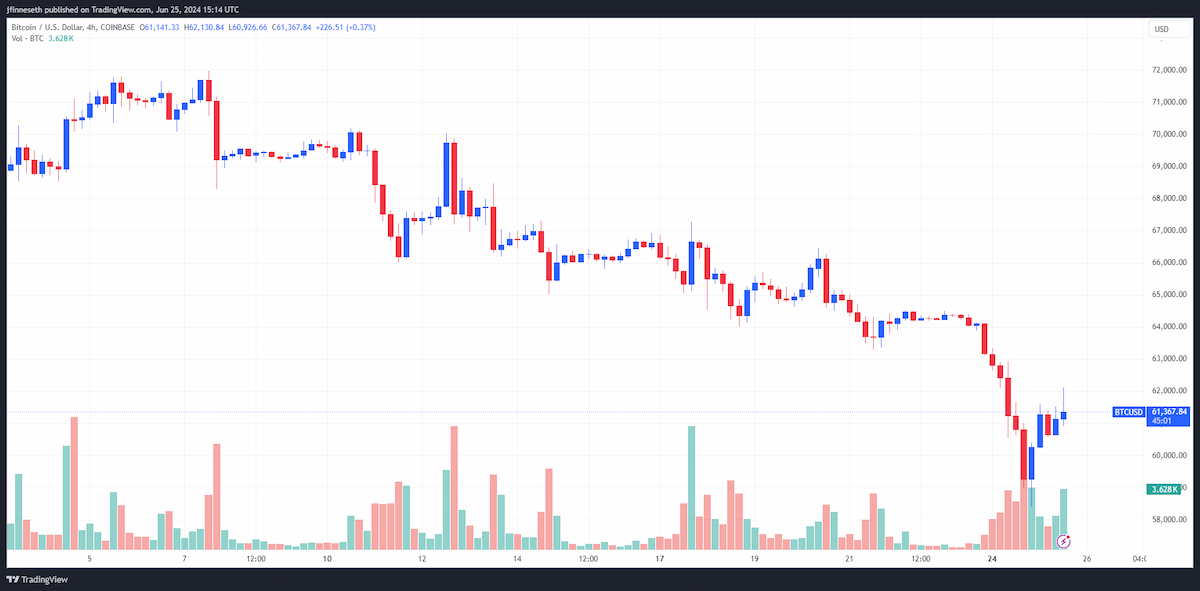
BTC/USD Chart by TradingView
Monday’s loss of support at $64,000 left many traders scrambling to cover bullish long positions, with more than $300 million in derivative positions liquidated between Sunday and Monday amid the cascading sell-off.
While many highlighted the threat of Mt. Gox Bitcoins being dumped on the market as the reason for the downturn, savvy analysts pointed out that the dangers posed by the distribution of BTC to creditors are overblown, and the effect on the market will be minimal. Instead, several analysts said that the crypto market is just experiencing typical post-halving chop combined with the dog days of summer that often depress financial markets.
“BTC and the wider crypto markets are currently demonstrating that the old adage ‘Sell in May and go away (for the summer)’ still holds true as prices remain depressed,” said Lucas Kiely, chief investment officer at Yield App, in a note shared with Kitco Crypto. “Despite Bitcoin hitting $72,000 when US non-farm payrolls were released at the beginning of June, the flagship currency is now dwindling at $61,000, with some analysts predicting a slide into the fifties.”
“Some are blaming yesterday’s slide on news that Mount Gox investors will, finally, receive their BTC back - and likely dump it,” he noted. “This might be true, however, it is macro factors that have been, and will likely remain, the biggest drivers in BTC price action.”
“While US inflation is slightly lower, it is still well above the Federal Reserve’s 2% target,” Kiely said. “This means that, despite this being an election year, the Fed is likely to hold off cutting rates until inflation is fully under control, as per its mandate. Neither traditional nor digital asset markets are thrilled about this - and are showing it.”
He also pointed out a common misconception about Bitcoin’s supply and demand dynamics.
“Contrary to the scarcity narrative often peddled by its biggest supporters, as long as BTC can be borrowed there will be enough physical BTC available,” Kiely said. “Hedged with futures to cover the ETF inflows, the supply/demand meetup hasn’t happened as fast as people would have hoped. This could, perhaps, lead to withdrawals from the BTC ETF as people lose patience with the asset class.”
This perspective is supported by the latest Bitcoin ETF flow data from Farside Investors, which shows that the ETFs have recorded outflows on nine out of ten trading days since June 10.
“As for the pending approval of an ETH ETF, the market is already showing a deep lack of enthusiasm,” Kiely added. “Unfortunately, Ethereum doesn’t enjoy as much demand and interest as Bitcoin and the approval of an ETF or ETH investment funds will, far from driving the ETH price higher, likely be a damp squib that adds downward pressure.”
“In short, there appears to be nothing to drive BTC, ETH, or the wider crypto market this summer,” he concluded. “Hopes now rest with a further softening of US inflation and the subsequent action of the Federal Reserve. For now, it is perhaps time to put in some shorts and longs, and enjoy a holiday.”
But according to analysts at ETC Group, the recent price drop has likely shaken out traders with less faith in the long-term prospects of Bitcoin and the crypto market, and the bottom is likely in.
“Wall Street wisdom assumes that the average individual investor is most bullish at market tops and most bearish at market bottoms,” they noted. “In theory, overly bullish sentiment signals a market top, while overly bearish sentiment signals a market bottom. In fact, one can observe similar behavioral traits in cryptoasset markets as well.”
“We think that several indicators already signal that positioning is lopsided, sentiment is bearish and ‘weak hands’ have mostly exited the market,” the analysts said.
They noted that “Crypto hedge fund’s beta to Bitcoin has declined to a 4-year low; Global crypto ETPs have seen the 2nd highest weekly net outflow on record; Bitcoin long futures liquidations have spiked to the highest since April; Bitcoin put-call volume ratios have increased to levels last seen during the rout in April; The Crypto Fear & Greed Index has declined to ‘fear’ levels; and Short-term holder spent output profit ratio (STH-SOPR) has declined to 0.96 signalling capitulation among ‘weak hands.’”
“Given all these indicators, we think that the short-term risk/reward has become increasingly asymmetric and that further downside risks are relatively limited,” the analysts said. “Therefore, we think the current market rout represents a good opportunity to increase exposure to Bitcoin and cryptoassets ahead of major events over the coming months.”
