
(Kitco News) – The cryptocurrency bull market that began in early 2023 has stalled of late as flows into spot Bitcoin (BTC) exchange-traded funds have reversed, but according to one recent study, the uptrend could soon resume as the next wave of institutional investors begins to make allocations to digital assets.
On Monday, financial services firm Nomura Holdings and its digital asset arm Laser Digital released the results of a survey titled the “Institutional Investor Survey on Digital Asset Investment Trends,” which found that more than half of institutional investors surveyed in Japan expressed intentions to invest in the crypto sector in the next three years.
The purpose of the survey was to gain better insight into the perspective of Japanese investment managers on cryptocurrencies, including the challenges the asset class faces in wooing potential investors.
The study – which included responses from 547 investment managers, including institutional investors with AUM of ¥10T or more, family offices, and public-service corporations – found that 54% of those surveyed intend to make allocations to digital assets within the next three years “for the purpose of stabilizing their portfolio while reducing risk, such as diversification and hedging against inflation,” the report said.
25% of respondents said their impression of crypto assets (especially Bitcoin and Ethereum) is “Positive” when looking ahead to the next 12 months, while 23% were “Negative” and 52% were “Neutral.”
As for the motivations behind investing in crypto, “Diversification opportunities” ranked highest with 60% of respondents highlighting this feature. 38% identified “low correlation with other assets” as a benefit, 37% said they offer a hedge against inflation, 30% touted the “high return potential” of cryptocurrencies, and 9% pointed to the 24/7 nature of the crypto market as a reason to invest.
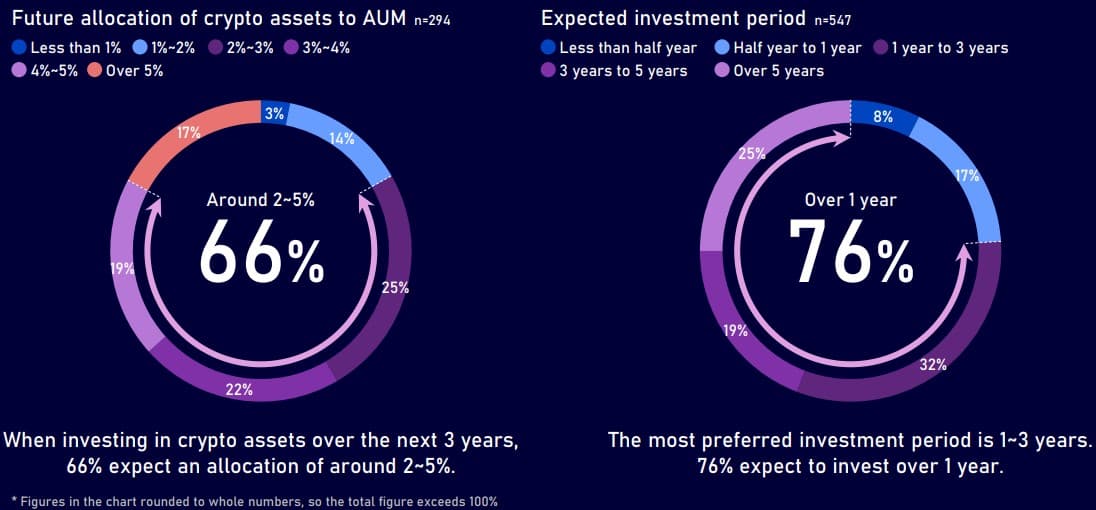
“The most preferred allocation is around 2~5%,” the report said. “Nearly 80% intend to invest over 1 year.”
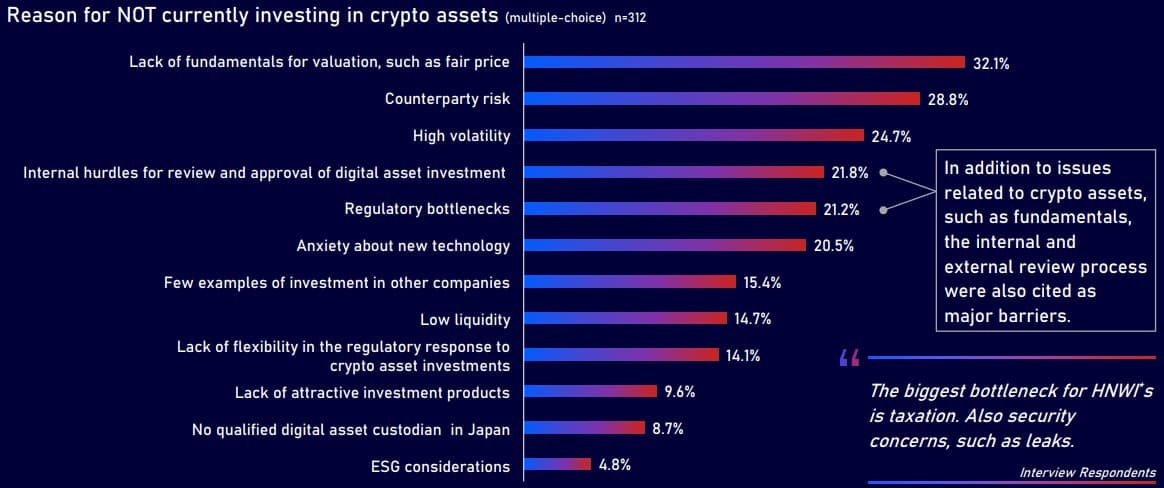
The biggest investment barriers are fundamentals, counterparty risk, volatility, internal environment, and regulation, the survey found.
When it comes to enticing more investors to make allocations to digital assets, respondents highlighted the need to develop a variety of investment products (38%) as the top way to boost investment in crypto assets, while 35% said seeing “Other companies begin to invest actively in crypto assets” would prompt them to enter the market.
Other drivers include “Expanding crypto asset use cases and DeFi economies (34%); Establishment of fundamental analysis methods, such as fair valuation (33%); [improvements] to the process in which investments are reviewed and approved within the company (31%); Security improvement (28%); Establishment of risk management methods (24%); Laws and regulations to be developed and reviewed (14%); Greater flexibility by regulators for crypto asset investments (11%); and Custody to be provided (3%).”
The development of crypto exchange-traded funds (ETFs), investment trusts, staking and lending options were also highlighted as attractive reasons for crypto investment.
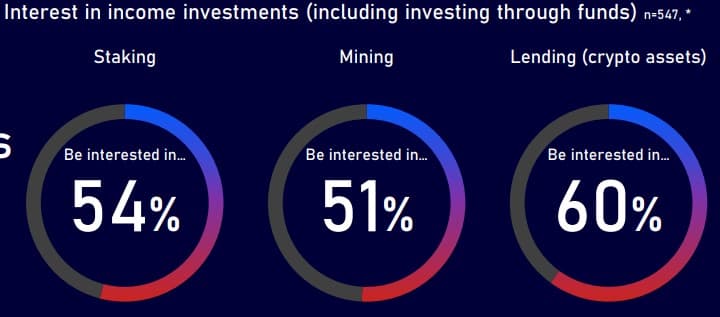
“In Japan, the ban on the issuance and handling of ETFs for crypto assets has not yet been lifted, but if this were to happen, the market may be further revitalized,” the report said. “31% of respondents want direct investment in crypto assets, and 53% want ETFs.”
The survey also found a growing interest in various sub-sectors of the crypto ecosystem, with roughly 40% of respondents saying they intend to invest in new Web3 services and projects, both as direct investment and via VC funds.
And stablecoins were another key area of interest for nearly half of the respondents, who highlighted their use in delivery versus payment (DVP) and payment versus payment (PVP) (51%), decentralized finance (DeFi), and in the settlement of daily transactions (48%) as the top applications.
