

(Kitco News) – Recent pro-crypto developments have led to rising optimism across the digital assets landscape, and things are set to get even more bullish as the U.S. Securities and Exchange Commission (SEC) has granted preliminary approval for multiple spot Ethereum (ETH) exchange-traded funds (ETFs) to start trading on Tuesday.
Update: Nate's instincts were right, hearing SEC finally gotten back to issuers today, asking them to return FINAL S-1s on Wed (incl fees) and then request effectiveness on Monday after close for a TUESDAY 7/23 LAUNCH. This is provided no unforeseeable last min issues of course! https://t.co/D21FD9Qf94
— Eric Balchunas (@EricBalchunas) July 15, 2024
As noted by Bloomberg senior ETF analyst Eric Balchunas, the regulator has finally responded to issuers concerning the final approvals for spot ETH ETFs and is looking to have all paperwork submitted by Monday for a launch on Tuesday, July 23.
On May 23, the SEC granted accelerated approval for eight filed Ether ETF applications and asked the issuers to submit their S-1 registration statements before the launch could take place.
According to Reuters, the approval to launch next Tuesday hinges on applicants submitting final offering documents by the end of this week, sources close to the matter said. One source said that all eight applications are expected to be approved and launched simultaneously.
In response to the news, the price of Ether has rallied from $3,200 late on Sunday to a high of $3,501 on Tuesday as traders moved to front-run a potential price rally once the ETFs launch.
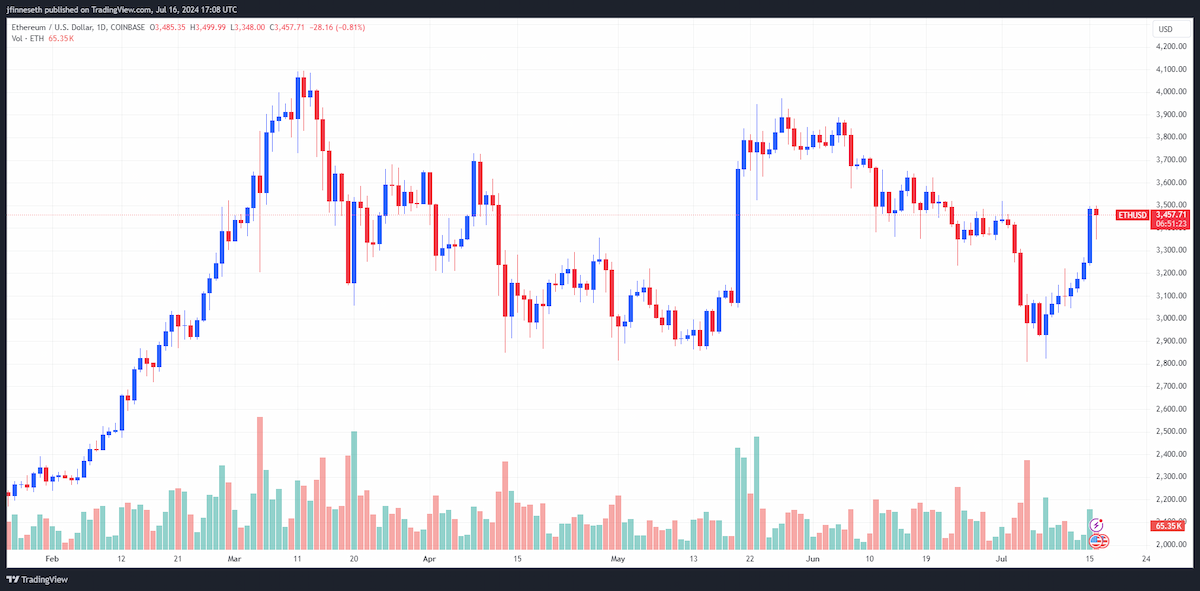
ETH/USD Chart by TradingView
The eight applications set for launch are the Grayscale Ethereum Trust, Bitwise Ethereum ETF, Blackrock’s iShares Ethereum Trust, VanEck Ethereum Trust, 21shares Ethereum ETF, Invesco Galaxy Ethereum ETF, Fidelity Ethereum Fund, and Franklin Ethereum ETF.
According to a report from Citi, the launch of spot Ether ETFs in the U.S. could result in net inflows equivalent to 30%-35% of what was seen with the launch of spot Bitcoin (BTC) ETFs, with distribution skewed to the downside.
The report said that the ETFs could see between $4.7 billion and $5.4 billion in net inflows over six months, adding that the inflows and the beta of Ether returns relative to such flows could be lower than the analysis suggests.
“One reason is that while ETH may offer diversification benefits in the long-term, given its different and more extensive set of use-cases, this is currently not the case,” Citi analysts led by Alex Saunders said. They added that investors who prefer to purchase crypto via ETFs may view Bitcoin and Ether as similar enough to split their allocations between the two cryptocurrencies, rather than viewing them as distinct assets.
This means that Ether could take some of the flows that were originally set to go into Bitcoin ETFs as a means of diversification, Citi said.
The analysts said one reason Ether will struggle to match the flows seen with Bitcoin ETFs is the inability to capture the upside of staking, as all language regarding staking yields was removed from the applications in order for them to receive approval.
Bitcoin also has the benefit of a first-mover advantage, the bank said. One positive working in the Ether ETFs’ favor is the increasingly dovish Federal Reserve, which could lower interest rates in September, leading to a stronger equity market and a weaker U.S. dollar. The report said that would create a macroeconomic environment that could support crypto.
Citi’s estimate of around $5 billion flowing into Ether ETFs in the first six months was supported in a report released by the Gemini cryptocurrency exchange.
“Using market comparables for ETH ETFs in international markets where both assets trade, we estimate spot ETH ETFs will garner $3-5 Bln in the first 6 months of trading,” the report said.
“On aggregate the share of ETH ETF assets under management relative to BTC is in the 25-30% range,” the analysts noted. “However, underlying this statistic is a wide range of country-level data. Sweden, for example, where assets for both BTC and ETH funds exceed $1 Bln has an almost 60% share of ETH assets relative to BTC. By contrast in Canada, the second largest market for crypto ETFs, ETH ETF AUM is a modest 28% compared to that of BTC.”
“We can also compare alternative metrics which affect portfolio allocation decisions,” they said. “Ethereum has a 33% market capitalization ratio relative to Bitcoin. From a risk perspective, ETH has a slightly higher option-implied volatility ratio compared to BTC, with a 0.74 return correlation over the past 6 months. This correlation coefficient has oscillated between 0.7 and 1 over the past 6 years, which, coupled with the volatility analysis, makes difficult an ex-ante case for portfolio gains from diversification beyond an equally-weighted allocation.”
“While Bitcoin has a firm grasp on the buy-and-hold, digital gold narrative, Ethereum’s use cases and robust on-chain fundamentals differentiate it in scale and scope,” they added. “The ratio of daily active addresses on Ethereum vs. Bitcoin have consistently exceeded 60% for the past quarter. Transaction fees paid to use either blockchain favor Ethereum 2-to-1 over the past 6 months. Layer 2 scaling solutions have grown sharply in terms of total value processed, with daily transactions besting Layer 1 Ethereum by an order of magnitude. Most stablecoins reside on Ethereum.”
“In sum, taking the ensemble of the data analyzed above we can construct a confidence interval of net inflows of $3-5 Bln into spot ETH ETFs in the first six months,” they concluded. “This means the total AUM for spot ETH ETFs in the US is estimated to be $13-15 Bln in the first six months (including the current ETHE AUM). Net inflows below 20% or $3 Bln would be a disappointment, given spot BTC ETFs had $15 Bln net inflows in approximately the first six months. Net inflows exceeding $5bln or 1/3 of those into spot BTC ETFs would be a strong showing, while anything close to 50% or $7.5 Bln should be a significant upside surprise.”
