

(Kitco News) – Asset prices retreated on Wednesday following a slew of new record highs on Tuesday as the threat of curbing U.S. exports to China weighed heavily on tech stocks, resulting in the Nasdaq suffering its worst day in 11 months.
“Stocks declined on Wednesday as the rotation out of high-flying technology shares continued,” said analysts at Secure Digital Markets. “Semiconductor stocks were particularly hard-hit following a Bloomberg News report that the Biden administration is considering stricter trade restrictions if companies continue providing China access to U.S.-made technology.”
For many analysts, the pullback was a welcomed sight for an equities market that has been in ‘up-only’ mode for some time, prompting anxieties about an equally intense downturn. They now look for a period of consolidation, where asset prices establish a new level of support before resuming their uptrend.
“This broader market rally reflects trader optimism about potential interest rate cuts, which are expected to benefit small-cap stocks and companies with higher financing costs,” Secure Digital Markets said. “Fed funds futures trading indicates a [98%] probability of the Federal Reserve lowering rates in September, according to the CME FedWatch tool.”
At the market close, the major indices were mixed, with the Dow gaining 0.59% while the S&P and Nasdaq fell 1.39% and 2.77%, respectively.
Another noteworthy development is the fact that the U.S. dollar index (DXY), the U.S. 10-year Treasury yield, and gold all saw declines on Wednesday, suggesting a high level of uncertainty among investors.
Data provided by TradingView shows that after hitting a high of $66,158 in the early hours on Wednesday, Bitcoin (BTC) entered into consolidation, dropping to a low of $63,866 before bulls managed to push it back above support at $64,500.
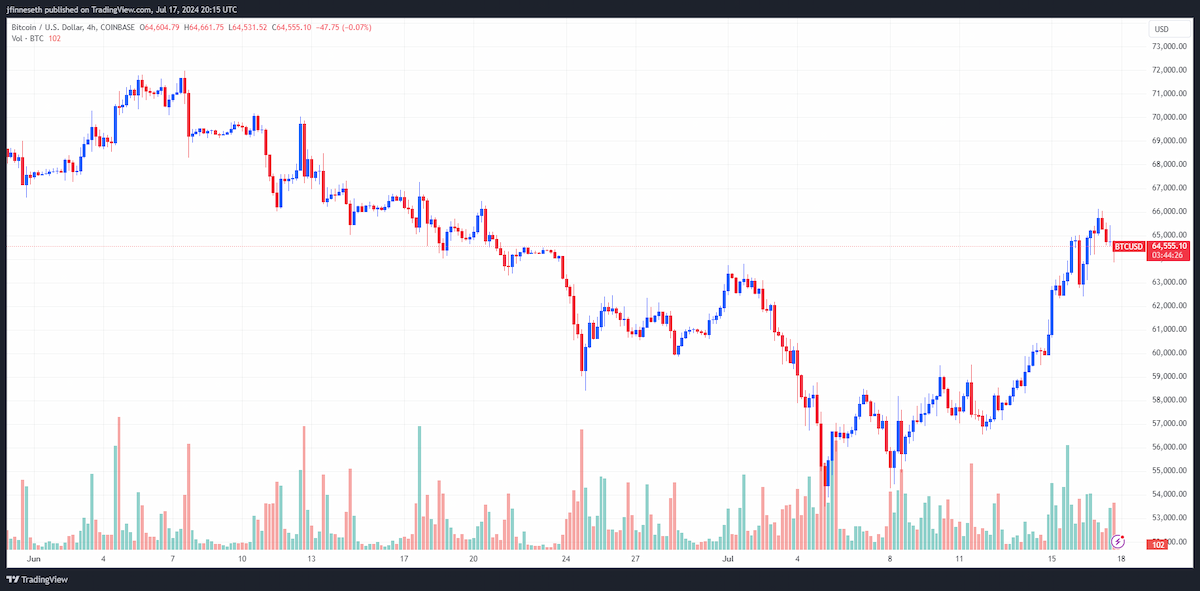
BTC/USD Chart by TradingView
“The market is forecasting a potential surge in BTC to $70,000, driven by an improved macroeconomic environment and the prospect of a more crypto-supportive U.S. administration under Donald Trump,” analysts at Secure Digital Markets said. “The market received a boost following Trump’s vice-presidential pick, signaling potential for more favorable crypto policies.”
“Reduced selling pressure from major wallets and a positive political outlook for the crypto sector have fueled bullish sentiment, despite recent volatility and concerns over Mt. Gox repayments,” they concluded.
At the time of writing, Bitcoin trades at $64,555, a decrease of 0.74% on the 24-hour chart.
Major development is still being integrated into the market
“A lot has happened over the past couple of weeks, but one of the most important bits – apart from the assassination attempt that only managed to kill Biden’s chances and overleveraged bears – was on the regulatory front,” said market analyst Bloodgood. “The [Supreme Court] overturned a decision from 1984, colloquially known as Chevron, that made federal agencies responsible for interpreting laws that aren’t completely clear.”
“Simply put: if there’s a novel industry or business model that isn’t unambiguously covered by laws passed by Congress, it was up to agencies—not courts—to decide how to interpret the law,” he explained. “That might already sound familiar, and it should: arbitrarily interpreting unclear laws in order to bully an emerging industry is exactly [SEC Chair Gary] Gensler’s playbook.”
“Now, rather than being judge, jury, and executioner in matters that have to do with (alleged) securities transactions, the SEC will have to play by the rules set by the courts,” Bloodgood said. “This means that it will take some time for legal precedent to be set and, especially, for Congress to pass clearer legislation, but in any case, it represents a huge shift in the right direction for crypto.”
“It will also make regulation less sensitive to political changes, which will make things more predictable in the long run,” he added. “Of course, the best thing short-term would be for Gensler to be replaced by a pro-crypto chairman after the elections, but without the guardrails set by the recent decision, any progress the new chairman would make could be undone after another change in the White House.”
Turning to the price action for Bitcoin, Bloodgood noted that the recent rally has not negated the bearish bent seen on the price chart that resulted from Bitcoin hitting a low of $53,500 on July 5.
“In the macro picture we are still seeing a lower high and have now formed a lower low, indicating that this remains a bearish structure,” he said. “For bullish continuation, we will need to break above $72.5k; otherwise, we are going for a new low, which could very well be below $50k.”
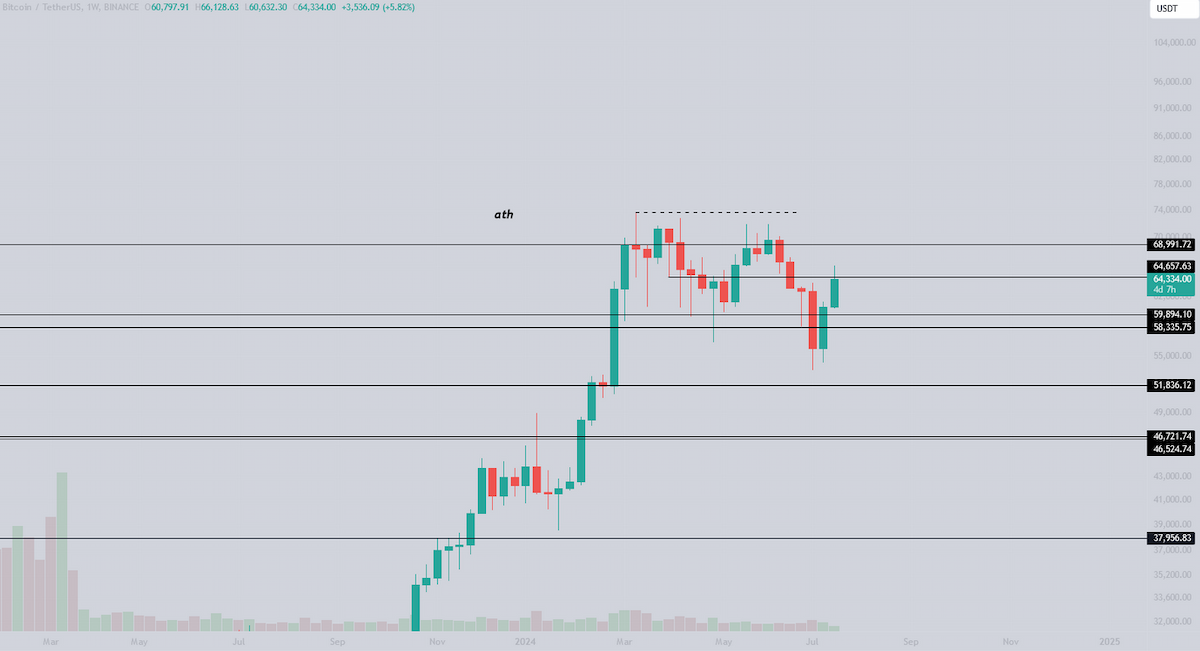
“The daily timeframe looks better than the weekly, as at the time of writing, Bitcoin is trading slightly above the important level at $64.5k,” he added. “We will know whether this breakout will stick or not in the next couple of days.”
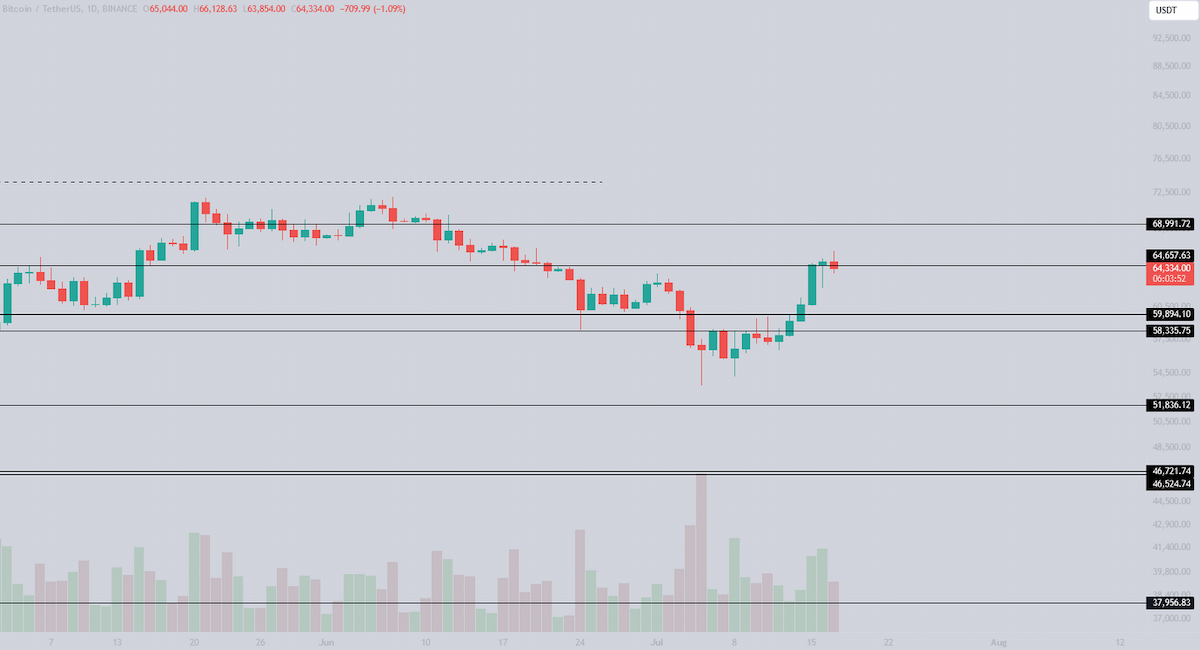
According to Joel Kruger, market strategist at LMAX Group, the crypto rally might stall if the stock market selloff turns into a deeper correction, but over a longer time frame, he thinks crypto could benefit by providing a haven for investors fleeing stocks.
"The one concern we’ve been flagging in recent sessions is our concern about the state of the U.S. equities market and the possibility we could soon see a major bearish reversal to allow for a healthy correction," Kruger said. “But even in such a case, there will be plenty of reason to be wanting to buy Bitcoin as a flight to safety asset, and plenty of reason to be wanting to pick up other crypto assets into dips on their potential for massive innovation.”
Mixed day for altcoins
It was a mixed day of trading for altcoins, with a slight majority of tokens in the top 200 recording losses.
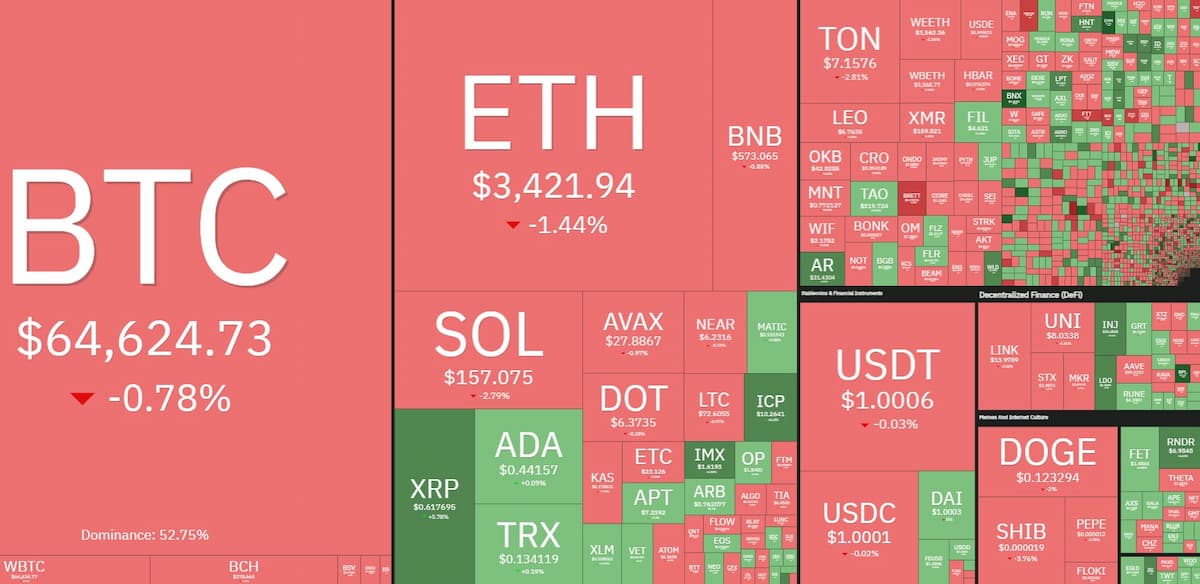
Daily cryptocurrency market performance. Source: Coin360
Dymension (DYM) was the top gainer, increasing by 33.6%, followed by a 16% increase for BinaryX (BNX) and a 13.7% climb for Rocket Pool (RPL). Dog (DOG) led the losers, falling 12.6%, while Brett (BRETT) fell 6.3%, and Mog Coin (MOG) lost 4.7%.
The overall cryptocurrency market cap now stands at $2.37 trillion, and Bitcoin’s dominance rate is 53.9%.
