
(Kitco News) – 2024 has marked a significant year for the adoption of blockchain technology and digital assets as the launch of the first spot Bitcoin (BTC) exchange-traded funds (ETFs) in the U.S. and the pending launch of the first spot Ethereum (ETH) ETFs, vaulted the asset class within reach of institutional investors – opening the market to trillions of dollars in investing capital.
With the ETF launches and the Bitcoin halving now factored in, the conversation around future price performance returns to the fundamentals of each network, where things like user adoption, interoperability, and scalability come into focus.
To get the latest on the state of adoption for the major networks, Kitco Crypto spoke with Alan Orwick, co-founder of Quai Network, the only fully scalable and programmable Proof-of-Work (PoW) layer-1 (L1) for the global and compute economies.
A major pain point for the Ethereum network has been its struggle to scale, especially during times of higher activity, which results in slower transaction confirmation times and higher costs.
When asked if Ethereum L1 can be meaningfully scaled, or if layer-twos (L2) like Polygon and Arbirtrum are the only way to achieve a notable increase in transactions per second (TPS), Orwick suggested that the future of scalability on Ethereum is likely dependent on L2 and even layer-three (L3) networks, which leaves the door open for other projects to increase market share.
“Although L2 and L3 solutions can mitigate Ethereum's scalability challenges, innovative solutions like Quai Network provide a more holistic approach to scaling,” he said. “Quai's hierarchical structure and advanced consensus mechanisms are built to support high transaction throughput without compromising security or decentralization.”
Orwick said solutions like Quai offer a way to “directly tackle and surpass the scalability constraints of Ethereum L1,” meaning that despite Ethereum’s first-mover advantage, the door is still open for a high-throughput L1 to gain a foothold in the industry.
For that reason, it’s likely that the list of blockchain networks will continue to grow, as developers have yet to find the precise mix of security, decentralization, and scalability that can offer the world a network capable of handling the high level of throughput needed to support the global population.
“Quai Network is inherently designed for high scalability, providing substantial advancements over traditional L1 blockchains like Ethereum,” he said. “Its hierarchical structure and efficient consensus mechanisms make it a top scalable solution. As the demand for efficient and scalable blockchain solutions increases, Quai is well-positioned for greater adoption thanks to its advanced scalability features.”
Blockchain interoperability
Until the ‘everything chain’ emerges, the blockchain ecosystem will function as an interoperable collection of platforms specializing in different things, which is where Ethereum virtual machine (EVM) compatibility plays a role.
“EVM compatibility is essential for scaling solutions as it enables developers to use existing Ethereum tools and expertise, simplifying the deployment and interaction with decentralized applications (dApps) across multiple networks,” Orwick said. “Cross-chain compatibility is equally important for widespread adoption, allowing different blockchain ecosystems to interact effortlessly. This interoperability creates a more cohesive and user-friendly environment, promoting wider use of blockchain technology.”
In September 2022, Ethereum transitioned from a PoW consensus mechanism to proof-of-stake (PoS), largely due to rising concerns about the energy cost of PoW, which is the type of consensus mechanism that Bitcoin (BTC) operates with.
PoW has been under increasing scrutiny in recent years as environmental concerns have become a higher priority in the eyes of the general public. When asked about the decision to launch Quai as a PoW network, and whether or not PoW will continue to fade as a consensus mechanism of choice moving forward, Orwick said the demise of PoW has been overblown.
“Despite predictions of its decline, Proof-of-Work is experiencing a resurgence as protocols actively experiment with it, recognizing its unique attributes as a credibly neutral and objective consensus mechanism at scale,” he said. “While Bitcoin remains the dominant PoW chain, other PoW cryptocurrencies may find renewed interest and adoption, particularly if they can address energy efficiency concerns or demonstrate novel applications of PoW.”
Decentralized finance and institutional investors
Transitioning to decentralized finance (DeFi) and the newfound access that institutional investors have to the crypto market thanks to the launch of ETFs, Orwick said he sees “significant potential in decentralized lending and borrowing platforms, automated market makers (AMMs), and synthetic assets. These sectors provide innovative financial instruments and opportunities, promoting financial inclusion and innovation.”
“Another real-world use case taking the crypto world by storm is real-world asset (RWA) tokenization,” he added. “RWAs are democratizing access to investments by allowing fractional ownership of assets like real estate and commodities, making them accessible to a broader range of investors.”
“This process enhances liquidity and lowers entry barriers, enabling individuals to invest in traditionally illiquid markets,” Orwick said. “By leveraging blockchain technology, RWA tokenization ensures transparency and security, further encouraging participation from diverse investor groups.”
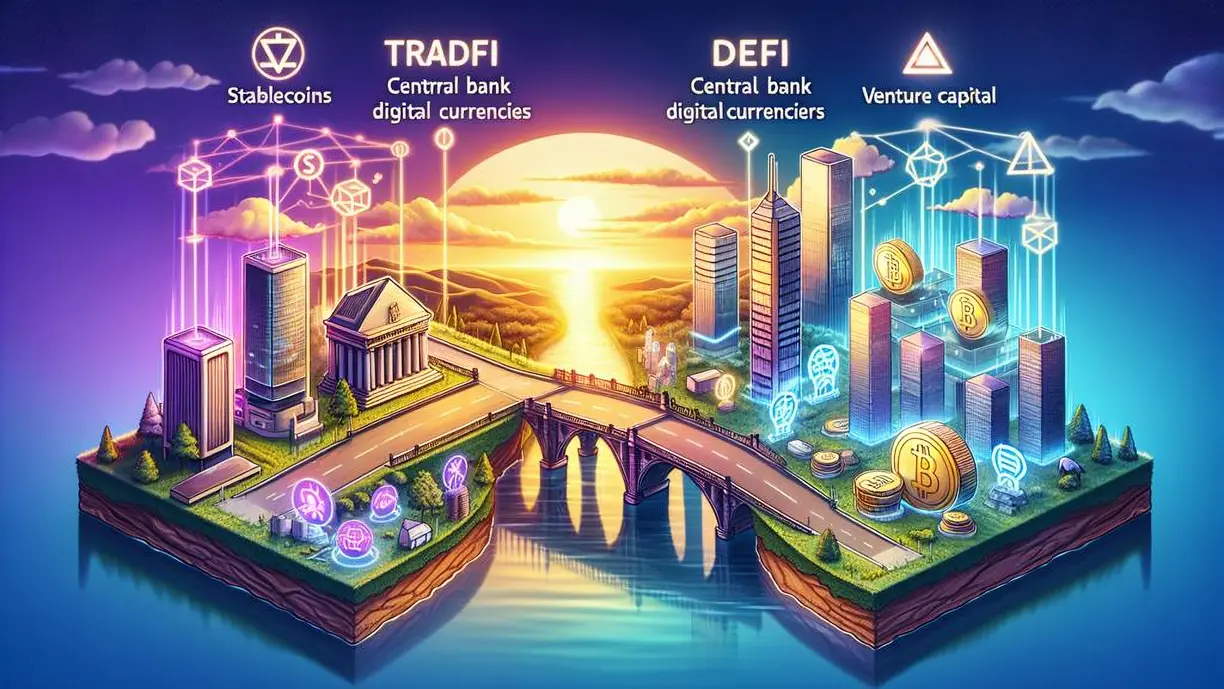
He suggested that the growing movement of RWA tokenization, “when combined with a highly scalable blockchain, offers a powerful way to merge TradFi and DeFi.”
An example is Quai’s Qi ‘energy dollar,’ which “enables tokenization of real-world assets tied to energy and commodities,” he said. “This creates financial instruments that directly reflect real-world economic conditions on a highly available compute layer.”
Orwick said this is a good example of “how TradFi and DeFi can merge while maintaining decentralization and scalability principles.”
When asked about the effect institutional investors and venture capitalists have on the broader crypto ecosystem, Orwick noted, "The influx of Venture Capital has significantly altered the crypto landscape, attracting institutional investors and sovereign funds to early-stage projects.”
“While VC-backed initiatives often generate excitement and are seen as trendsetters, it's crucial for builders to maintain their focus on the industry's cypherpunk roots,” he said. “Many developers continue to prioritize decentralization and individual empowerment, sometimes diverging from VC-driven trends. This tension between institutional investment and grassroots innovation highlights the ongoing challenge of balancing growth with the foundational principles of cryptocurrency.”
Stablecoins and central bank digital currencies
One of the primary applications of RWA tokenization thus far has been the widespread adoption of stablecoins – tokens that track the value of an underlying asset, such as the U.S. dollar. Tether (USDT) and Circle’s USDC are the two most well-known examples of stablecoins, with a combined market capitalization of approximately $147.4 billion. According to data from CoinMarketCap, the total market cap of stablecoins is roughly $165 billion.
“Stablecoins are attracting more users to DeFi by offering a stable and familiar entry point, minimizing the risks associated with volatile cryptocurrencies,” Orwick said. “They enable quicker and easier cross-border transactions and are commonly used in DeFi platforms for lending, borrowing, and earning interest.”
“Additionally, stablecoins simplify the conversion between fiat and cryptocurrencies, acting as a bridge between traditional finance and the Web3 ecosystem,” he noted. “Increasing regulatory clarity around stablecoins boosts trust and acceptance, encouraging wider adoption. Finally, stablecoins support innovative financial products and services, drawing users interested in advanced financial solutions.”
For their part, Quai Network has taken “a novel approach to stable value, designed as a non-fiat dollar alternative that scales with the network's energy usage,” Orwick said.
“Issued as block rewards proportional to mining difficulty, Qi reflects stable value tied to energy costs without traditional pegging or collateralization,” he explained. “This dynamic model demonstrates how blockchain-native assets can bridge traditional and decentralized finance with enhanced stability and scalability.”
Stablecoins have been a point of focus for regulators, with the European Union’s Markets in Crypto Assets (MiCA) providing clear guidelines around how issuers and banks should deal with them throughout the EU. In the U.S., legislators continue to craft legislation and debate the finer points of how stablecoins can be integrated into the U.S. economy.
When asked if passing stablecoin legislation is the first step towards introducing central bank digital currencies (CBDCs), Orwick said, “Stablecoin legislation could indeed pave the way for CBDCs, which pose significant risks to individual freedoms.”
“CBDCs could grant governments unprecedented control over citizens' finances, enabling transaction monitoring, programmable money restrictions, and direct account freezes,” he warned. “This level of centralized control threatens financial privacy and economic freedom, potentially eroding personal liberties and altering the citizen-state relationship in concerning ways.
As the conversation came to a close, Orwick highlighted one topic that doesn’t get much coverage but is crucial to the future of blockchain, DeFi, and the integration of traditional and decentralized finance: developer relations.
“Industry stakeholders must prioritize strong developer relations, acknowledging that developers drive innovation and growth in the blockchain sector,” he concluded. “By offering comprehensive support and resources, Quai aims to empower developers to create scalable infrastructure that addresses the industry's future needs.”
