
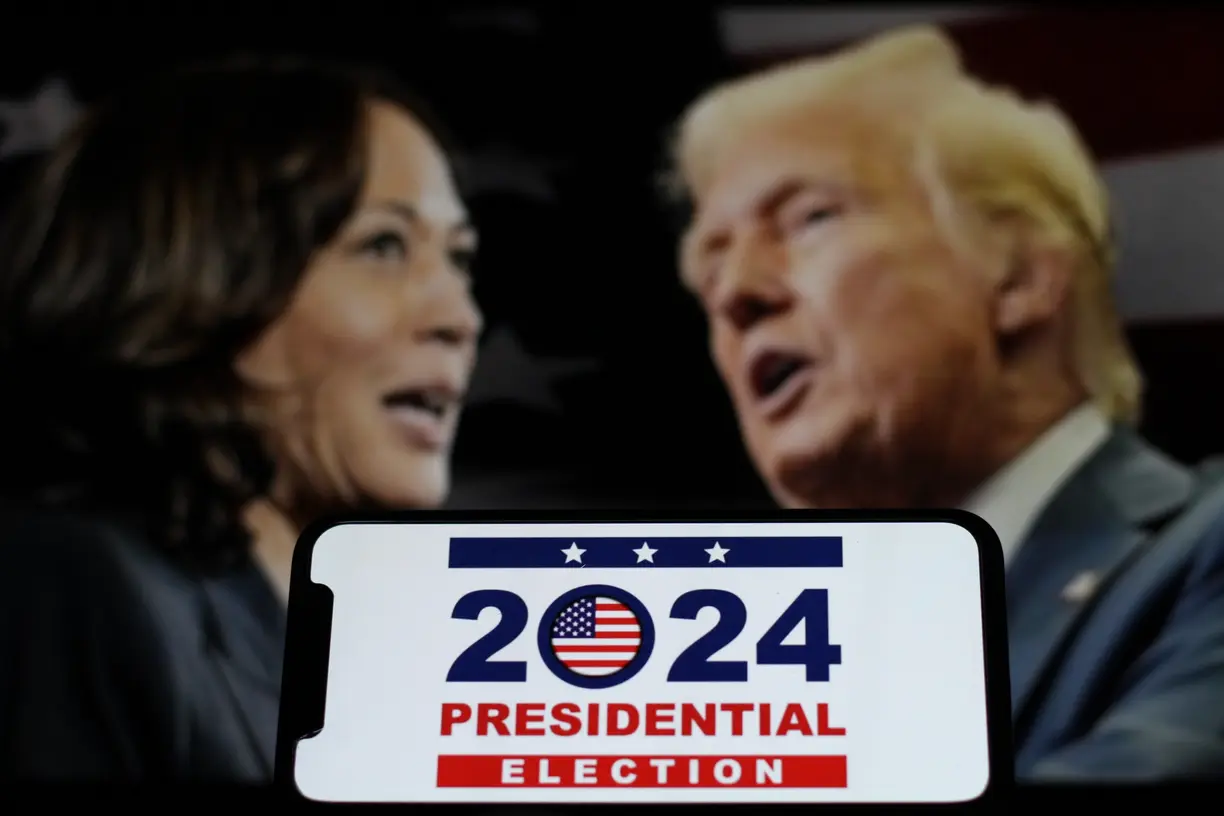
(Kitco News) – The 2024 U.S. Presidential race was upended last month when sitting President Joe Biden announced he was withdrawing his name from contention, making way for Vice President Kamala Harris to be the Democratic party candidate.
While analysts widely agreed that presidential candidate Donald Trump would be the better choice for cryptocurrencies over Biden, the market is less sure about who would be better now that Harris has replaced Biden, as her campaign has shown signs that they are looking to build bridges between Democrats and the crypto community.
Kitco Crypto reached out to several experts in the ecosystem to get their take on the Trump v. Harris presidential battle and which candidate would be better for the future of the crypto industry.
“Thus far, the Trump campaign has been more vocal in support of the Bitcoin and crypto industry, and it's expected that a Trump win would, at the very least, result in a softening of the significant regulatory scrutiny that companies in the industry have had to bear over the last few years,” said Ian Major, Co-Founder of Joltz Rewards.
However, Major sees a definite improvement with the option of Harris over Biden, as the Biden administration has presided over the harshest crackdown on the industry since its inception.
“While some in the industry are concerned that a Harris win would continue the ‘Operation Chokepoint 2.0’ style crackdowns observed during Biden's tenure, the Harris campaign does appear to be realizing what a key issue this is for voters and is reaching out to companies in the industry,” he said. “Either way, Bitcoin and the broader crypto market have historically rallied hard following a U.S. election regardless of which political party wins, suggesting that the mere resolution of uncertainty could be a tailwind for the market heading into 2025.”
While some analysts and commentators have questioned the sincerity of both Trump’s and Harris’ outreach to the crypto community, Major said, “At this stage, it's too early to tell whether either campaign's outreach is based on a genuine interest to support the industry and the many of Americans who care deeply about digital assets.”
“It is increasingly clear that both sides recognize the importance of the issue for voters, and time will tell whether either side follows through on any campaign promises,” he said. “As an industry that has long been shunned by traditional institutions and power structures, we are not holding our breath.”
On the back-and-forth battle regarding who will win that has emerged on the Polymarket prediction platform, Major said that, generally speaking, “prediction markets have been shown to be more accurate on average than polls and pundits. At the very least, it's likely that Polymarket will more quickly reflect changes in odds given that real ‘skin in the game’ is involved.”
Bartosz Lipiński, CEO of Cube Exchange, said, “Based on recent rhetoric, it appears that Kamala Harris has been receptive to the idea of regulating crypto rather than trying to outlaw it like some of the more hardline Democrats.”
“Given this development, it appears that neither candidate would be a detriment,” he said, noting that he has actually met directly with the Trump campaign and spoken with them about the industry.
“That said, Trump has been more explicit in his desires for how to oversee and regulate the industry than Kamala Harris has, and she remains a bit of an unknown,” he noted. “Her evolution has made a number of single-issue voters change their minds on whether or not to vote for Trump, but that does not mean she will be better for the industry than he would be.”
“I do want to believe that their interest in relaxing stances towards crypto is a legitimate effort to foster innovation and growth, but most politicians tend to go where the votes are, and it is hard not to be at least somewhat cynical - especially after the support Trump received that spurred Democrats to reconsider their position on the industry,” Lipiński said when asked about each candidate’s level of sincerity.
“That said, from what I gathered in personal meetings with Republicans and the Trump campaign, Trump's efforts towards the industry appear to at least be more honest and well-intentioned,” he added. “The right has made efforts to learn about the industry and to engage us in a positive manner, whereas the DNC this week is holding a workshop to learn about crypto.”
On the topic of Polymarket, Lipiński noted that “the vast majority of people using it are crypto-native and, therefore, are likely to be skewed similarly towards the conversations happening within the crypto industry and on crypto Twitter. For now, I'd hesitate to place a lot of stock in what Polymarket says, with it being a broader gauge of sentiment, but it should eventually serve in that capacity.”
Also in the Trump camp was Taras Kulyk, CEO of Synteq Digital, who said, “The impact of a Trump administration will likely be a net positive to the Bitcoin ecosystem, given the number of folks on the Trump campaign trail that actually disclosed Bitcoin ownership, in addition to Trump's own million dollar plus Bitcoin holdings.”
“The potential administration's staff have all signaled that they're very much pro-Bitcoin, pro-Bitcoin mining, so it'd be a net positive for the entire ecosystem,” he added.
“On the opposite side of the table with Kamala Harris, she's still actively saying that she doesn't think Bitcoin is a net positive for the economy,” Kulyk noted. “However, there have been overtures in the past few weeks around crypto markets being a potential opportunity for integration into the existing financial capital markets.”
He said it remains to be seen “if Kamala will maintain this if she does get elected.”
“I do think the outreach [from both candidates] is legitimate,” he added. “However, time will tell if the outreach will actually end up as an opportunity for policymaking and policy changes.”
“The best thing Kamala Harris can do in convincing the Bitcoin community is a statement or potential policy positioning that's formalized in their actual policy papers that support Bitcoin and Bitcoin mining, similar to what Trump has put out in addition to what Loomis has suggested being the Bitcoin strategic reserve,” Kulyk said. “All of these things could be something that the incoming presidential candidates can really push forward and make sure that they know to tell the population that they're serious and it's not just pandering and bandwagoning as they need votes, especially in swing states.”
Both candidates bring greater regulatory clarity
According to Kimberly Rosales, founder and CEO of ChainMyne, regardless of who wins the election, “2025 is shaping up to be pivotal for cryptocurrency regulation in the USA.”
“After years of regulatory uncertainty, we're likely to see a more defined framework emerge, balancing the need for innovation with consumer protection and market integrity,” she said.
“The possibility of Trump becoming president next year brings both enthusiasm and unpredictability,” she noted. “In the past, Trump has been skeptical about digital assets, once calling Bitcoin a 'scam' and expressing disapproval of its potential effect on the U.S. dollar. However, there have been signs from his campaign suggesting a more nuanced approach.”
Rosales suggested that “Trump's running mate, JD Vance, may have influenced this shift” as “he supports Bitcoin and blockchain technologies.”
“Trump recently stated that if we don't embrace the technology, China or another country will (it sounds like he doesn't want this to happen). In light of his intention to reach out to tech-savvy voters and the growing enthusiasm for blockchain innovations, it is possible that if elected, Trump will work to make the U.S. market more crypto-friendly by reducing regulations,” she said. “On the other hand, specific rules that target fraud prevention and the preservation of the established financial system may be put in place, which could limit certain aspects of the digital currency market.”
In the opposing camp, Rosales noted that “Kamala Harris has carefully approached digital assets, emphasizing the need to regulate the market to protect customers and promote innovation.”
“Even though she has yet to speak out as other politicians, her administration's involvement in talks on digital currencies issued by central banks and more comprehensive fintech regulation points to a cautious but developing approach,” she said. “As a sitting Vice President, it’s difficult to aggressively take a significantly different approach to regulation by enforcement on the campaign trail, and not including digital assets at the Democratic National Convention this week may signal a potential change of stance that is more favorable to the industry.”
“Even though they should be regarded with caution, the odds on sites such as Polymarket might offer some insight into the current state of the market,” Rosales added. “Because it's open to the general public beyond just the U.S., the odds may represent more expansive, foreign viewpoints, which sometimes diverge from American realities. These platforms are decentralized, so although they provide an interesting sentiment indicator, they sometimes can accurately predict results.”
“Making digital assets a top administration initiative by politicians like Trump or Harris could be considered strategic. Both may gain support by aligning with the expanding crypto community, which by some accounts is as many as 40-50 million U.S. adults,” she concluded. “Irrespective of which party wins, this coming November, we will have greater clarity on the crypto industry's regulatory environment and hopefully more favorable policies.”
Trump short-term, Harris long-term
“In the short-term, there may be more initial upside from a Trump win, but longer term, Kamala Harris may be a better President for the future of the industry,” said Tim Kravchunovsky, founder and CEO of decentralized telecommunications network Chirp. “That is, provided she is open to engaging with the Web3 industry and pushing through a regulatory framework that is designed with the complexities of blockchain technology in mind.”
“Given Harris’ connections to Silicon Valley, it is possible that she will emerge as a supporter of crypto innovation, but we haven’t seen any real indication of this yet,” he added. “Trump, on the other hand, promises a lot, but much of what he’s promising is almost certainly a publicity stunt. So while many in the industry will rejoice if he wins the race, they may become disillusioned further down the line.”
While Trump has come out full-throated in support of cryptocurrencies with tantalizing promises, Kravchunovsky said his “lofty promises to the crypto industry have felt like nothing but a publicity stunt from the very beginning.”
“Sure, he also has a vested interest in supporting the performance of cryptocurrencies like ETH, given the fact he’s holding millions of dollars worth of the token,” Kravchunovsky noted. “But he may well forget all about his newfound love for crypto as soon as he wins.”
“Meanwhile, Harris’s attempts to win over the crypto crowd have been lackluster so far, and we’re yet to see any clear crypto policies from the Democrats,” he said. “We would have to see much more engagement from the left to be convinced that it’s genuine.”
“For now, I don’t think we should be getting our hopes up about either candidate,” he warned. “Rather, we should just keep building our projects and developing our technology. Crypto was never meant to be political, and we shouldn’t start now.”
As for the odds on Polymarket, Kravchunovsky said, “Sometimes, prediction markets can predict election results more accurately than polling because the people placing bets are well-informed about the situation and have put their money on the line.”
“According to news reports, there’s currently $606 million wagered on the U.S. election on Polymarkets, and Harris is currently in the lead,” he noted. “But her odds remain narrow – barely above 50% – while Trump’s odds recently surged.”
These comments from Kravchunovsky came before presidential candidate Robert Kennedy Jr.'s announcement that he was backing out of the race and throwing his support behind Trump. This led to a shift in the odds on Polymarket, which now show Trump leading Harris 51% to 48%.
“With such a tight margin, prediction markets like Polymarket are simply not an accurate enough tool to predict the outcome,” Kravchunovsky said. “They can give an indication of the overall market expectations, same as polling data, but the result of this election will be particularly difficult to predict. We’ll have to wait until the day itself to find out who’ll win.”
According to Georgii Verbitskii, founder of TYMIO, Trump’s positive outreach to the community and his family’s plans to launch a decentralized finance (DeFi) protocol make him the better choice in the short and long term.
“While Donald Trump is currently advocating for Bitcoin, this has not always been the case,” Verbitskii said. “For example, in 2019 he admitted he did not support BTC and cryptocurrencies, the value of which he said was ‘based on thin air.’”
“Today, the narrative changed: he promises less regulation and more incentives for the crypto industry,” he noted. “Such an approach is intended to trigger the growth of the entire Web3 space: it allows projects to attract investors and contributes to massive crypto adoption.”
“Trump’s pro-crypto stance makes him a more desirable candidate in both long- and short-term perspectives,” Verbitskii said. “His election would mean a lot for the market where current participants are playing against both stocks and digital assets, slowing down growth and not giving clear instructions on implemented regulations.”
“In the event of Kamala Harris’s victory, the Web3 industry should brace for tighter regulations,” he warned. “It would take a toll on development rates, but market participants would be protected better. In any case, digital assets are bound to develop, but Trump’s presidency seems to be more promising for all financial markets and businesses.”
Verbitskii added that while it’s nearly impossible to tell whether either candidate's outreach to the crypto commutes is just “a strategic play to get more votes only,” he noted that “both candidates understand the weight of the crypto-enthusiast votes in the upcoming race, which is already a big step towards recognizing the importance of the sector economically and politically.”
Regarding Polymarket, he said the “odds can be a useful tool for assessing market sentiment, especially in the absence of other data, but they should be treated with caution and not be considered as the only source of information. It is important to correlate them with other sources of analysis, such as traditional surveys and expert opinions.”
Republicans seem more sincere
“The Republican Party recognized early on that the enthusiasm for technology and innovation, especially around cryptocurrencies, provides a significant opportunity to attract the 18-30 voter demographic,” said Oliver Linch, CEO of Bittrex Global and founder of OJL Advisory. “Their stance stands in stark contrast to the current administration's policies, which have generated frustration within the crypto community, largely due to the actions of SEC Chair Gary Gensler and Operation Chokepoint 2.0.”
“Trump, in particular, has been vocal in his support of cryptocurrencies, which has helped the Republican agenda resonate with crypto advocates and Silicon Valley—marking a shift from previous years,” he noted.
“For Vice President Harris, who has deep roots in California’s tech industry, her election could represent a pivot toward the innovation sector,” Linch acknowledged. “Although her campaign has sent mixed signals, she's shown signs of wanting to engage with the crypto community, such as meetings with industry leaders like Mark Cuban.”
“So far, no concrete proposals have materialized, and many remain skeptical, given the record of the Biden administration,” he said. “If Harris were to move away from the current administration’s more skeptical approach, she could open the door to innovative regulations. In doing so, her leadership might foster collaboration and trust within the industry, potentially rekindling crypto market optimism. However, sticking too closely to Biden's regulatory framework risks alienating this key sector.”
Linch said that at this point, whether the outreach by Trump or Harris is legitimate doesn’t matter.
“Pollsters and journalists often try to separate out a party’s platform from what the candidates ‘really’ think. But this is a distinction without a difference. A politician’s primary motivating factor is, usually, to get elected, and to do that, they will develop a platform that has broad popular appeal, targets key demographics, etc.,” he said. “Once elected, they will pursue that program, both because the incoming administration will be geared up to deliver what the people voted for and because those policies will likely cause them to retain the popularity and support that got them elected in the first place.”
“Obviously, circumstances and priorities change, and it would certainly be naive to pretend that every politician doggedly pursues what they said they would in the election,” he noted. “But that shift is better explained by those changing circumstances rather than some disconnect between ‘legitimate’ policies and ‘strategic’ plays.”
“Put perhaps more cynically, if you like a policy, you don’t need the politician’s motives to be pure, you just need them to believe – and continue to believe – that it is popular and will lead to them being supported,” Linch said.
“Outreach efforts by Trump and, to a lesser extent, Harris likely serve both strategic and legitimate purposes,” he suggested. “Trump’s vocal support for the crypto sector appears to align with his broader strategy of courting young voters and technology advocates, signaling a calculated move to bolster his voter base.”
“Harris’s engagement with tech leaders also suggests a legitimate interest in understanding the industry, particularly as she seeks to reclaim the tech community’s support,” he added. “However, in a tight election, these outreach efforts are clearly also aimed at securing votes, especially in swing states where the tech community and crypto investors may play a pivotal role.”
As for Polymarket odds, Linch highlighted that “The question as to whether betting markets or pollsters are more accurate is long-standing.”
“Those advocating for betting markets maintain that it is a more ‘true’ indicator because people are putting their money where their mouth is,” he noted. “But defenders of traditional polls point to the advanced psephological analysis involved in sophisticated polling science, the ease of manipulating betting markets, and the fact that external considerations – such as international participation – can skew the results.”
“Ultimately, a global betting market offers one particular perspective – insights from highly motivated participants on a global basis,” he concluded. “These may provide some useful background information and context, but must be considered alongside other forms of analysis, especially controlled and rigorous analysis, that focus specifically on U.S. voters.”
Too early to tell?
“Right now, there’s not a concrete answer, as Harris has yet to reveal her stance on crypto,” said Ashley Ebersole, General Counsel of 0x, when asked which candidate was better for the industry.
“The Republican side has thus far been more vocally supportive of crypto and of reducing regulatory hostility toward the industry,” he said. “Vice President Harris, now in the lead role for Democrats, brings a fresh perspective, and her staff has made overtures to the crypto community suggesting they’d be less adversarial than the Biden White House.”
Ebersole called this “a positive step for Democrats since silence on Harris’ crypto stance would suggest a continuation of the current administration’s more hostile approach.”
“So while there is still more work to be done for crypto voters to shift allegiances, Harris’ approach thus far has earned her a second look from crypto voters,” he said.
Discussing the shifting stance from both candidates, Ebersole said, “Viewpoints evolve as policymakers increase their knowledge about crypto tokens and blockchain technology.”
“This requires openness and a little learning, but it results in policies based on facts rather than on hype and misconceptions,” he said. “We’ve seen how crypto has become a trending topic within the past few years, from FTX to TerraLuna. Since these events, lawmakers on both sides have called for different solutions to prevent these situations from occurring again. If Trump or Harris are able to learn more about the industry and meet with web3 leaders, it’s a sign that legitimate steps are being taken to work with digital assets to create clear, concise legislation.”
Ebersole also said she gives some credence to the odds provided by platforms like Polymarket because “When people express these types of opinions in this type of market, they tend to hold more weight since money is involved.”
“This greatly differs from a general poll, where if a respondent lies, there is no consequence,” he said. “That’s one way Polymarket bettors tend to hold more weight during an election.”
“However, when it comes to a geographical perspective, there’s less weight to be held on Polymarket,” he added. “At the end of the day, it is American voters who decide on the next president. It may be well-advised to look at what U.S. bettors and polls are saying, considering they hold more weight on deciding during elections.”
Analysts at Bitfinex also said it's a challenge to know who will be better for the crypto industry as “we haven't seen much of Kamala Harris's stance on crypto to date.”
“Given her political background, she might lean towards a regulatory approach, which could also be seen as red tape in the name of consumer protection and financial stability,” they said. “This could mean stricter regulations. The crypto market has continuously sought clarity in regulation, but it's unclear if Harris will be able to bring such clarity.”
“If some rumors are to be believed, she is inclined to appoint Gary Gensler as the Treasury secretary, which will not be seen as positive for the sector,” they noted. “Trump has promised to make the U.S. the crypto capital, but it is uncertain exactly what path and policy he will adopt to reach that path.”
After highlighting the negative comments Trump made about the industry in the past and his sudden about-face when his campaign realized it was an important issue for younger voters, Bitfinex analysts said they “do believe that Trump will be more approachable to crypto business owners and the existing exchanges, some of whom are donors to his campaign, and would be allowed to have their say in future crypto policies, once Trump is the president.”
They also warned that while “Polymarket odds can provide a great insight into the collective sentiment of those actively participating in the market and be indicative of trends and popular beliefs, they shouldn’t be taken as a definitive prediction as Polymarket tends to give more weight to the most recent events and the actual swing in people's voting decisions might not be represented by the daily volatility of the winning odds shown on the platform.”
“Also, Polymarket’s global accessibility means that the bettors are diverse in their views, but this also introduces a wide range of biases and assumptions that might not reflect the actual outcome of the U.S. election and the sentiment of the U.S. population,” they concluded.
A report from CoinShares largely echoed what the analysts interviewed by Kitco Crypto said and included some macroeconomic viewpoints to consider.
“In a potential second term, Trump’s economic policies could significantly impact Bitcoin. His protectionist measures and inflationary trade policies might weaken geopolitical stability and the U.S. dollar’s status as a reserve currency, indirectly benefiting Bitcoin as a hedge,” CoinShares analyst Max Shannon wrote. “On the other hand, a stronger dollar, typically correlated with Trump’s fiscal conservatism, could negatively impact the Bitcoin price.”
“Meanwhile, Trump’s pro-crypto stance, especially with J.D. Vance as VP, could foster a more favorable regulatory environment for digital assets,” he added. “Overall, Trump’s presidency could create a mixed but potentially advantageous landscape for Bitcoin.”
“A more balanced approach to crypto could set Vice President Harris apart from the Biden administration’s more critical stance, aligning her with Democrats who are advocating for positive crypto legislation,” Shannon added. “Although Harris’s position on crypto is unclear, her past affiliations suggest a cautious approach, potentially making her presidency less favorable to digital assets than a Trump presidency.”
