

(Kitco News) – Bitcoin (BTC) bulls reclaimed support above $63,000 over the weekend after Friday’s dovish comments from Fed Chair Jerome Powell boosted asset prices, with investors seeing the strong likelihood of a rate cut in September as a signal to go risk on.
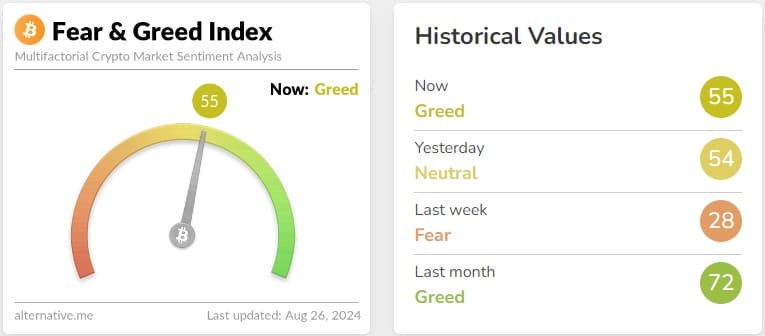
“Since Friday, the crypto market has been in a mood of easy greed, as evidenced by the corresponding index, which reached 55 on Monday, close to levels at the beginning of the month,” said Alex Kuptsikevich, senior market analyst at FxPro. “Market capitalization has also returned to $2.25 trillion, the highest since August 2nd.”
“A decisive breakthrough came on Friday when Fed Chairman Powell supported optimism in global financial markets, tipping the scales in favor of the bulls,” he added. “The cryptocurrency market has managed to overcome the local resistance of the past few weeks and is likely to head towards the upper end of the range, now nearing $2.35 trillion.”
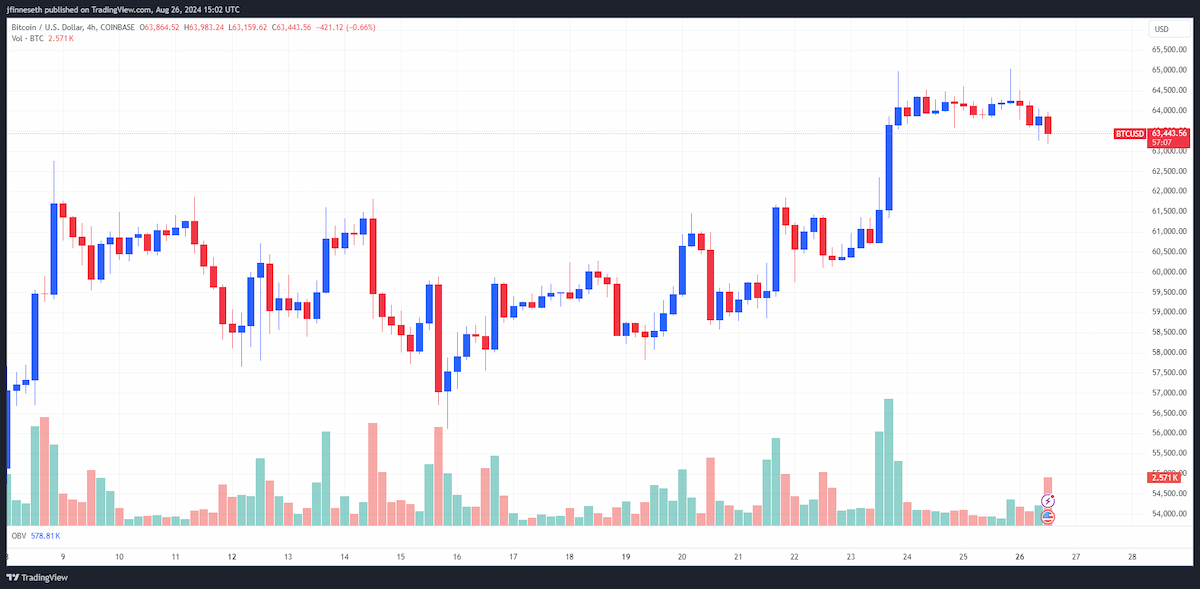
“Bitcoin broke above both its 50- and 200-day moving averages on Friday and briefly touched the $65,000 level on Saturday and Monday morning,” Kuptsikevichv noted. “The bulls will need to confirm this breakout by holding above $63.0K on Monday.”
Data provided by TradingView shows that bears aren’t ready to let bulls rally without a fight and are attempting to slap Bitcoin’s price back below $63,000 in the morning hours on Monday. At the time of writing, BTC trades at $63,336, a decrease of 1.33% on the 24-hour chart.
BTC/USD Chart by TradingView
According to Alvin Kan, Chief Operating Officer for Bitget Wallet, the efforts by bears may be in vain, however, as an uptick in flows into spot Bitcoin exchange-traded funds (ETFs) is putting a solid level of support under Bitcoin’s price.
“The cumulative net inflow of Bitcoin Spot ETFs has reached a record high, which suggests that there is a continuous demand for Bitcoin in the markets, as investors are likely turning to more stable assets,” Kan said in a note shared with Kitco Crypto. “Last week, we also observed an increase in Ethereum’s (ETH) net outflow.”
“The trend reflects investors' confidence in Bitcoin, which will help drive the price of Bitcoin and the stability of the market in the longer run,” he said. “The current overall economic environment is still in a high interest rate state, and Bitcoin’s price breakthrough can only be achieved after the Federal Reserve starts to cut interest rates and the market is fully active. With the increase in capital inflows, the mainstream recognition of Bitcoin is also increasing, further promoting its status as an investment asset.”
Kan said that in the short term, “the Federal Reserve's announcement of potential rate cuts could lead to increased market liquidity, a shift in investor behavior towards riskier assets, and potential volatility due to ongoing geopolitical tensions.”
“In the long run, a decrease in U.S. interest rates could weaken the dollar, reducing its attractiveness of the dollar as a funding currency for carry trades and potentially destabilizing emerging markets that rely on capital inflows,” he added. “At the same time, a weaker dollar could benefit emerging markets by making their exports more competitive.”
“While the short-term effects may be positive, the long-term consequences, particularly for emerging markets, will depend on the interplay between monetary policy, geopolitical factors, and investor sentiment,” he concluded.
“The market is anticipating a rate cut in the September FOMC meeting, but there’s uncertainty over whether it will be a 25 or 50 basis points reduction,” said Alice Liu, lead researcher at CoinMarketCap. “Trader expectations currently show a 65.5% chance of a 25 bps cut and a 34.5% chance of a 50 bps cut.”
“In the crypto market, the initial response to Powell’s speech was positive; however, these gains largely reflect a recovery from the August downturn,” she noted. “Compared to precious metals or tech stocks, crypto still carries higher specific risks.”
“Looking ahead, markets are anticipating nearly 100 basis points of cuts by the end of the year, indicating the possibility of a significant cut in November or December, which contrasts with Powell’s more cautious stance,” Liu said. “Additionally, the labor market is under scrutiny: the ratio of job vacancies per unemployed worker has dropped to 1.2 from a high of 2.0 in 2022, nearing pre-pandemic levels. This suggests that further reductions in inflation could come with increased economic costs as the job market tightens.”
