
(Kitco News) – Bitcoin (BTC) and the broader crypto market trended lower in early trading on Wednesday after the August Consumer Price Index (CPI) report showed headline inflation climbed at its slowest pace in more than three years on an annual basis.
The data from the Bureau of Labor Statistics showed that the CPI increased 2.5% over the prior year in August, falling in line with expectations and below July’s 2.9% annual increase. August’s reading was the lowest annual rate since early 2021.
The month-over-month (m/m) increase was 0.2%, the same as in July, while core prices climbed 0.3% m/m in August and 3.2% over 12 months.
Market watchers had hoped the CPI reading would boost the odds of a 50 basis point cut from the Federal Reserve next week, but following the hotter-than-expected month-over-month increase for core inflation, Wall Street sees a 25 bps cut as more likely. The CME FedWatch Tool now puts the odds of a 50 bps cut at 15%, down from 44% last week.
Bitcoin responded negatively to the development as hopes for easier money had put a bid under the top crypto on Tuesday. But with the market now expecting a 25 bps cut next week, which many analysts say was already priced in, traders who were looking for potential gains following the CPI exited their positions, leading to a Bitcoin sell-off below $56,000.
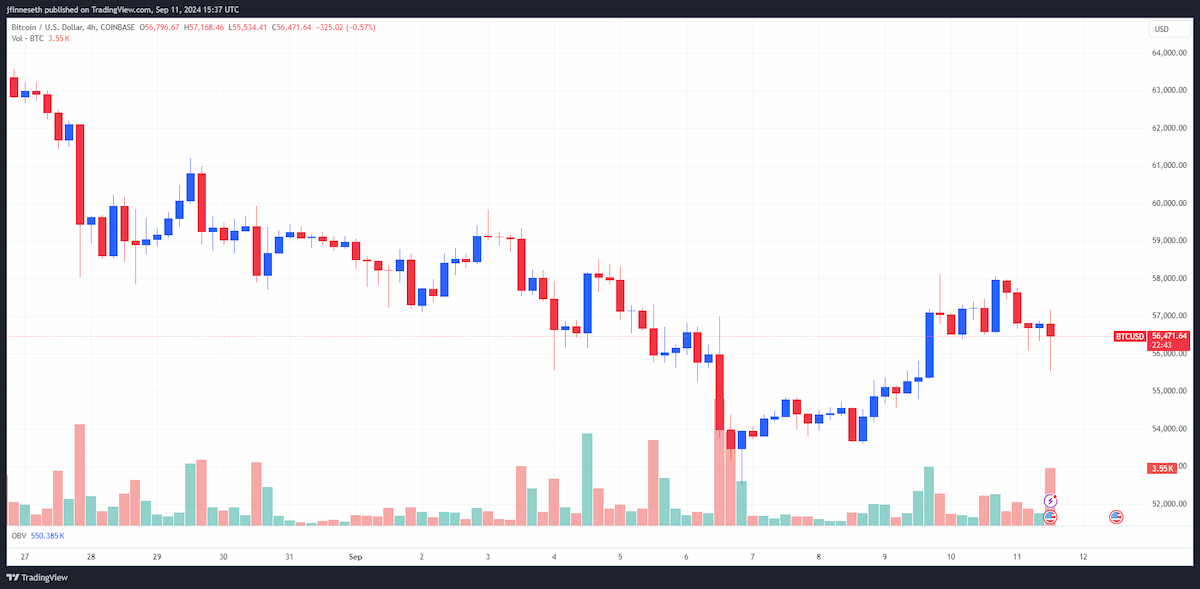
BTC/USD Chart by TradingView
But the pullback is expected to be short-lived as the economy is on the path to rate cuts, with Wall Street expecting at least three cuts in 2024 that will total at least 75 bps.
“With annual inflation cooling down in line with expectations, we could see a recovery of investors’ appetite for risk-on assets like crypto, instigating more flows into Bitcoin spot ETFs, which have been especially quiet over the past week,” said Leena ElDeeb, Research Analyst at 21Shares.
“There are more indicators to look at, especially in the labor market, which would greatly impact whether the Fed will cut rates by 25 or 50 bps,” she added. “The unemployment claims and producer price index coming out on Thursday would give the Fed a more comprehensive picture of where inflation is headed and whether a recession is in the equation.”
For those still calling for a 50 bps cut, ElDeeb said a more aggressive rate cut “would shock the markets, given that it would ring alarm bells for a recession. Investors would trade cautiously to weather market conditions, which could hurt risk-on assets in the short term. However, it doesn’t change the long-term prospects of Bitcoin, whether fundamentally or even in relation to macroeconomics.”
“If the US economy shows more signs of weakness, it may trigger the Fed to expand its balance sheets, which has historically boded well for Bitcoin, which usually attracted more demand for the asset at times of liquidity injections,” ElDeeb noted.
“Inflation data this month comes at a very critical time, with the presidential debate airing last night,” she added. “Although it may act one-sidedly in the short term, Bitcoin is a neutral and bipartisan asset that acts as a hedge against currency debasement, especially for countries suffering from hyperinflation, such as Venezuela.”
Looking at the broader markets, analysts at BlackRock said they expect the volatility seen across markets recently to continue until at least early November amid the ramping up presidential election.
“We could see more volatility flare-ups ahead of the U.S. presidential election,” BlackRock analysts led by Jean Boivin said in their weekly commentary. “We don’t see the Federal Reserve cutting policy rates as sharply as markets expect and go underweight U.S. shortdated Treasuries. We prefer medium-term Treasuries and quality credit.”
“We see multiple factors driving market volatility: resurgent recession fears due to some softer economic data, pre-U.S. election jitters and profit-taking as investors make room for new stock issues,” they added.
“Even as inflation is falling toward the Fed’s target in the near term, higher inflation over the medium term will limit how far the Fed can cut rates, we think,” the analysts warned. “Growth jitters and cooling inflation have driven 10-year yields to 15-month lows as investors have priced in more than 100 basis points of cuts by year-end and about 240 basis points of cuts over the next 12 months – implying a Fed response to a recession.”
“That would take policy rates below our view of the neutral interest rate – the rate at which policy neither stimulates nor holds back growth,” they concluded. “We go underweight short-dated U.S. Treasuries, looking for income elsewhere in developed markets such as short-dated euro area bonds and credit.”
At the time of writing, Bitcoin trades at $56,463, a decrease of 0.92% on the 24-hour chart.
