

(Kitco News) – Cryptocurrency proponents have long referred to Bitcoin (BTC) as digital gold in an attempt to liken the top crypto with the world’s oldest trusted safe haven and store of value in times of strife – but that comparison has been called into question after BTC fell 6% on Tuesday as the conflict in the Middle East escalated.
Bitcoin price fell to an intraday low of $60,300 amid the ramp-up in fighting, while gold surged to $2,673 per ounce as markets reacted to the missile attack.
Jeroen Blokland, founder of Blokland Smart Multi-Asset Fund, noted this divergence on X, suggesting that traders were dumping their BTC for gold as a safe-haven play.
Investors are literally selling #Bitcoin to buy #gold as geopolitical tensions spike. pic.twitter.com/ib7c38K75K
— jeroen blokland (@jsblokland) October 1, 2024
Precious metals analyst Jesse Colombo also used the opportunity to highlight his thesis that cryptos are not a safe haven and instead behave more like risk assets.
Bitcoin and crypto always tank when there are geopolitical fears, unlike precious metals.
That confirms my long-held belief that crypto is not a safe-haven.
It's yet another risk asset just like high-flying tech stocks. $BTC $GLD pic.twitter.com/SBLgLgdpKB— Jesse Colombo (@TheBubbleBubble) October 1, 2024
“We don't need more risk assets!” he said in a follow-up post. “We're in a huge bubble with more risks assets than you can shake a stick at and new ones each day. We need more safe havens, but there is a very fixed supply of those: gold and silver.”
The most direct attack on Bitcoin’s perception as digital gold came from GoldSeek’s Peter Spina, who said, “Yesterday was another demonstration that the ‘digital gold’ narrative for #Bitcoin is an utter failure.”
Yesterday was another demonstration that the "digital gold" narrative for #Bitcoin is an utter failure.$BTC peaked in 2021 against real money, -42% since peak.
Still an excellent window to get into precious gold + silver before the crowd figures out they hodl gambling tokens! pic.twitter.com/rYHeIgHGmf— Peter Spina ⚒ GoldSeek | SilverSeek (@goldseek) October 2, 2024
Crypto proponents were more than happy to weigh in on the subject.
JAN3 founder Samson Mow pushed back against Blokland’s post, saying, “Imagine trying to hedge against war by selling #Bitcoin to buy paper gold that you can’t move anywhere in the event of actual war.”
Influencer “moneyordebt ∞/21M” also weighed in on the chart, suggesting that “Gold is a short term risk hedge; #Bitcoin is the long term risk hedge.”
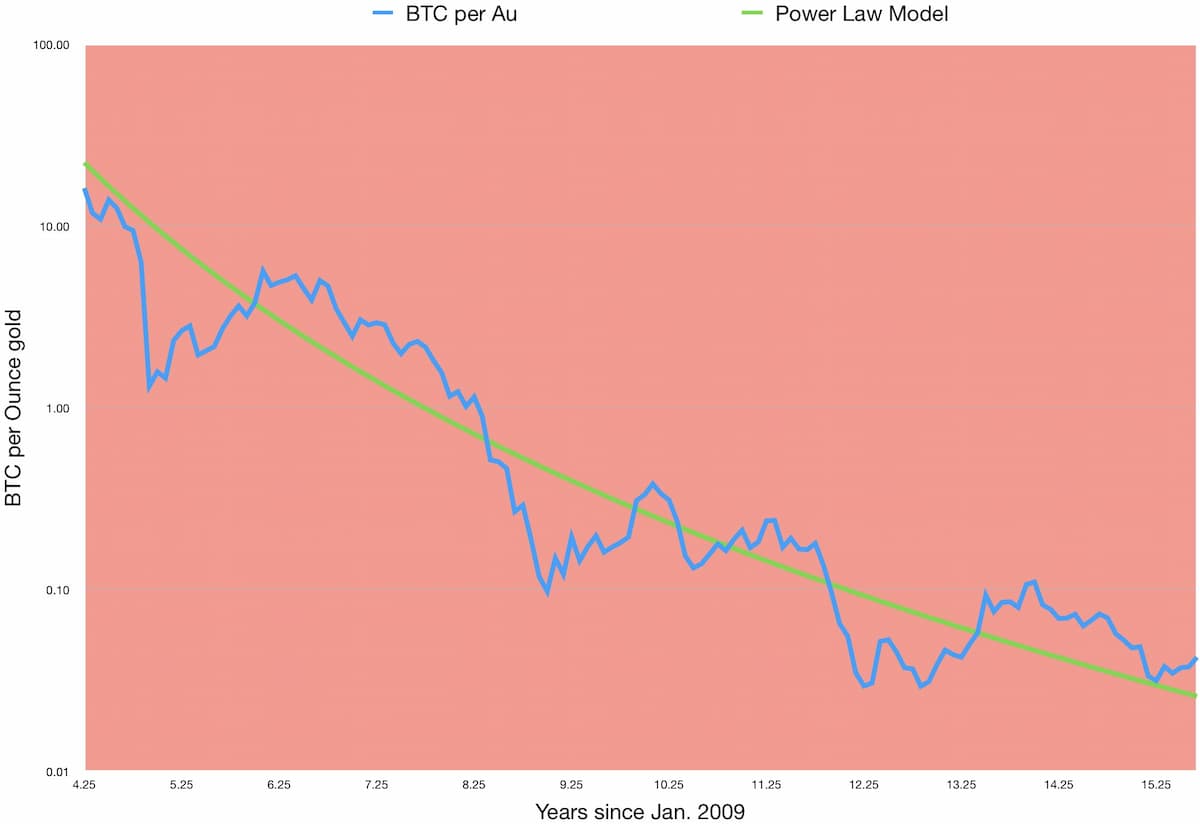
“The decline and fall of gold AU/BTC power law with a negative index,” moneyordebt highlighted.
Interestingly, a post from the Blokland Fund X feed offered up the following data table from BlackRock, which shows that Bitcoin has, overall, performed the best through the various geopolitical events in recent years.
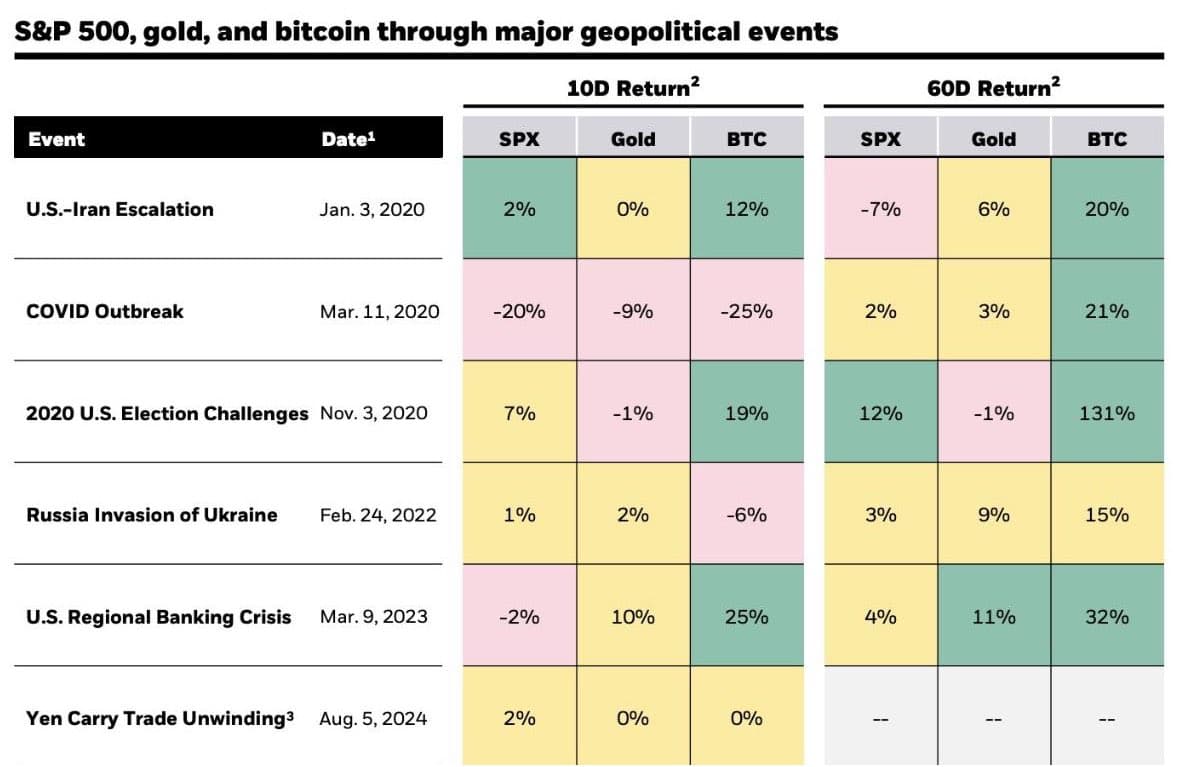
“While #Bitcoin is undoubtedly a high-#volatility, #liquidity-driven asset class relatively sensitive to overall market #sentiment, its #diversification benefit during recent geopolitical events looks way better than many investors expect,” Blokland Fund said. “Interesting data from Blackrock.”
Jeroen Blokland reposed this tweet in response to his original post, asking, “Another #Bitcoin geopolitics test?”
While the Bitcoin v. gold debate continues to rage, cooler heads highlighted that crypto and precious metals traders are focused on the wrong enemy, noting that it’s central banks and non-stop fiat printing that are the real issues.
Fiat is Fake money. Trade it for sound money of all types & real assets as fast as you can. They are stealing from you. They will never stop. H/T @GoldTelegraph_ for chart. #gold $BTC #Silver https://t.co/Hw7JCSrz6N pic.twitter.com/buT77kwcsJ
— Steve Mueller (@SilverCrisis405) September 24, 2024
Market analyst Mark Hubbard suggested that each serves a different purpose. “$BTC coming down: it doesn't like geopolitical risk at all. $Gold is up,” he tweeted. “So, buy BTC against liquidity and fiat printing. Buy gold against geopolitical risk. (For record, money printing is the future).”
And while many make it seem like Bitcoin and gold are in a constant battle for supremacy, Bitcoinsensus noted that they have both helped protect investors over the past year and have enjoyed a correlation of 85%.
During the last year, the correlation between Bitcoin and Gold has been quite high consistently, at around 85% of correlation. pic.twitter.com/S62R0x0I5P
— Bitcoinsensus (@Bitcoinsensus) October 2, 2024
Bitwise CIO Matt Hougan provided the best answer as to why the debate is really more of a comparison between apples and oranges, ultimately saying that the decision comes down to what type of investors each person is and what they are looking for.
“At a conference last week, a $10 billion financial advisor asked me a simple question: Bitcoin or gold?” Hougan wrote in his latest Weekly CIO Memo. “He was worried about the long-term outlook for the dollar and wanted a hedge. But which?”
“With the Fed aggressively cutting rates and China pumping out economic stimulus, it’s a good question, and one many are asking right now,” he said. “I thought I’d address it head-on.”
“Bitcoin and gold are similar in important ways,” Hougan said. “Principally, both are forms of money that are free from government interference. Jerome Powell can print all the dollars he wants, but he can’t create more gold or change Bitcoin’s supply cap of 21 million.”
“But the two assets have key differences, too,” he noted. “Bitcoin is less established and more volatile than gold, but it’s also easier to send, store, and divide. When you consider the role each asset can play in a portfolio, you see the same dynamic: Bitcoin and gold are similar but distinct. Both are liquid alternative assets that historically have demonstrated low correlations to stocks and bonds.”
Hougan provided several charts, with one showing the impact of adding 1.0%, 2.5%, and 5.0% Bitcoin to a traditional 60/40 stock/bonds portfolio, and another showing the same for similar allocations to gold. He highlighted that “adding either to a traditional portfolio has enhanced risk-adjusted returns over the past decade. (Of course, past performance is no guarantee of future results).”
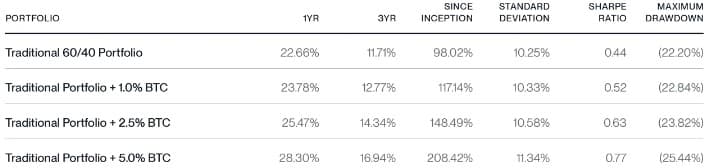
Hougan said the choice between BTC and gold comes down to choosing between “more return or less risk.”
“Look at the ‘Since Inception’ column,” he said. “Historically speaking, as you add more and more Bitcoin, the portfolio’s total return rises dramatically. The same is true for trailing one-year and three-year returns. Now look at the Standard Deviation column: It barely moves! According to the simulation, a 2.5% allocation to Bitcoin would have boosted the portfolio’s return 50 percentage points, from 98% to 148%, while the standard deviation would have risen just 33 bps.”
“Contrast that with what happens when you replace Bitcoin with gold,” Hougan said. “As the table below shows, there is almost no effect on return: Over the full 10+ years of the study, a 2.5% allocation to gold would have boosted the portfolio returns by just 1%! Where gold does have an impact, however, is on the volatility side (check the Standard Deviation column again), which falls as you add more and more gold to the mix.”
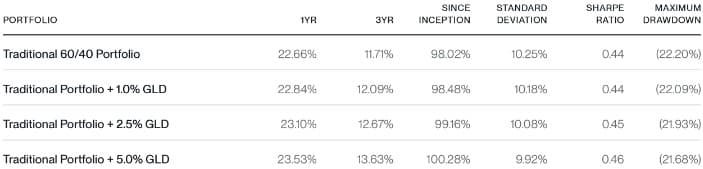
“Each asset tells a story of trade-offs,” he said. “More returns for essentially the same risk? Look to Bitcoin. Basically, the same returns for less risk? Look to gold. Both are great outcomes, but they are critically different. Which you choose depends on your personal circumstances.”
As for investors who say to invest in both to get the best of both worlds, Hougan said that sadly, “There is no free lunch here.”
“The table below compares three possibilities: A portfolio enhanced with 5% gold, 5% bitcoin, and a 5% split between the two (2.5% gold, 2.5% bitcoin),” he said. “The split portfolio is about what you’d expect: When it comes to risk/return metrics, it basically splits the difference between the 5% gold and 5% BTC portfolios.”
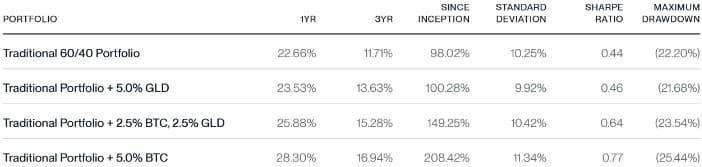
“Probably the biggest thing this table makes clear is just how much bigger an impact Bitcoin has than gold at equal allocation sizes,” Hougan noted. “Look at the swing in the Sharpe ratio between the 5% GLD and 5% BTC portfolios – gold barely moves the needle, while Bitcoin smashes it.”
“Given all that, what’s the answer to the advisor’s ‘bitcoin or gold’ question?” he asked. “One answer might be, ‘It depends on your risk tolerance, and whether or not you prefer a similar return at lower volatility or a much higher return with similar volatility.’ That would be accurate and supported by the data.”
“But there's a different, far simpler answer I'd give if I were speaking for myself and looking at those Sharpe ratios: ‘Bitcoin,’” Hougan concluded.
