
(Kitco News) – Precious metals investors embarked on another wild ride this week, as downbeat U.S. data and escalating trade tariff threats combined to drive gold prices to fresh all-time highs.
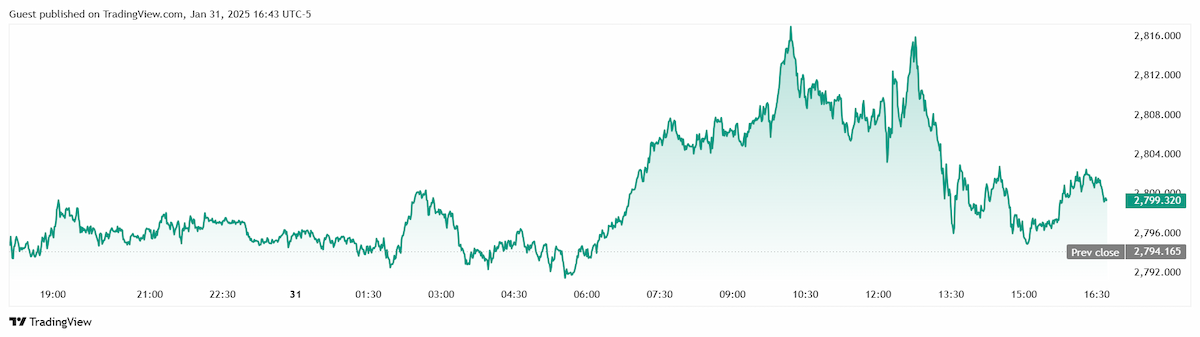
Spot gold kicked off the week trading at $2,770 per ounce, but the North American open saw the yellow metal driven down to $2,740 in short order, and by noon Eastern, spot gold was trading at $2,731 per ounce.
This proved to be the weekly low, however, as gold prices quickly returned to the $2,740 range, a level that held despite multiple retests on Monday.
Tuesday morning saw gold prices rise to the mid-2760s, whereupon the market sat back for the most part and waited for Wednesday afternoon to see what the Federal Reserve would say and do. The central bank held rates as expected, and also signaled that further rate cuts were unlikely given persistent inflation and robust labor data, driving spot gold back down briefly to $2,745 per ounce. But gold recovered quickly, and by 3:30 am Thursday morning spot gold had set a fresh weekly high above $2,772 per ounce.
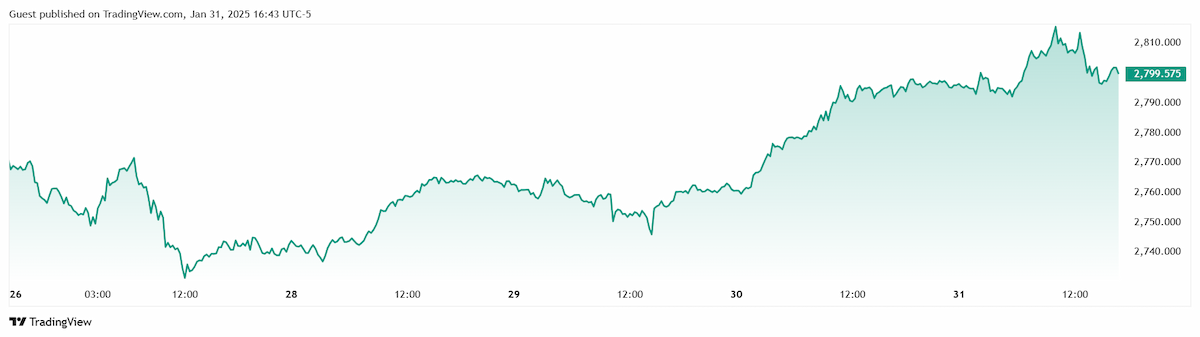
The release of significantly weaker-than-expected GDP data for December was the next catalyst for prices, driving gold to the edge of $2,800 per ounce multiple times during Thursday’s trading, a level it ultimately reached at 2:15 a.m. Eastern.
Friday morning saw the ratcheting up of trade war chatter, with conflicting reports which saw gold prices ultimately reach a new all-time high of $2,817.21 per ounce shortly after 10:00 a.m. Eastern, and after setting a double-top at this level just before 1:00 p.m., prices slid back to trade around $2,800 per ounce for the duration of Friday's trading session.
The latest Kitco News Weekly Gold Survey showed industry experts maintaining their bullish posture on the yellow metal, while an identical proportion of retail traders also saw further highs in gold’s near-term future.
“I am bullish on Gold for the coming week,” said Colin Cieszynski, chief market strategist at SIA Wealth Management. “It has just completed a period of consolidation and has broken out to new all-time highs. Technically, it appears to be starting on a new upleg. What is particularly interesting is that Gold is showing strength even against a strong USD.”
“Up,” said Adrian Day, president of Adrian Day Asset Management. “Gold is particularly strong in recent weeks on concerns about U.S. tariff policy. Even though the tariffs will likely be less draconian than the fears, nonetheless, the concerns that have driven gold over the past two years are not going away.”
“My gut says down on profit-taking… but I will say up,” said Rich Checkan, president and COO of Asset Strategies International. “Whether it is blown out of proportion or not, the news of the shortages of gold in London combined with the tariffs from President Trump and the stickiness of inflation referenced by the FOMC last Wednesday will all conspire to nudge gold higher still.”
“Up,” said Darin Newsom, senior market analyst at Barchart.com. “The uncertainty being created intentionally by the new US administration isn’t going away any time soon. In fact, it is safer to say it will only get worse. Given this, the more interesting discussion is if we can call it Chaos given we know it is going to happen, but we don’t know what ‘it’ might be.”
“Every day brings something new, just as it did during the US president’s first time in office,” he added. “It took a while for markets and media to grow numb and block out the noise. Until then, look for gold (and silver, precious metals in general) to continue to see safe-haven buying despite the market already moving to new all-time highs.”
Daniel Pavilonis, senior commodities broker at RJO Futures, was unpacking the near-term catalysts that sent gold shooting higher this week.
“I think it was a sharp selloff in rates and the dollar, even though the dollar seems to be getting a little bit stronger, but still well off its highs,” he said. “And then the possibility of tariffs may be increasing inflation, tariff war with Canada, tariff war with Mexico, possible tariff war with China. So we're starting to see some more flight quality into the [gold] market. The market is just really bullish, any little reason to get longer in gold, looking for that ultimate target of $3,000. It feels close now. I think psychologically, it's a magnet, and any little thing helps right now in the news.”
On the other hand, Pavilonis doesn’t see this week’s Federal Reserve rate hold and statement as having been very impactful as far as gold is concerned.
“I think the gold market expects inflation for longer,” he said. “They're looking for the 10-year inflation rate compared to the 10-year yield to narrow a little bit. But the impact from higher tariffs, trade wars, currency issues that are culminating because of tariffs, and everything else… it's just flight to quality into gold. And I think you're seeing central bank buying along with retail buying, and the volatility seems pretty reasonable.”
“Another thing that's happening too is people are buying options,” Pavilonis said. “And it's forcing market makers to buy more futures to hedge, as we get higher and we get those far out of the money calls start to happen. I think there's several different things going on. But gold seems to be, I think, a big barometer of how much faith money has in the global economy, but also global trade and anything that can come out of it.”
“Trade wars sometimes lead to shooting wars,” he warned. “Maybe that's playing a part in it too.”
Pavilonis believes that even if and when the tariffs are resolved, the major drivers that have propelled gold to new all-time highs over the past few years will continue. “I think we see $3,000 by the end of the quarter,” he said. “Depending on how the tariffs play out, I could also see a situation where we see some profit-taking and we come back down to maybe, $2,750, somewhere around there, maybe the 50-day moving average, or 100-day moving average, and then we could see it rebound again.”
“What's driving gold is not going to change, unless you see some situation where it gets too out of hand and then you see the exchanges come in and start raising margins through the roof, and then you start to see a washout because of that,” Pavilonis added. “But I still think there's a lot of ups and downs because even if the tariffs are renegotiated, it's going to take time. There's going to be a lot of noise that would drive this thing still. It's not going to happen overnight.”
“But it also has the potential for this to scale from retaliatory tariffs that turn to kinetic fighting, things start to happen, mistakes happen, and this stuff can also drive gold prices higher.”
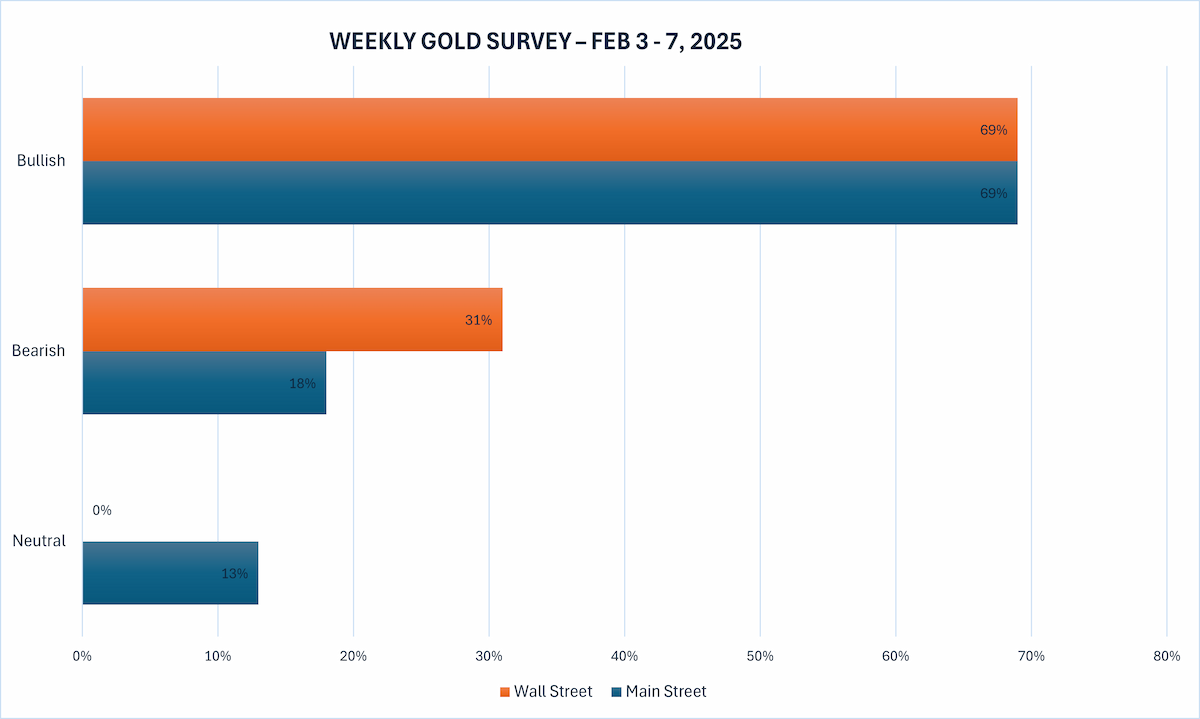
This week, 13 analysts participated in the Kitco News Gold Survey, with a strong majority predicting higher gold prices in the coming days, though not as many as last week’s high watermark for sentiment. Nine experts, or 69%, expect to see gold prices climb even higher than this week’s records during the week ahead, while four analysts, or 31%, predicted a price decline for the precious metal. No one saw stability or consolidation for gold next week.
Meanwhile, 147 votes were cast in Kitco’s online poll, with Main Street investors just as bullish as the experts. 101 retail traders, or 69%, looked for gold prices to rise next week, while another 27, or 18%, expected the yellow metal to trade lower. The remaining 19 investors, representing 13% of the total, saw gold trending sideways in the near term.
After this week’s economic calendar was dominated by central bank rate decisions and inflation data, markets will turn their attention to the labor market next week with the release of December’s nonfarm payrolls report on Friday.
Gold traders will also have plenty of other market-moving data to watch, including the Monday release of ISM Manufacturing PMI, Tuesday’s U.S. JOLTS Job Openings, ISM Services PMI, and the ADP employment report on Wednesday, the Bank of England’s monetary policy decision and U.S. weekly jobless claims on Thursday, and Preliminary University of Michigan Consumer Sentiment for January on Friday.
“I had anticipated the move to record highs in gold but for different reasons,” said Marc Chandler, managing director at Bannockburn Global Forex. “With the US tariff threat, and the uncertainty that it represents, gold may have some additional near-term potential. Maybe $2820 or so, but I suspect US 10-year rates are at the lower end of the range, and higher rates, perhaps helped by the US supply concerns around next week’s quarterly refunding announcement, may sap some strength from the yellow metal. Trendline support is near $2755, but I suspect bids will emerge before then.”
“I do not make much of the bullion transfers to the U.S. from Europe,” Chandler added. “It may impact US trade balance, but the purpose seems to be to beat US tariffs and says little about the value/price of gold.”
Adam Button, head of currency strategy at Forexlive.com, believes Trump’s tariff threats will ultimately prove to be a bluff, and the market will breathe a sigh of relief when the deadline is extended by Monday.
“I think it's pretty clear that they'll declare victory no matter what,” he said. “The main thing is the U.S. Constitution gives Congress the power [over trade], and then you'd have to pass a new law. The law's pretty clear that it has to be a genuine emergency, and there's no way this qualifies. And then the courts are just going to block it. And it's such a stupid case to try it on, because if they block Canada, then you lose the stick. The stick they carry is tariffs, and then other countries can just say, ‘You don't have the power to put tariffs on us.’ Especially the allies.”
The other reason Button believes this is all a bluff is that Trump is still changing the severity and scope of the tariffs on a daily basis. “If you had a plan to put on tariffs, you'd have a plan by now,” he said. “He wouldn’t be saying yesterday, ‘Maybe I'll put it on oil, maybe I won't.’ The guy's just shrugging off everything, it's obvious he's bluffing. He talks like that, but then he doesn't do it, which is the classic Trump.”
Button believes all the tariff bluster only serves to set the stage for a renegotiation of USMCA, the trade deal Trump himself negotiated with Canada and Mexico during his previous term.
“The problem is it's July 1, 2026 when you have to give notice that you want out [of USMCA, to review it,” he said. And then there's a six-month period of renegotiation, which takes you to the end of 2026. What happens in November 2026? Midterms. So, that negotiation period would go right over the midterms. So you can't put on tariffs at that point, and the whole thing starts to fall apart if you end up in a tariff war in, like September, October, November 2026 because Canada and Mexico have a lot of leverage to hit back during the midterms, and then you lose Congress.”
“He wants to do it this summer instead. The ask is only going to be to move up USMCA negotiations to this summer.”
Another possibility Button sees is that Trump could announce the tariffs but add a two-week or one-month implementation period.
“So he announces it Saturday, he doesn't call it off Sunday, but calls it off in two weeks,” he said. “So you do want to crawl through that valley over the next two weeks, or a month, 90 days even, before you come out to the other side? And that's just keeping the pressure on. So if Canada says no renegotiation, you say, okay, the tariffs are going on then, but we're going to have, two weeks until we can put it on, or 90 days, or whatever. But then the courts can start to get involved, and I think that's Trump's risk.”
“So that's why I think it's all over by Sunday,” Button said. “I think we could have a Colombia thing, where it's announced Saturday, called off Sunday. That's probably my base case.”
All this chaos has been good for gold prices, and Button sees this continuing in the medium term, though he expects the yellow metal to take a step back in the short term.
“People love gold when there's uncertainty,” he said. “We already knew that, but all the flight to gold, and physical gold, and has again proven it. This is a strange episode of uncertainty that really underscores the case for gold.”
“That said, I think we're at a short-term peak in tariff worries, and that should be a short-term peak in gold,” Button said. “It can fall back down to $2,750, $2,700, but it's not going away. The dips are to be bought.”
“I am bearish here,” said Michael Moor, Founder of Moor Analytics. “In a higher time frame: we are still in an overall bull trend from November 2015, and likely in the later stages. Part of this is a prediction I made of $151 minimum, $954 (+) maximum from $2,148.4 – of which we have attained $714.5 so far. This is ON HOLD.”
“On a lower time frame, the trade above 27041 (-.6 of a tic per/hour) has brought in $158.8 of strength,” he said. “The trade above 27247 (-.6 of a tic per/hour) projected this upward $55 minimum, $235 (+) maximum — we have attained $138.2. These are ON HOLD.”
“I noted that we are likely in yet another 'last stretch' of the move up from 16183, with areas of possible exhaustion at 28721 – we came just shy of this today with a 28629 high and started to roll over,” Moor noted. “The break back below 28519 (+3.5 tics per/hour) now warns of decent pressure. Decent trade back above where this comes in at 28527 (+3.5 tics per/hour starting at 1:30 pm) will take bullish calls OFF HOLD. Decent trade below 28252 (+2.5 tics per/hour starting at 1:30 pm) should bring in additional pressure.”
“Double top in gold,” warned Mark Leibovit, publisher of the VR Metals/Resource Letter. “Look for a pullback. Seasonal high also due.”
At the time of writing, spot gold last traded at $2,799.42 per ounce for a gain of 0.20% on the day and 1.25% on the week.