
(Kitco News) – Gold saw another standout week of price action as the impact of ongoing tariff threats combined with rising inflation fears drove investors to the yellow metal.
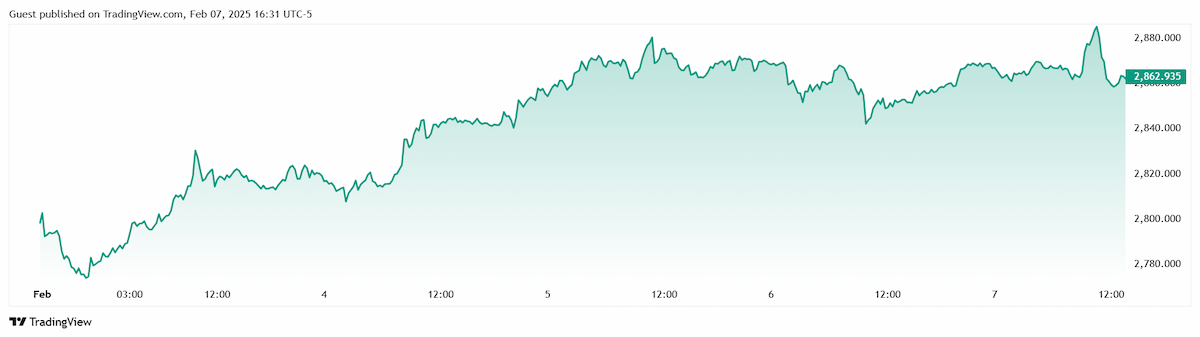
Spot gold kicked off the week trading at $2,797 per ounce, and after a quick spike up to $2,802, prices slid down to what proved to be the weekly low of $2,774 per ounce just before 11:00 p.m. EST on Sunday evening.
But the precious metal’s weakness would prove short-lived, as gold prices rose through the Asian session, and broke back above $2,800 per ounce by 6:00 a.m. Eastern. The North American open saw gold prices deliver their first sharp spike of the week, with spot gold rising from $2,814 per ounce just before trading began to $2,830 15 minutes after the open.
Tuesday morning saw a similar move, with gold trading around $2,816 at 7:00 a.m. Eastern, before spiking up to a fresh weekly high of $2,843 per ounce by 10:00 a.m. This time, the yellow metal also made a sustained move higher during the Asian and European sessions, and by Wednesday morning, spot gold was already trading at $2,867 per ounce, with North American traders driving it to a new nominal high of $2,880 just before 11:00 a.m.
This high held through Wednesday and Thursday, with gold pulling back to retest support at $2842 on Thursday morning.
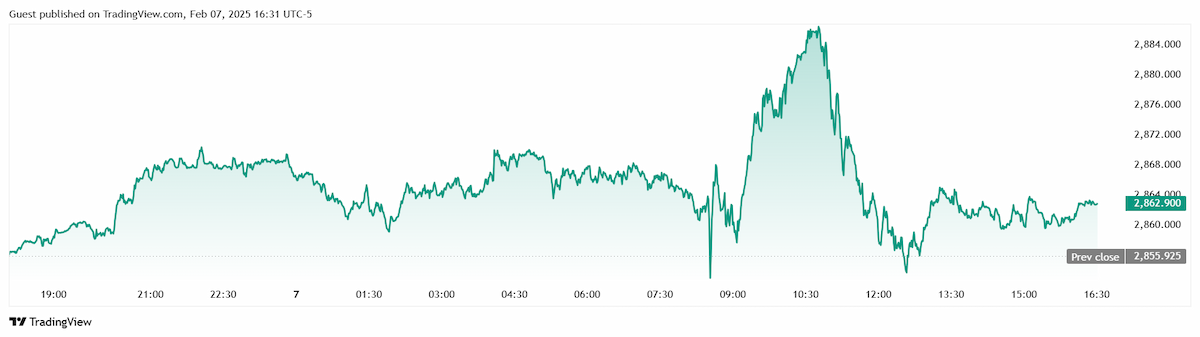
But Friday brought renewed drama to precious metals markets with the release of January's non-farm payrolls report, driving spot gold from $2,862 per ounce all the way to a new all-time high of $2,886.85 following the release of the University of Michigan consumer sentiment survey, which showed one-year inflation expectations rising a full percentage point in just one month.
The fresh peak proved unsustainable, however, as spot gold returned to the $2,860 area by noon Eastern, whereupon it trended sideways in a narrow $5 range for the duration of the North American trading session.
The latest Kitco News Weekly Gold Survey showed industry experts as bullish as they’ve ever been on the yellow metal, while retail traders also saw further gains in gold’s near-term future.
“Up,” said James Stanley, senior market strategist at Forex.com. “As of right now, spot gold has just pushed up to a fresh all-time high. While something like that is difficult to chase, I think it’s even more difficult to fade it as there’s no signs yet that the run is over. I still like gold prices higher.”
“Neutral, as we are in a cyclical topping area,” said Mark Leibovit, publisher of the VR Metals/Resource Letter.
“I remain bullish on Gold for the coming week,” said Colin Cieszynski, chief market strategist at SIA Wealth Management. “It’s building nicely on its recent breakout.”
“Up,” said Adrian Day, president of Adrian Day Asset Management. “Momentum with gold as the drivers of the gold price over the past year remain intact. Soon, we will need a pause and consolidation, but perhaps not yet.”
“Higher,” said Rich Checkan, president and COO of Asset Strategies International. “The trend is your friend, and I clearly underestimated that last week. The volatility and fluidity of the first few weeks of the new administration here in the U.S. is absolutely driving investors to take safe haven positions in gold. That should continue.”
“Up,” said Darin Newsom, senior market analyst at Barchart.com. “We can throw out all the analysis we think we know, meaning fundamental, technical, seasonal, etc., and focus on the fact the world is more unstable these days. With nonsensical and potentially dangerous thoughts said and shared by the US administration nearly every day, investors are likely to continue buying precious metals as a safe-have hedge against other market sectors. I don’t think it matters if gold is already at all-time highs. I also don’t see this situation changing any time soon.”
John Weyer, director of the commercial hedge division at Walsh Trading, was looking at gold’s dramatic move on Friday morning, but also the broader move higher amid the swirling geopolitical uncertainty.
“With tariff talk and inflation, gold remains a safe haven play,” Weyer said. “Since biblical times, gold is a safe haven. In times of uncertainty, I don't mean bad, and you can see the way tariff talks have gone last week and a half there's more [tariff] uncertainty: on, off, who's got them, and when they're going to take effect.”
Weyer said that after recent inflation reports, some people have thrown around the idea that the Fed may actually decide to hike rates.
“I just think they can't do it,” he said. “From a principal perspective, they can't be moving them higher, lower, hike, cut, you can't play a ping pong game with it. But as soon as this came out, I saw people on TV and elsewhere saying a rate hike is in play to combat inflation. It doesn't make sense to me. I don't think they go that route. But, there may be some sentiment here that they might do something.”
Weyer said spot gold’s spike to a new high of $2,886.85 shortly after the release of Friday’s consumer sentiment data was just a short-term move followed by a retracement, but the overall trend is still upward.
“It's an intraday event, is the way I'm looking at it right now,” he said. “But I think we're going to continue to creep higher. $3,000 has got a little psychological, a little technical momentum to that area. Not saying we can't have pullbacks down to $2,700 or even lower, but I think until we get the idea of, I don't mean stability, but a little more confidence in where the economy is going to be and parameters for an economy, you're going to see people go to gold, which will continue to keep it up.”
Turning to the broader impact of the tariff threats, Weyer said that even though it’s impossible to accurately gauge the chances of their implementation, the markets are forced to take them seriously.
“We looked at [agriculture] markets earlier in the week, where we sold off big,” he said. “Then there's the news they're going to be delayed, and the rally, so I think they're treating them as real. If they thought they were going to be at those [25%] levels, maybe they’d be a lot higher, but I think they're definitely being treated as real throughout the market, and until further notice, that they will be happening.”
“I don't know if anything was gained or lost by kicking them down the curb,” he added. “I don't know that we got anything from anyone that they weren't already doing. But I think the market is treating this as real.”
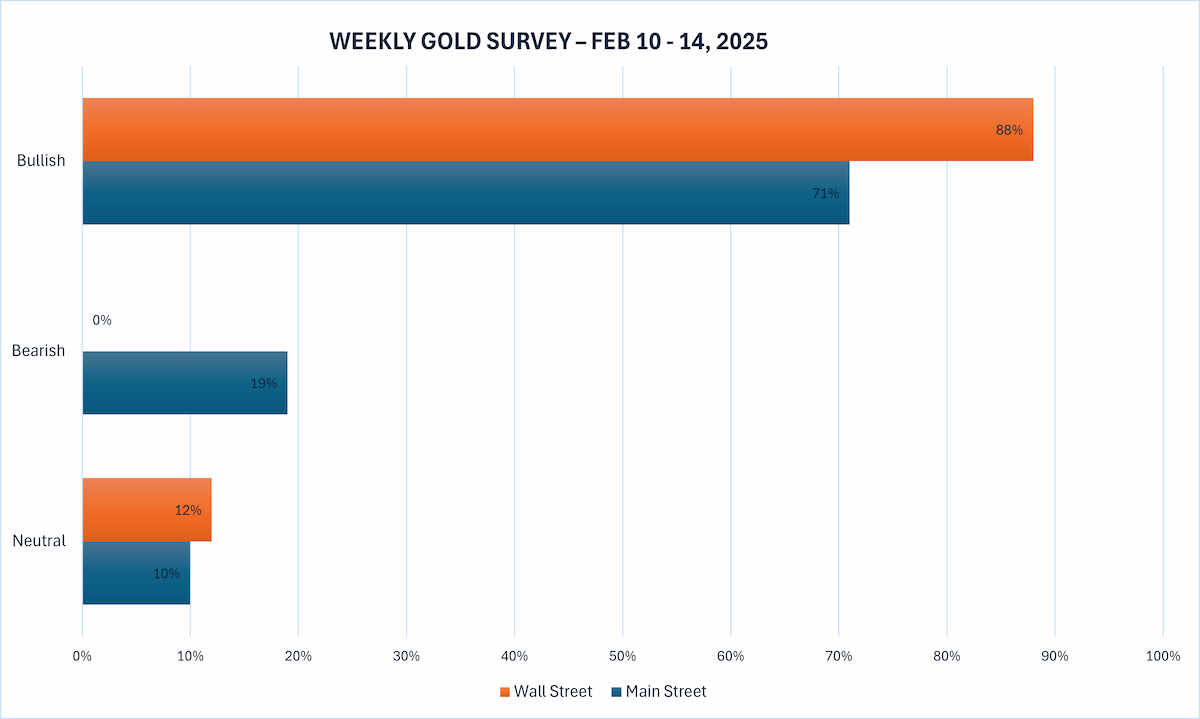
This week, 17 analysts participated in the Kitco News Gold Survey, with the bearish camp completely deserted as all respondents saw gold prices either rising or treading water. 15 experts, or 88%, expect to see gold prices set new nominal record highs during the week ahead, while two analysts, or 12%, saw stability or consolidation for gold next week. No one predicted a price decline for the precious metal.
Meanwhile, 170 votes were cast in Kitco’s online poll, with Main Street investors also very bullish, though not to the same degree as the experts. 120 retail traders, or 71%, looked for gold prices to rise next week, while another 33, or 19%, expected the yellow metal to trade lower. The remaining 17 investors, representing 10% of the total, saw gold trending sideways in the near term.
After Federal Reserve Chair Jerome Powell delivered a staid and steady post-FOMC press conference last week, markets will likely be in for a dramatic dialogue next week as the central bank head testifies before the Senate Banking Committee on Tuesday and the House Financial Services Committee on Wednesday.
Gold traders will also be paying attention to the Wednesday release of U.S. CPI for January, U.S. PPI and weekly jobless claims on Thursday, and the January retail sales report on Friday.
“I still like gold higher,” said Marc Chandler, managing director at Bannockburn Global Forex. “But it could pull back in the coming days as the US jobs and then CPI underpin the US dollar and rates. Still, what are seen as destabilizing US policies may continue to see central bank purchases. Before the weekend, China reported the PBOC bought gold for the third consecutive month after taking a six-month hiatus. A pullback below $2850 may offer a new entry opportunity.”
Kevin Grady, president of Phoenix Futures and Options, was weighing the implications of the latest inflation data on the Federal Reserve’s rate trajectory.
“We're in a position where there's still inflation, and it's sticky inflation,” he said. “[Trump] has been in for two weeks, and he's trying to address some of these concerns, but it takes a little time to get them done. But right now, I don't see them being able to sustain a long-term rate-cut plan. And I see a lot of people looking at that.”
“In all honesty, if you look at where the economy is right now, I think the prudent thing is to stay put, just to sit where they are for right now.”]
Grady said the massive demand for physical gold in the United States to get ahead of possible tariffs is continuing to distort both the physical and the paper markets.
“Right now, there's just a disconnect between what's happening in New York and what's happening in the spot market,” he said. “And people are trying to move metal around and people are nervous about what's going on. Unfortunately, it's difficult to answer those questions because we don't know how it's going to roll out. We don't know if anything's going to change. So all you can do, especially as a trader, is trade with the information you have immediately.”
“These people are saying, ‘I think if he does, this is what's going to happen, in the long term, and we would need to have metal in the United States, so we're not going to be subject to these tariffs. But, that being said, we don't want to do a deal and then have to pay a lot more for the deal when the tariffs come down, so we're going to start baking that into our pricing.’ I think that's what people are trying to do.”
All of this adds up to a very bullish scenario for gold prices in the short, medium and long term.
“My short-term answer for the price of gold is I'm bullish next week,” Grady said. “The other thing is, I did think that the first quarter we were going to be hitting $3,000 in gold. I don't see a reason why that would change. I think it looks like the market wants to go higher.”
“There's a lot more reasons, it's not just this,” he added. “It's not like gold was trading at $1,000 and this happens and all of a sudden, the price spikes. We had a lot of underlying buying from central banks that we've been talking about for the last year or so. We kept saying on every dip, there’s buyers under the market. That shows you we’re strong, so it is bullish.”
“What happened is you put this [tariff] situation into a bullish market,” Grady said. “It wasn't like it was a flat market, and it's not like gold is rallying just because of this. Gold was rallying in and of itself, because of its own dynamic. Now you're adding this in, and I think it's going to give you higher prices because of the uncertainty.”
“Higher,” said Adam Button, head of currency strategy at Forexlive.com. “Gold is proving to be stronger than Teflon. Relief on tariffs and a variety of environments for both stocks and bonds haven’t been able to dent the gold rally. Eyes are on China now.”
“I am overall bullish here, but the break back below 29060 is currently bringing in pressure within,” said Michael Moor, Founder of Moor Analytics. “In a higher time frame, we are still in an overall bull trend from November 2015, and likely in the later stages. Part of this is a prediction I made of $151 minimum, $954 (+) maximum from $2,148.4 – of which we have attained $762.2 so far. This is OFF HOLD.”
“On a lower time frame, the trade above 27041 (-.6 of a tic per/hour) has brought in $206.5 of strength,” he said. “The trade above 27247 (-.6 of a tic per/hour) projected this upward $55 minimum, $235 (+) maximum — we have attained $185.9. These are OFF HOLD.”
“I warned we may be in the last stretch up from the 16183 low in November of 2022, with possible exhaustion at 29627-936,” Moor noted. “Decent trade below 28419 (+3.5 tics per/hour starting at 12:20 pm) should bring in pressure.”
At the time of writing, spot gold last traded at $2,862.90 per ounce for a gain of 0.24% on the day and 2.18% on the week.