
(Kitco News) - Silver continues to struggle below $33 an ounce as global recession fears weigh on the precious metal’s industrial consumption; however, one Canadian bank expects that one sector will remain an important driving force for silver.
Commodity analysts at BMO Capital Markets said the solar power sector will continue to play a dominant role in the silver market as global demand for cheap renewable energy continues to grow. Silver is a key component in photovoltaic solar panels.
“Our analysis suggests that this will keep silver in deficit for the foreseeable future, with the market balanced by flows from the investor space to the industrial space. Recent positioning data suggests a new psychological floor around the $30/oz mark, which we believe will persist while the market remains in deficit,” the analysts said.
According to BMO estimates, the solar sector is expected to consume 246 million ounces of silver, an increase of 5.5% from 2024. Next year, solar-sector silver demand is expected to peak at 261 million ounces. For comparison, 203 million ounces are expected to be consumed in the jewelry sector this year, and investment demand is expected to total 234 million ounces.
The growing solar power sector has completely transformed the silver market. Ten years ago, only 54 million ounces of the precious metal were used in solar panels.
“Despite struggling to capture the imagination of the investor space in recent years, solar energy continues to be a major bright spot in the global industrial economy, with market growth seemingly limited only by how quickly projects can be physically connected to power grids. We expect this trend to persist in a more trade-protectionist world, with policymakers enticed by the prospect of cheap, clean energy likely turning a blind eye to Chinese dumping,” the analysts said in the report.
BMO analysts noted that since 2016, the International Energy Agency has significantly underestimated the growth of solar power. The Canadian bank noted that since 2011, solar capacity has grown at a compounded annual growth rate of 20%. There are expectations that this growth rate will be sustained through 2030.
The analysts noted that China continues to dominate the marketplace, driving the costs of solar panels down sharply. Although nations like the U.S. have placed significant tariffs on Asian solar panels, BMO said that falling solar power costs are too enticing for the rest of the world.
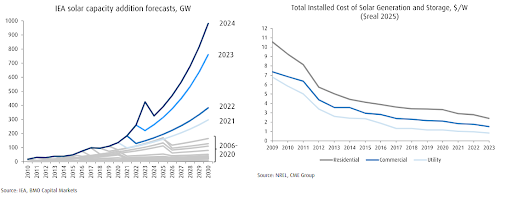
“While some countries (notably the U.S.) will seek to counter Chinese cell dumping to support local industry, we expect that the opportunity to rapidly expand clean energy generation with limited upfront capex will be too enticing to resist for most of the world,” the analysts said. “As such, we see solar as a market that is effectively not demand-constrained for the foreseeable future.”
BMO said that the only limiting growth factor for the solar sector is the bottleneck around infrastructure. The analysts said that solar power can’t be connected to national grids fast enough.
“In the U.S., for example, the total capacity of solar and battery projects awaiting connection is almost double the total operating energy generation capacity in that country, according to data from Berkeley Lab,” the analysts said.
BMO said that the biggest risk for silver demand in the solar sector is the potential for further thrifting. Silver is the most-used non-silicon material in solar panels, and, as a result, companies have been thrifting the precious metal. However, the analysts said this trend is near the end.
It is expected that in the next 10 years, solar panels will use about eight milligrams of silver per panel, down 4.1% from 12.5 milligrams used in today’s manufacturing. However, thrifting has significantly slowed as silver usage per cell fell nearly 13% between 2009 and 2016.
“Silver metallization paste is also one of the most process-critical components for solar and is vitally important for cell conductivity efficiency, meaning that there are diminishing returns to thrifting silver out of solar cells,” the analysts said.
Looking at the broader picture, BMO expects overall solar power demand will outweigh thrifting measures.
In the current environment, as the solar power sector creates further supply deficits in the silver market, BMO sees prices trading between $30 and $35 an ounce.
