

(Kitco News) – Gold prices are rising sharply on Thursday morning after the Philadelphia Federal Reserve's manufacturing sector survey collapsed far beyond expectations this month.
The regional central bank said its manufacturing business outlook for December came in at -10.2 after a reading of -1.7 in November. The data was far worse than expected, as economists were looking for a positive reading of 3.0 this month.
“Manufacturing activity appeared weak this month, according to the firms responding to the December Manufacturing Business Outlook Survey,” the report said. “The survey’s indicator for current general activity fell and remained negative for the third consecutive month. Meanwhile, the new orders and shipments indexes both returned to positive territory after turning negative last month. The employment index rose and continued to reflect overall increases in employment. Both price indexes remained elevated but moved in opposite directions.”
“Most of the survey’s future indicators softened but continued to suggest widespread expectations for growth over the next six months,” they added.
Gold prices shot higher in the minutes following the worse-than-expected manufacturing data - which was released at the same time as November CPI and weekly jobless claims - with spot gold turning positive and matching the overnight high of $4,343 per ounce.
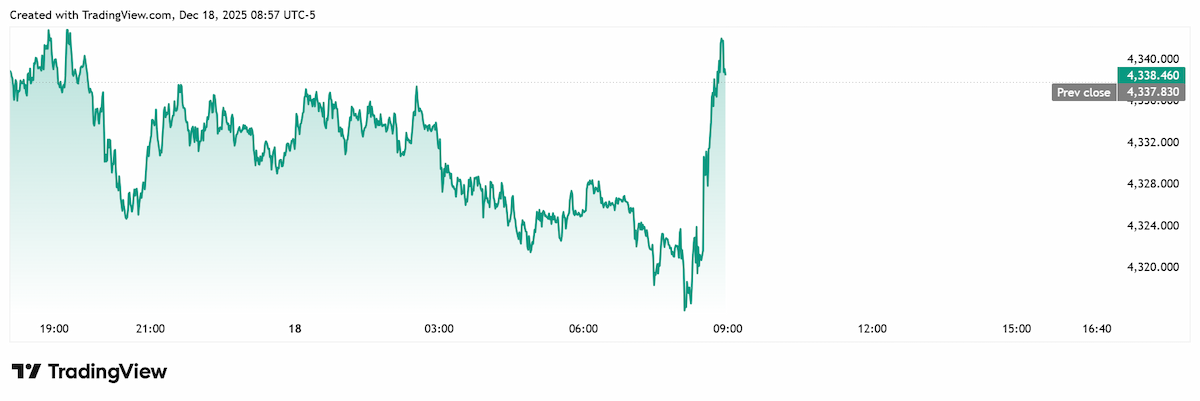
Spot gold last traded at $4,338.38 per ounce for a gain of 0.01% on the day.
Many of the current conditions indicators weakened in December. “The new orders and shipments indexes both turned positive after falling below zero last month,” the report stated. “The new orders index rose 14 points to 5.0 this month, and the shipments index rose 12 points to 3.2.”
The employment picture improved in the region, with the employment index rising from 6.0 in November to 12.9, its highest reading since May. “Most firms continued to report no change in employment levels (83 percent), while the share of firms reporting increases (13 percent) exceeded the share reporting decreases (less than 1 percent),” they said. “The average workweek index rose 11 points to 14.7.”
The Philly Fed report also showed price pressures continued on balance.
“Both price indexes remained elevated,” they said. “The prices paid index fell 13 points to 43.6, its lowest reading since June. Forty-six percent of the firms reported increases in input prices, while 2 percent reported decreases; 52 percent of the firms reported no change. The current prices received index rose 7 points to 24.3, mostly undoing its decline from last month. Over 28 percent of the firms reported increases in prices received for their own goods, 4 percent reported decreases, and 68 percent reported no change.”
The survey’s broad indicators for future activity indicated growth expectations were also weakening this month.
“The diffusion index for future general activity fell 8 points to 41.6 in December, its first decline since June,” the report said. “The share of firms expecting increases in activity over the next six months (54 percent) exceeded the share expecting decreases (13 percent); 27 percent expect no change. The future new orders index declined 12 points to 44.0, and the shipments index moved down 5 points to 43.2; both indexes remain above their historical averages.”
“The future employment index fell from 35.7 to 27.1,” they added. “Both future price indexes moved lower but remained well elevated compared with their historical averages. The future capital expenditures index rose 5 points to 30.3, its highest reading since August.”
