
(Kitco News) - The silver market continues to garner significant investor attention as prices have surged in the final days of 2025.
However, this unprecedented run has also created significant volatility, with prices falling 9% on Monday after hitting an all-time high of $84 an ounce. Despite the selling pressure, the grey metal has managed to hold initial support above $72 an ounce and is on track to end the year up 160%.
After Monday’s selloff, many investors are now asking whether the silver market is in a bubble that has already popped. Commodity analysts at Société Générale said that while some modelling suggests silver’s parabolic run has turned into a bubble, investors shouldn’t ignore the fundamental factors that continue to support higher prices.
The analysts said that, viewed on a standard linear scale, silver prices look expensive, but viewing the price action through a logarithmic scale reveals a compounding trend that has been building for the last 25 years.
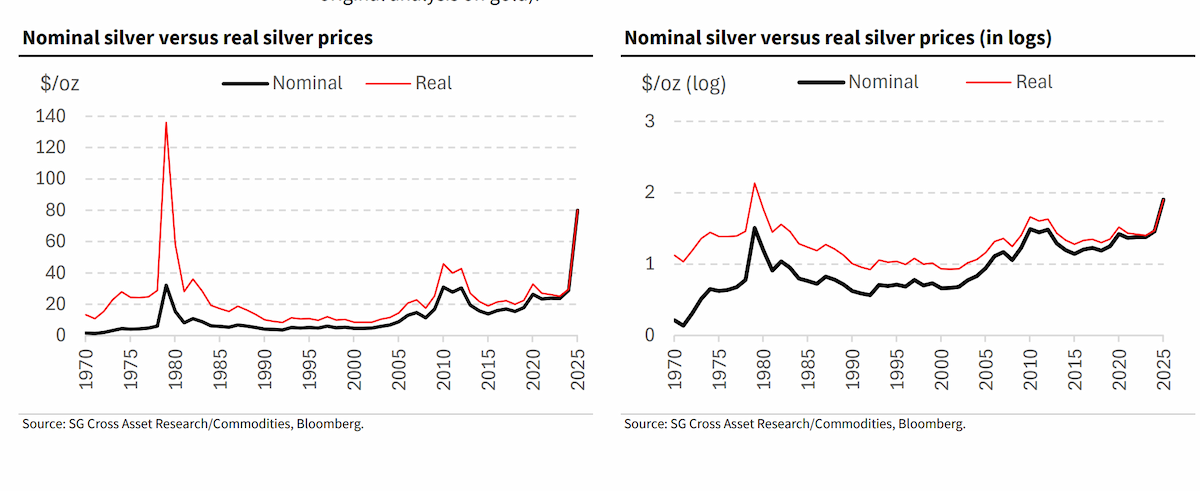
“When we saw a near-vertical move above $80/oz last week, it naturally looked dramatic, perhaps emotionally driven, and, in some people’s view, resembling a bubble. However, the moment you switch to a time series plot on a logarithmic scale (lower RHS), the narrative changes, as the run-up looks much more stable and not unprecedented,” the analysts said. “The logarithmic scale is the correct baseline because it clearly reveals the underlying exponential trend.”
Although silver’s rally could be defined as a bubble according to some models, the French bank argues that the parameters are flawed when applied to the precious metal because silver is a smaller, more volatile market. They explained that the silver market can generate bubble-like signals because illiquidity amplifies herding, feedback loops, and price instability.
“We therefore prefer to interpret the ‘bubble’ regime as potential instability indicators, as we would always expect healthy corrections to extreme price moves,” the analysts said.
The analysts added that they do not expect their bubble models to forecast a change in the momentum or general trend of silver prices, given the current fundamental backdrop. They noted that silver demand remains well supported amid the global de-dollarisation trend and elevated uncertainty.
Looking ahead, SocGen said it expects the silver market to experience further liquidity issues, particularly as China restricts its exports starting Jan. 1.
“China supplies between 60–70% of refined silver globally, so this crackdown is expected to tighten refined supply sharply—potentially reducing China’s silver exports by up to 30%. Given persistent global deficits (around 200–230 million ounces, with demand topping 1.24 billion ounces in 2025), the restriction could deepen shortages,” the analysts said.
At the same time, SocGen also sees some relief in Western markets, as the analysts do not expect the U.S. government to implement tariffs on silver imports, even with silver’s new designation as a critical metal.
“We hear through industry sources that we will receive clarity mid-January on the results of the critical Section 232 analysis,” the analysts said. “It’s our opinion that it’s hard to imagine the U.S. government would impose tariffs on silver, particularly 1,000-ounce bullion bars. If that were to happen, OTC tightness would intensify dramatically, as outbound shipments from the U.S. would effectively halt. The market is experiencing geographical shortages of 1,000-ounce bars, including in China, London, and India, leading to physical premiums across the key markets.”
