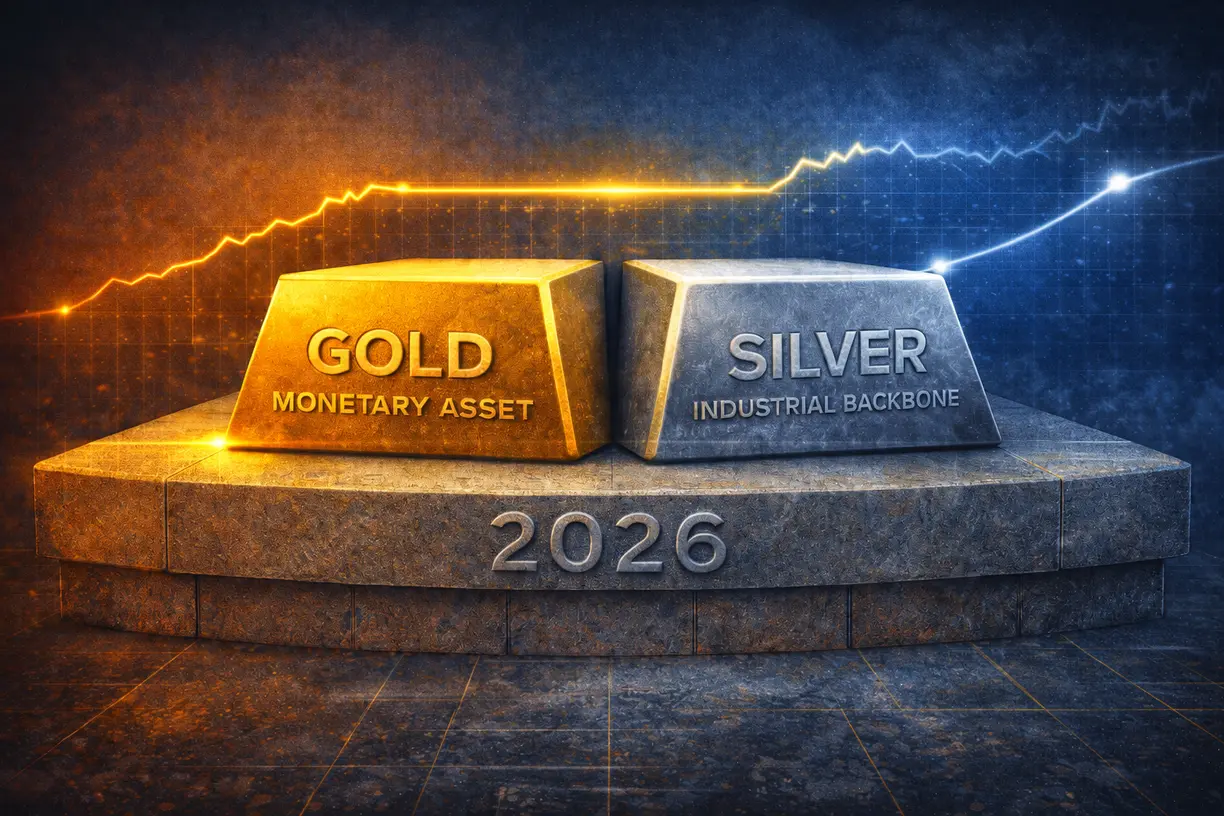
(Kitco News) - Gold and silver are no longer basic investments seen solely as hedges against inflation; they have transformed into cornerstone assets in the global economy. The yellow metal is now viewed as an important monetary asset and an alternative to the U.S. dollar, while the grey metal is a key component in the evolution and electrification of the global economy.
In his latest note on the precious metals, Ole Hansen, Head of Commodity Strategy at Saxo Bank, said that gold and silver’s recovery in the early days of the new year shows how resilient demand has become.
In the final trading week of 2025, gold and silver were hit with significant selling pressure as market volatility forced the CME to increase margins for speculators. However, since then, gold has recovered nearly all of its losses, and silver has regained more than half of its lost ground.
Spot gold last traded at $4,477.50 an ounce, up 0.66% on the day; meanwhile, spot silver last traded at $80.24 an ounce, up more than 4% on the day.
“The early strength suggests that the underlying drivers behind the 2025 rally remain intact rather than exhausted,” Hansen said in his note. “At a macro level, familiar themes continue to dominate. Concerns about currency debasement and the long-term sustainability of fiscal debt creation remain unresolved, while expectations of lower policy rates later in the cycle and a softer US dollar continue to underpin investor demand for hard assets. In that sense, the turn of the calendar has done little to change the broader investment narrative.”
In a recent interview with Kitco News, Hansen said that he is bullish on both gold and silver through 2026, but for different reasons. He added that he sees the $5,000-an-ounce level as a reasonable target for gold.
Hansen said that gold remains in a strong uptrend in a world defined by geopolitical fragmentation, fiscal strain, and shifting monetary alliances. Gold’s role as a geopolitical hedge has been on full display this week after the U.S. government launched an operation to capture Venezuelan President Nicolás Maduro.
“Assertive US actions in its own backyard risk reinforcing territorial ambitions elsewhere, notably in China and Russia, contributing to a more fragmented and volatile global landscape,” Hansen said.
At the same time, Hansen sees even more potential in silver, but not as a monetary metal on the same level as gold. Although silver has seen a surge in speculative and investment demand, it remains an important industrial metal.
“Simply put, you cannot have a monetary metal competing with industry,” he said. “A central bank will not hoard a metal that the industrial sector critically needs. Silver is a relatively small part of the overall cost of a finished product, and companies simply cannot afford to run out.”
Looking at the gold/silver ratio, Hansen said that historically it might take a drop back to 30 points before investors see silver as more expensive than gold. Silver’s solid outperformance has pushed the ratio to 55 points, its lowest level since April 2013.
Near-term risks to gold and silver
While Hansen remains bullish on gold and silver, he also warned of near-term risks in the marketplace, specifically as funds rebalance their portfolios.
Silver’s nearly 150% gain in 2025 - and gold’s 67% rally - make them significant rebalancing targets, Hansen warned.
“Following a strong 2025 for gold and silver, and additional gains into early 2026, index-tracking funds are required to reduce exposure to recent outperformers and reallocate toward weaker or underweighted sectors. These flows are price-insensitive and technical in nature, but they can still have a noticeable short-term impact on liquidity and price action,” he said.
Quoting data from Goldman Sachs, Hansen stated that the gold market could see $5.5 billion in gold sales and $5 billion in silver sales.
“This highlights the risk of short-term volatility during the rebalancing window, even if any weakness is more likely driven by technical flows than by a deterioration in the broader fundamentals,” he said.
