
(Kitco News) - Gold prices a bit lower in early U.S. trading and seeing some selling pressure due to much-improved trader/investor risk appetite in the general marketplace. Silver prices are higher. February gold was last down $3.60 at $4,833.70. March silver prices were up $0.918 at $93.535.
Global marketplace breathes sigh of relief as Trump backs off European countries’ Greenland-related tariffs, citing framework deal. President Trump Wednesday afternoon said he would refrain from imposing tariffs on goods from European nations opposing his effort to take possession of Greenland, citing a “framework of a future deal” he said was reached regarding the island, Bloomberg reported. Trump announced the decision after a meeting with North Atlantic Treaty Organization Secretary General Mark Rutte at the World Economic Forum in Davos, Switzerland, but did not detail the parameters of the framework. Danish Foreign Minister Lars Lokke Rasmussen welcomed the latest developments but added that it’s obvious that Trump has not given up on his ambition to gain control of Greenland, which is still “a red line for the Kingdom of Denmark.” Rutte said a breakthrough over Greenland was secured without discussing the territory's sovereignty with President Trump. The discussion centered on regional security in the Arctic region and how to prevent Russia and China from accessing Greenland. Global stock and financial markets breathed a sigh of relief of the framework news. Global stock markets rallied and gold prices backed off, while the U.S. dollar and Treasury markets steadied.
Trump touts “Peace Board” in Davos. President Trump in a speech just concluded at the World Economic Forum in Davos, Switzerland said his new Board of Peace will work with the United Nations and work to end wars. He said only “little fires” are left regarding the war in Gaza, while saying Iran does want to talk to the U.S. Trump reiterated his desire for $1.5 trillion in annual U.S. defense spending. He said all NATO members have committed to spending 5% of the GDP on defense, except Spain.
Japan’s government bond market stabilizes, at least for now. Japanese government bonds rebounded for a second straight session Thursday, led by super-long maturities as market sentiment steadied after a steep sell off earlier this week. The recovery followed calls for calm from Japanese Finance Minister Satsuki Katayama, with some fund managers viewing the recent jump in yields as an opportunity for buying the dip. Traders will be watching the Bank of Japan policy decision on Friday, and any comments on the market from Governor Kazuo Ueda, as well as an auction of 40-year Japanese bonds next week.
Swift: U.S. dollar continues to dominate global transactions—and its share is increasing. The U.S. dollar continues to dominate foreign exchange transactions and international currency usage, JPMorgan strategists wrote in a note this week and as reported by Bloomberg. Large global banks use Swift to communicate with each other and facilitate interbank currency deals. The U.S. dollar's portion of international transactions rose to 50.5% in December, up from 46.8% a month earlier, according to Swift data. The greenback was followed by the Euro currency, which carried about a 22% share, then the British pound, Canadian dollar, Japanese yen and Chinese yuan in international transactions. The U.S. dollar's share of global payments topped 50% for the first time since 2023, and its role in international finance and trade remains healthy despite growing talk of “de-dollarization among some countries, including China, Brazil and India. Separate Bank of International Settlements data shows the U.S. dollar on at least one side of 89% of all foreign-exchange transactions as of April 2025, while the Federal Reserve estimates some 60% of all foreign currency debt is issued in U.S. dollars.
The key outside markets today see crude oil prices lower and trading around $59.75 a barrel. The U.S. dollar index is slightly down and the U.S. 10-year Treasury note yield is presently 4.24%.
Note: The gold market operates through two primary pricing mechanisms. The first is the spot market, which quotes prices for on-the-spot purchase and immediate delivery. The second is the futures market, which sets prices for delivery at a future date. Due to year-end positioning market liquidity, the December gold futures contract is currently the most actively traded on the CME.
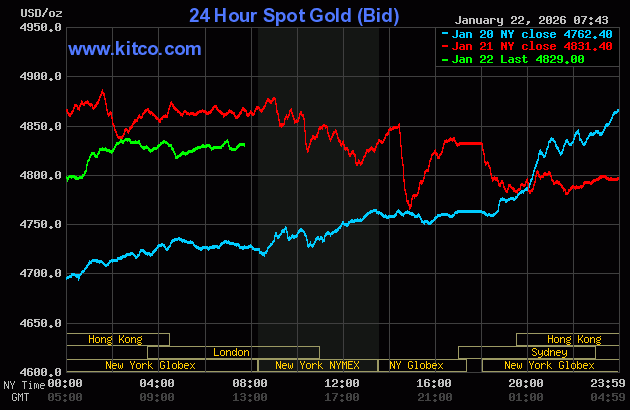
Technically, February gold futures bulls’ next upside price objective is to produce a close above solid resistance at $5,000.00. Bears' next near-term downside price objective is pushing futures prices below solid technical support at $4,539.10. First resistance is seen at the record high of $4,891.10 and then at $4,900.00. First support is seen at the overnight low of $4,772.70 and then at $4,750.00. Wyckoff's Market Rating: 9.0.
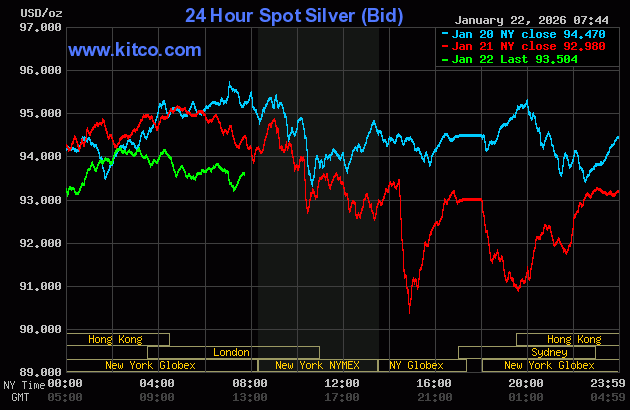
March silver futures bulls have the strong chart advantage and their next upside price objective is closing prices above solid technical resistance at $100.00. The next downside price objective for the bears is closing prices below solid support at $85.00. First resistance is seen at the record high of $95.78 and then at $96.00. Next support is seen at $92.00 and then at $90.00. Wyckoff's Market Rating: 9.0.
(Hey! My “Markets Front Burner” weekly email report is my best writing and analysis, I think, because I get to look ahead at the marketplace and do some market price forecasting. Plus, I’ll throw in an educational feature to move you up the ladder of trading/investing success. And it’s free! Sign up here; it’s real easy. https://www.kitco.com/services

