
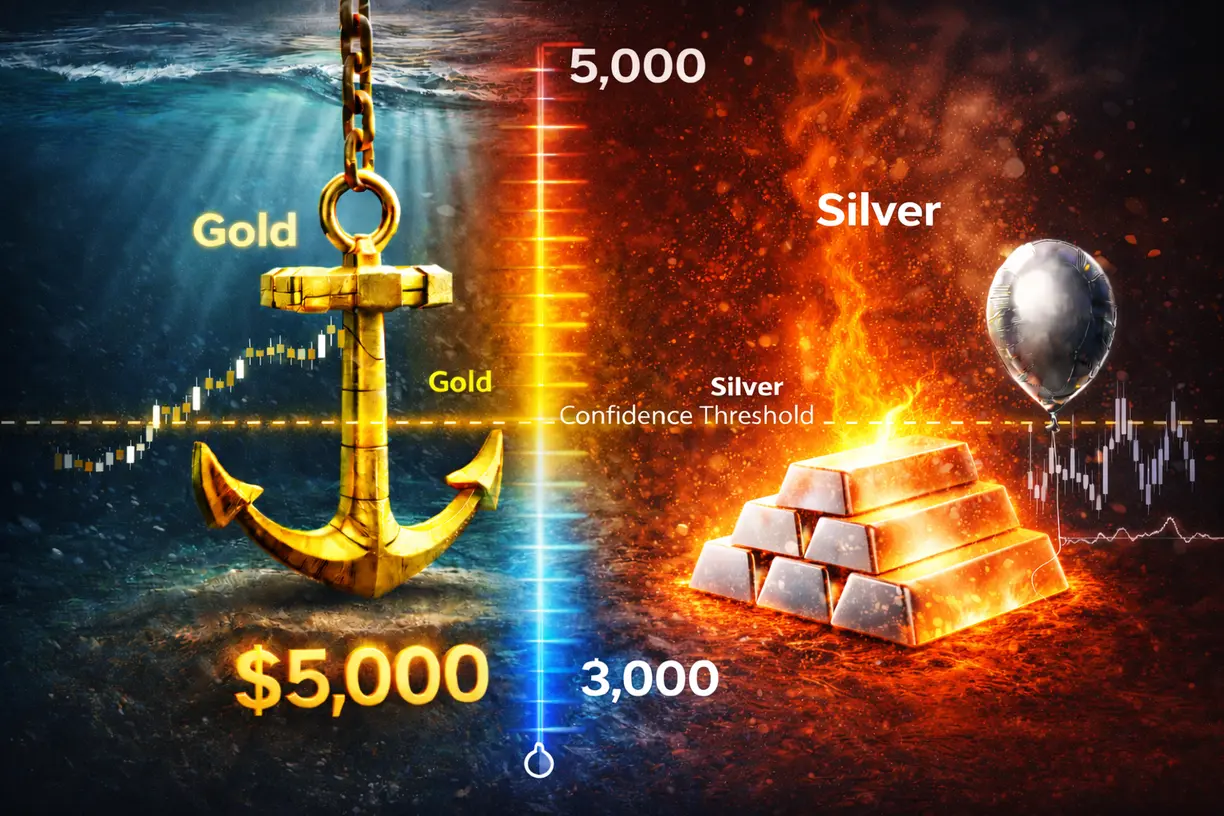
(Kitco News) - With gold prices holding above $5,000 an ounce, the precious metal is starting the year with a nearly 18% gain, its best start since 1980.
Although gold prices remain well supported and have enough momentum to move higher, one analyst also warns that a resilient global economy could create headwinds for the precious metal.
In a note on Tuesday, Ole Hansen, Head of Commodity Strategy at Saxo Bank, said that speculative momentum could push gold prices to $5,500 an ounce.
“The drivers are well known and largely concern-driven: worries about unchecked fiscal debt creation, a weaker dollar as U.S. exceptionalism fades and capital rotates elsewhere, geopolitical uncertainty amplified by an unpredictable U.S. president, and lingering inflation concerns,” he said. “Importantly, however, most of these fears have not yet materialised. U.S. fiscal debt continues to rise, but markets have so far reacted mainly through a steeper yield curve as investors demand a higher premium for long-dated risk. The dollar has weakened but not collapsed, while geopolitical tensions across several fronts have yet to escalate into something more disruptive.”
While safe-haven demand may start to cool, Hansen added that he doesn’t see a major correction on the horizon.
“We see a growing risk of a prolonged period of consolidation rather than an imminent major correction, with the broader structural case for gold remaining intact,” he said.
However, Hansen said that he is more concerned about silver. The grey metal is seeing its best start to the year on record, going back to 1972. Spot silver is currently trading around $109 an ounce and is up more than 52% in just the first month of 2026. This follows a nearly 150% rally through 2025.
“While gold’s ascent continues to be orderly without many signs of a bubble emerging, silver has clearly moved into bubble territory, with retail participation, speculative positioning and fear of missing out acting as the primary drivers of a rally that has pushed prices to historically expensive levels, both relative to gold and platinum,” he said.
Hansen said that silver’s historic rally could create significant demand destruction within the industrial sector, which represents about 60% of annual market demand. He added that rising volatility also threatens to create disorderly market conditions.
“Looking ahead, we continue to expect the supply-demand balance to improve, thereby reducing its supportive impact on prices, as industrial demand slows and consumers worldwide take advantage of the rally by selling back long-held bars, jewellery and silverware after a seven-fold price increase over the past decade,” he said. “Those seeking strategic exposure to hard assets are, in our view, better served by sticking with gold, where underlying central bank demand should continue to shield the metal from a major correction.”
