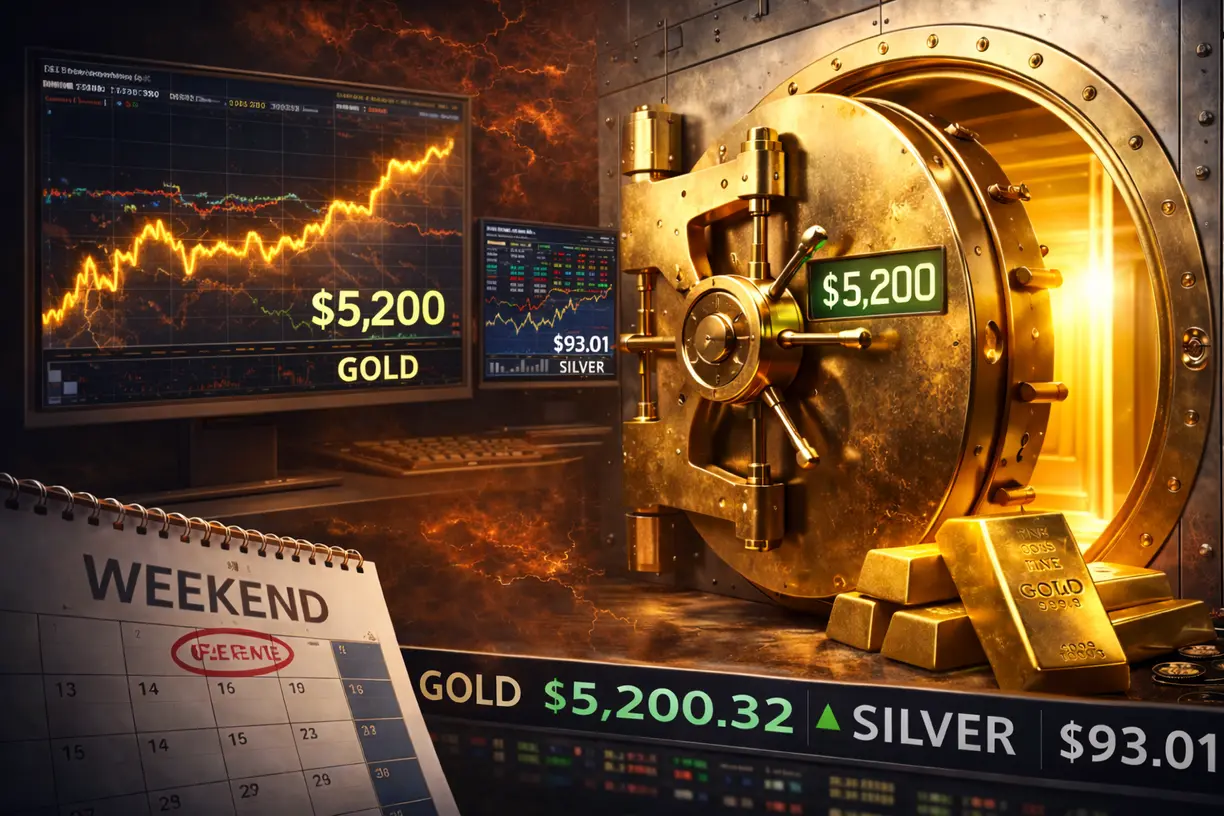
(Kitco News) - The threat of a geopolitical flare-up is once again giving investors a reason to sleep with one eye open — and one hand firmly on their bullion. As markets brace for potential escalation in the Middle East, gold has climbed back above $5,200 an ounce heading into the weekend, a move that suggests investors would rather pay up for insurance than spend Saturday night worrying about Sunday’s futures open.
Silver, meanwhile, is behaving like gold’s slightly more volatile sibling — enthusiastic, occasionally dramatic, but still very much part of the broader safe-haven rally. Prices are consolidating above $93 an ounce, holding firm even as momentum cools slightly.
Both metals are ending the month near record territory, an impressive turnaround considering how February began. An early-month correction pushed gold sharply lower before buyers stepped back in with conviction, while silver’s swings were even more pronounced. Gold prices are now up roughly 19% from their lows near $4,400 an ounce, while silver has rallied more than 45% from its trough near $64 an ounce. Despite the volatility and heavy selling pressure at the start of the month, the broader uptrend has remained intact.
And it’s not just geopolitics doing the heavy lifting. Rising global debt levels, persistent fiscal deficits and renewed trade tensions continue to reinforce gold’s strategic appeal. Bank of America maintains that despite recent consolidation below $5,200, gold still has a pathway toward $6,000. MKS PAMP has described the current bull market as mid-cycle, with the potential for prices to reach $6,750 as the U.S. political calendar heats up. In other words, the rally may be catching its breath — but the race itself is far from over.
That said, momentum never moves in a straight line. After such historic gains, many analysts argue that further consolidation would be healthy. Markets that move straight up often correct just as quickly, and even committed gold bulls recognize that digestion phases can help build a more durable foundation. Silver, given its sensitivity to industrial demand, may continue to see choppier trading if economic growth expectations shift alongside tariff headlines and global trade uncertainty.
Looking ahead, one of the biggest potential headwinds could be U.S. monetary policy. On Friday, the Labor Department reported that headline wholesale inflation rose 2.9% over the past 12 months, above economists’ expectations for a 2.6% increase. Sticky inflation pressures could force the Federal Reserve to maintain its neutral policy stance longer than markets currently anticipate, potentially tempering some of gold’s upside momentum if rate-cut expectations are pushed further out.
For now, however, the precious metals market remains supported by a simple reality: uncertainty is abundant, debt continues to climb, and policymakers are navigating an increasingly complex geopolitical landscape in real time. In that environment, investors are not abandoning gold and silver — they are adding to positions on dips.
The debate is no longer whether gold and silver deserve a place in portfolios. The real question is how much insurance is enough when the world is this unpredictable. Judging by the latest price action, many investors would rather hold a little extra — just in case the world delivers another surprise before Monday morning.

Neils Christensen
Neils Christensen has a diploma in journalism from Lethbridge College and has more than a decade of reporting experience working for news organizations throughout Canada. His experiences include covering territorial and federal politics in Nunavut, Canada. He has worked exclusively within the financial sector since 2007, when he started with the Canadian Economic Press. Neils can be contacted at: 1 866 925 4826 ext. 1526 nchristensen at kitco.com @KitcoNewsNOW

Disclaimer: The views expressed in this article are those of the author and may not reflect those of Kitco Metals Inc. The author has made every effort to ensure accuracy of information provided; however, neither Kitco Metals Inc. nor the author can guarantee such accuracy. This article is strictly for informational purposes only. It is not a solicitation to make any exchange in commodities, securities or other financial instruments. Kitco Metals Inc. and the author of this article do not accept culpability for losses and/ or damages arising from the use of this publication.