
(Kitco News) – Gold and silver likely have further to fall before they reach their price floor, even as the Iran conflict and tariff uncertainty support gold, while ETF investors continue to bet on silver, according to precious metals analysts at Heraeus.
In the latest update, the analysts wrote that history suggests that gold and silver prices both have further to fall.
“The dramatic price rallies that ended in late January saw the silver price gain 72% in a month and 322% from the beginning of 2025, with gold up 30% and 115% over the same periods,” they noted. “After a sharp drop, the silver price rebounded and has pushed to a new high for February reaching the 50% retracement of the decline. Silver has underperformed gold which has retraced about 70% of its decline. Geopolitical risks have given a boost to precious metal prices but whether that is sustained once hostilities in the Gulf end may depend on what settlement is reached.”
The analysts warned that similar rallies that ended in 1980 and 2011 “took the silver price close to $50/ oz and were followed by significant price declines over several years.”
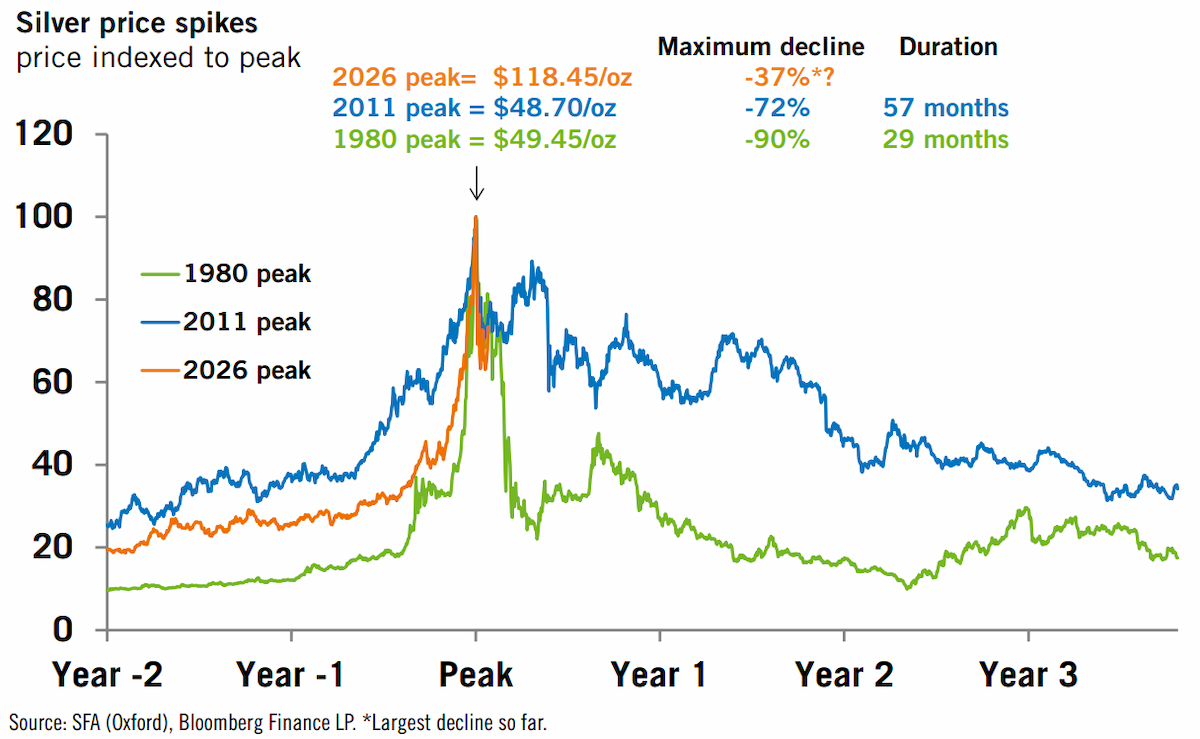
“There have been several other extremely sharp price rallies in the past and once the top was in, it was followed by a price decline of 40% to 70%,” they added. “After the recent peak, the silver price declined by 37% in a little over a week, which is in line with what has been seen in the past. However, in earlier episodes it took several months and often several years before the price low was reached. The outlier was a 35% decline in a month in 2006 which was both the fastest and smallest decline from an extreme rally and occurred in the middle of an ongoing bull market.”
Heraeus said that while the fundamental reasons for owning gold and silver haven’t changed since January, the reaction of market participants to their rapid rallies was consistent with past instances. “Silver is more volatile than gold but the implication for gold is similar – it will most likely take more than a month or two and lower prices to remove the excessive optimism that pushed prices so far, so fast through 2025 and into January.”
Looking at gold in particular, the analysts said that the conflict with Iran is clearly driving near-term price action.
“Geopolitical risk became reality at the weekend as the US and Israel launched missile strikes on Iran, with Iran retaliating and targeting Israel and many Gulf countries,” they wrote. “The initial reaction in the markets has been what would have been expected, the biggest move was in the oil price which jumped higher and stocks sold off with most stock markets down 1 to 2 percentage points. Safe haven bids lifted gold and the US dollar and the other precious metals followed gold higher. The US has been building up its military presence in the wider region for some time so some of the risk may have already been factored into the gold price which was up more than 10% in February as it rebounded from the sharp decline at the end of January.”
Heraeus said that economic uncertainty has also risen after the Supreme Court ruled that President Trump lacked the authority to enact most of his trade tariffs.
“The tariffs imposed under Section 232, such as those on auto imports, remain in place,” they noted. “The US president immediately used a different piece of legislation to impose blanket 10% tariffs instead. This throws various trade agreements into doubt and again changes the costs for US importers. The new tariffs are in place for 150 days unless Congress decides to extend them. The Trump administration could use the 150-day window to prepare alternative measures for when that period runs out.”
Turning to the mining majors, the analysts said that planned mine sequencing will see Newmont’s gold production drop by 0.6 million ounces to 5.3 million ounces in 2026.
“A return to growth is expected in 2027, with the company targeting 6.0 moz in the longer term,” they wrote. “The growth is supported by the ramp-up of Ahafo North in Ghana, the completion of the stripping campaign at Boddington which will enable access to higher-grade ore in 2027 and the completion of the Tanami Expansion 2 in 2027.”
Gold prices are setting new session lows as they pull back from their early morning peaks above $5,400 per ounce.
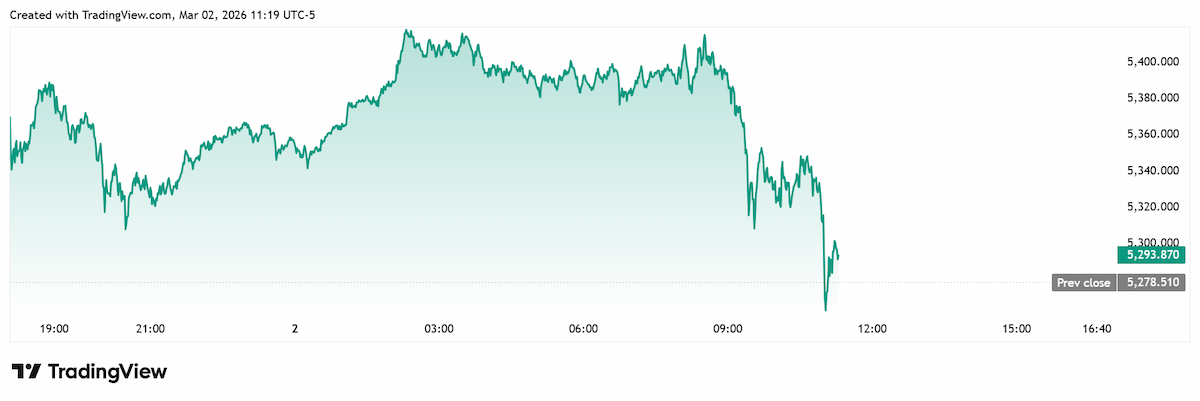
Spot gold last traded at $5,294.29 per ounce for a gain of 0.30% on the session.
Turning to silver, Heraeus analysts noted that ETF investors continue to crave silver.
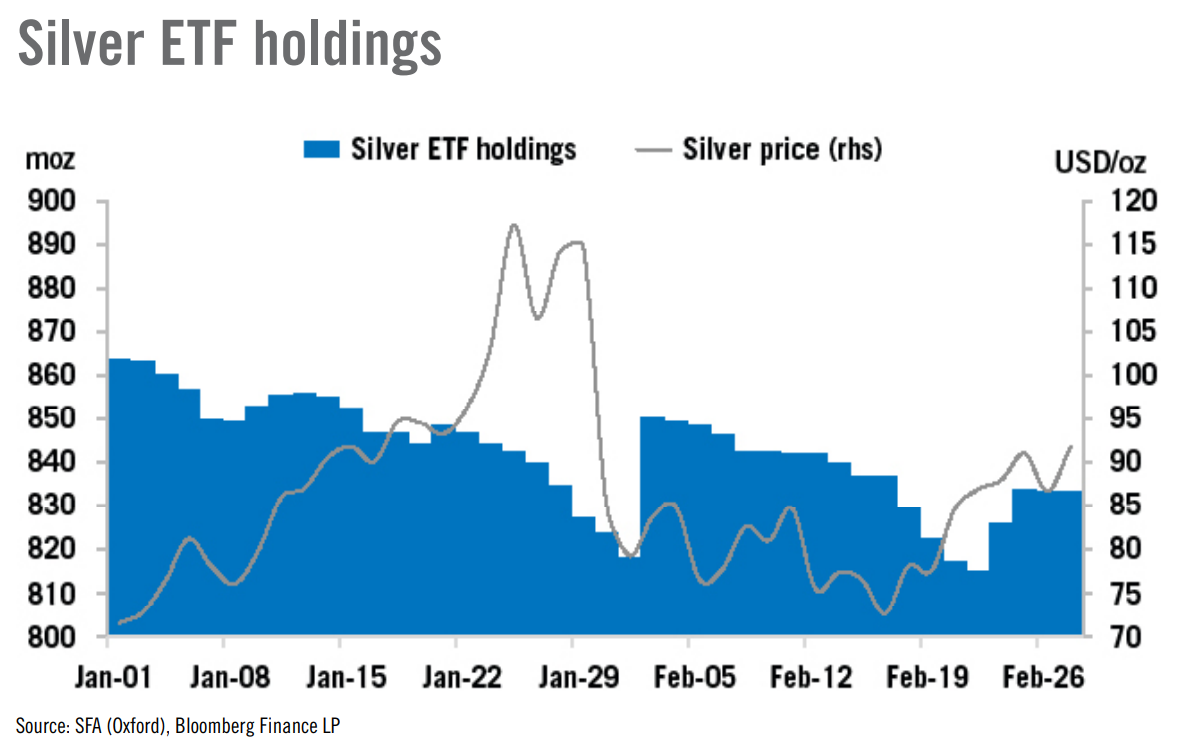
“Global silver ETF holdings rose by over 18 moz last week as the price recovery enticed some investors to increase their silver exposure,” they wrote. “However, at 834 moz the total is still down from 864 moz at the start of the year and 870 moz in late December.”
They also noted that Chinese margin requirements for silver trading are being lowered as price volatility has eased. “The SGE’s margin requirement has been cut to 24% from 27% for silver and the limit on daily price movement has been reduced to 23%,” they said. “Similarly, the margin requirement and price limits for gold have also been cut by 3 percentage points to 18% and 17%, respectively. This has the potential to improve liquidity, but margins are still high and further reductions may be necessary to see higher trading activity.”
Silver prices are sliding alongside gold, only further, after spiking to a session high above $96 per ounce in the Asian and European sessions.
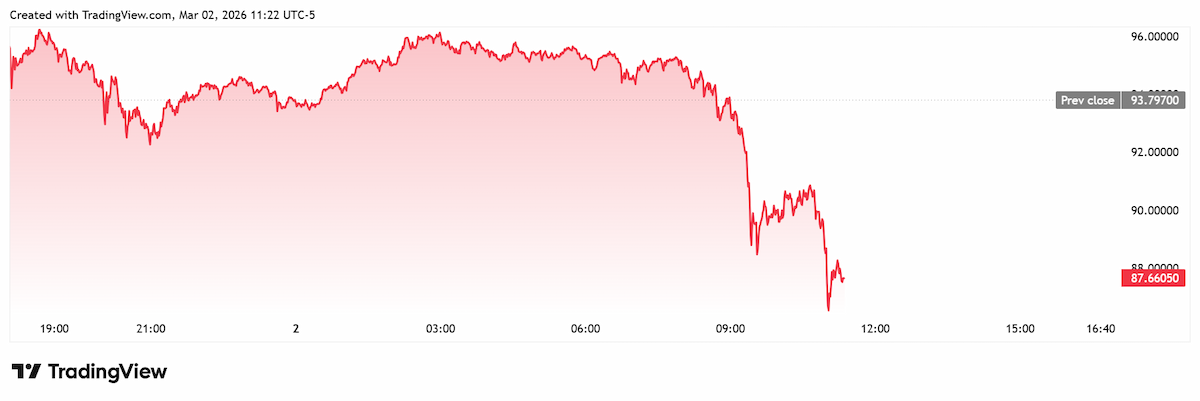
Spot silver last traded at $87.660 per ounce for a loss of 6.34% on the daily chart.
