
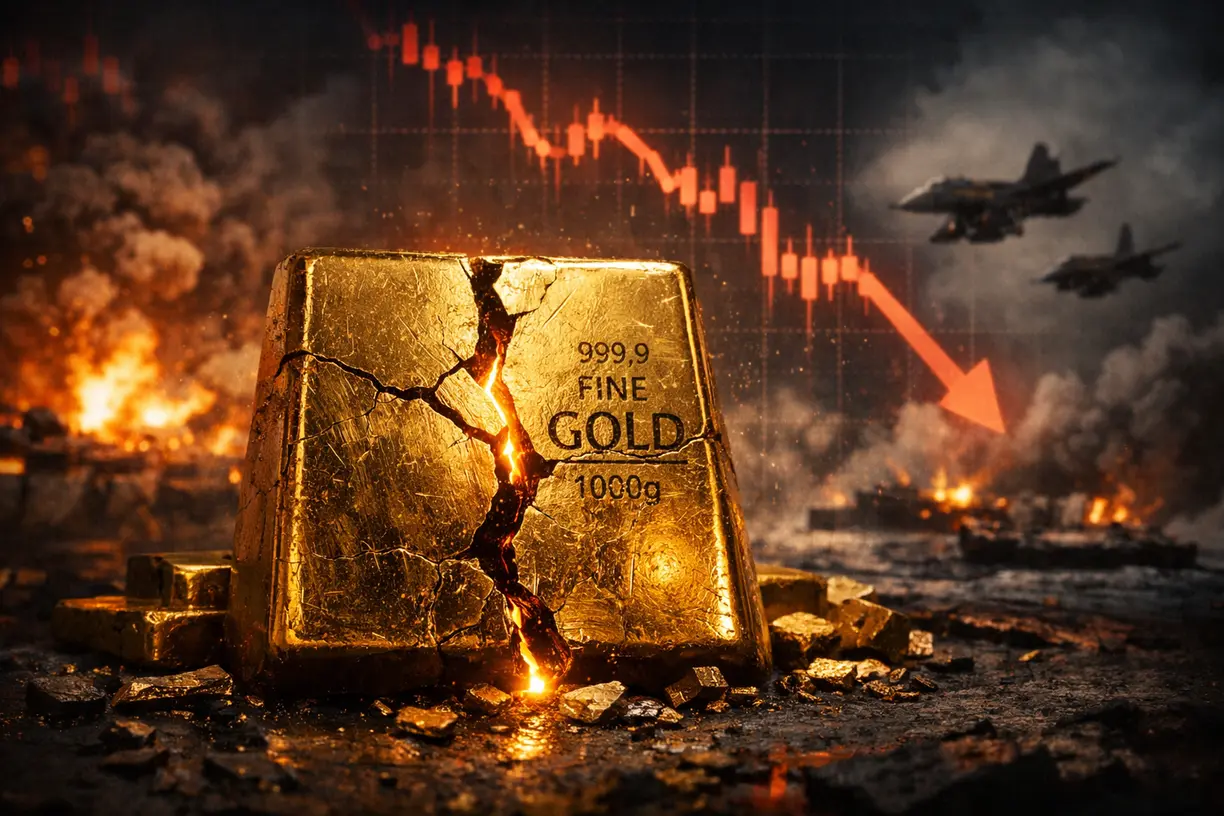
(Kitco News) - A perfect storm is brewing in the gold market as a technical breakdown and shifting market fundamentals outweigh gold’s safe-haven appeal as the U.S. and Israel continue to wage war against Iran, creating a global supply-chain bottleneck.
In the last week, Ole Hansen, Head of Commodity Strategy at Saxo Bank, has been watching gold’s 50-day moving average just below $5,000 an ounce as an important line in the sand. That initial support level broke at the start of Wednesday’s European trading session and has dragged gold prices to a six-week low.
Spot gold last traded at $4,888 an ounce, down more than 2% on the day.
Hansen noted that the selloff is frustrating some gold investors who are disappointed that the precious metal has not been able to attract a sustained safe-haven bid despite the growing chaos in the Middle East.
However, along with the technical selling pressure, Hansen also noted that gold faces some near-term fundamental headwinds.
“The war’s impact on energy markets has lifted inflation expectations at a time when central banks were already cautious about easing. The surge in oil and refined product prices—particularly diesel—has reduced the likelihood of near-term rate cuts and, in some cases, pushed market pricing toward a ‘higher-for-longer’ rate outlook. This has supported real yields, a key headwind for non-yielding assets such as gold,” he said.
At the same time, Hansen noted that geopolitical uncertainty is also pushing more capital into dollar-denominated assets, creating a competing safe-haven dynamic with gold.
The rising inflation threat and growing economic fears come as the Federal Reserve wraps up its latest monetary policy meeting. Markets are expecting the Federal Reserve to keep rates unchanged, but there are fears that it could solidify its neutral stance, signaling that rates will remain unchanged longer than expected. According to the CME FedWatch Tool, markets have nearly completely priced out potential rate cuts through the summer.
Hansen noted that the war with Iran is primarily a supply-driven inflation shock, which means that central banks will have limited tools to deal with the growing risks.
“That combination—sticky inflation and a constrained policy response—creates an uncertain backdrop for gold in the short term,” he said.
Hansen said that in this environment, gold’s technical outlook is expected to add to the volatility and near-term selling pressure.
“Gold has been one of the most profitable and crowded trades over the past couple of years, supported by central bank buying, geopolitical hedging, and debasement concerns. The recent break below key technical levels has triggered momentum-driven selling, while the broader risk-off tone has led investors to reduce profitable exposures to raise liquidity,” he said.
But it's not only gold that will continue to struggle; Hansen said that he sees further downside risk for silver as prices fall below $78 an ounce, trading at a four-week low.
Spot silver last traded at $77.13 an ounce, down 2.5% on the day.
“In addition to following gold lower, it is more sensitive to growth expectations due to its industrial use, with copper trading sharply lower as well today. Concerns that higher energy costs will weigh on global activity have added an additional layer of pressure, while its higher volatility and leverage to speculative positioning amplify the downside during corrections,” he said.
As for how far gold prices can fall, in a social media post, Hansen said that he is looking for initial support around $4,840, with the next level all the way down at $4,660 an ounce.
