
(Kitco News) – Gold used to be a good hedge against market pullbacks, but that's no longer the case, and the yellow metal now qualifies as a high-beta asset – one that actually magnifies rather than mitigates market selloffs, according to Robin Brooks, Senior Fellow at the Brookings Institution and former Chief Economist at IIF and Chief FX Strategist at Goldman Sachs.
In a new analysis, Brooks said something bad is happening with gold.
“Gold has traditionally been a safe haven asset, which means it’s been a good place to hide when other assets plummet,” he wrote. “That hasn’t been true in the past six weeks of war. Gold is down ten percent, which is far more than the S&P 500 that’s down less than one percent. You’re not much of a risk hedge if you sell off harder than the S&P 500 in a bad shock. You’re the opposite.”
“Gold is behaving like a high-beta asset that amplifies sell-offs.”
Brooks outlined the various theories that have attempted to explain what’s happened with gold. “The first is that emerging market (EM) central banks sold gold holdings during the recent shock, but that’s really only true for Turkey, where holdings fell by 128 tons to mobilize foreign exchange reserves to defend the Lira,” he said. “Turkey is an outlier in this regard. Its insistence on pegging to the Dollar forces its central bank to sell reserves in bad shocks, a practice most other EMs ditched long ago and for good reason.”
“The second is that the massive rally in gold over the past year - the ‘debasement trade’ - sucked in many new buyers who turn out to be more skittish and prone to bail in bad shocks,” he suggested. “This would certainly explain why gold has been trading like a high-beta asset in recent weeks. If this is what’s going on - and I think it is - then it’s just a matter of time until the ‘debasement’ crowd gets washed out and gold returns to being the usual safe-haven asset.
“So safe-haven status isn’t gone forever, it’s just contaminated at the moment.”
Brooks shared a chart suggesting the run-up in gold prices over the last two years was driven by a combination of geopolitics and Fed policy.
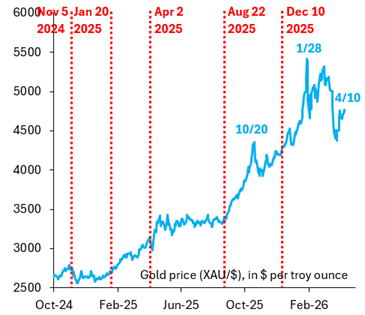
“’Liberation Day’ on April 2, 2025, sparked a big rise in gold prices, but it wasn’t until Chair Powell’s Jackson Hole speech on August 22, 2025, that gold prices really took off,” he noted. “That speech proved pivotal because it signaled the start of a Fed easing cycle even though inflation was elevated. It was at this moment that the debasement trade was born.”
Brooks said the December 10 rate cut – the final Fed cut of 2025 – was another catalyst for gold prices to move higher. “At its peak on January 28, 2026, gold was up almost 100 percent from a year before,” he wrote. “It’s clear there were perfectly rational drivers of the rally, but it’s also clear that - by the end - things had gotten totally out of control.”
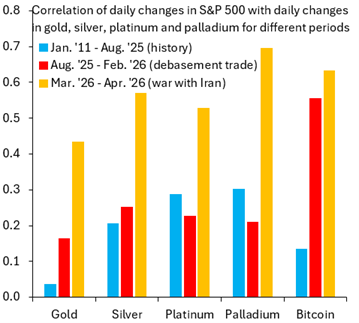
Brooks then turns to the recent sell-off. “The chart above shows the correlation of daily changes in the S&P 500 with daily changes in various precious metals and bitcoin,” he said. “The blue bars are the correlation from January 1, 2011, to August 21, 2025. The red bars are the same thing from August 22, 2025, to February 27, 2026. The orange bars are for the past six weeks of war.”
“What’s clear is that gold has become more pro-cyclical, i.e. it rises when other risk assets rise and it falls when they decline,” he noted. “Its correlation is lower than for other precious metals or bitcoin, but that’s little comfort.”
