
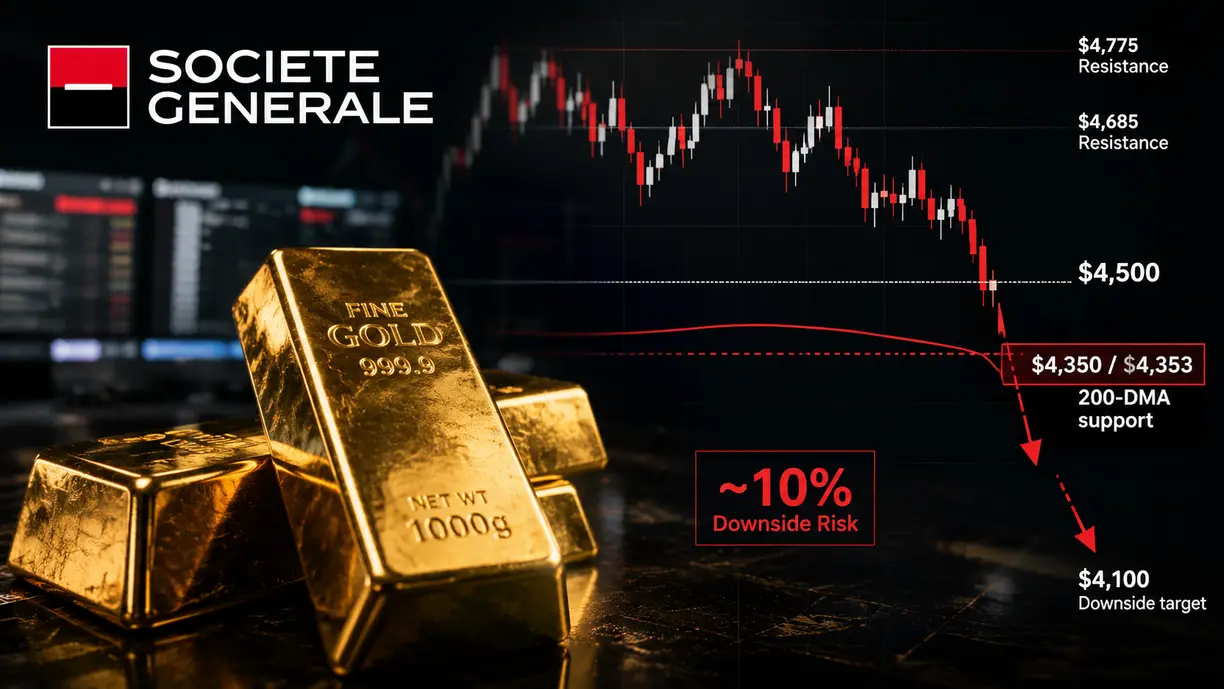
(Kitco News) – Gold’s recent break below $4,500 per ounce has brought fresh downside risk to the yellow metal, and a key cluster of technical levels is now acting as critical support to prevent a further 10% slide, according to commodity analysts at Societe Generale.
In a new note, Societe Generale analysts noted that gold has been under significant pressure since prices dropped below their 50‑day moving average (50-DMA) two months ago.
“Gold has undergone a pullback after slipping below its 50‑DMA in March,” they wrote. “Its failure to reclaim this MA during the latest rebound attempt underscores the persistence of downward momentum.”
SocGen is now flagging the confluence of the 200‑DMA and a multi‑year trend line near $4,350 as critical support.
“The confluence of the longer‑term 200‑DMA and a multi‑year ascending trend line near $4,350 could be the next potential support,” they said. “It will be important to observe whether Gold can hold above this and attempt a bounce.”
“Gold erased the key $4,500/oz level and must hold the 200dma of $4,353/oz to halt a deeper correction towards $4100/oz,” they warned. “If a short‑term rebound develops, the recent pivot high around $4,685 / $4,775 could act as resistance.”
On March 23, Société Générale published its updated Multi-Asset Portfolio strategy report for the second quarter, with the bank’s market analysts saying that, for the first time since 2022, they are no longer overweight gold.
Taking a more balanced stance, the French bank reduced its gold exposure to 7%, down from 10% in the first quarter.
Although the bank reduced its exposure to gold, it remained bullish on the precious metal and maintained its $6,000 year-end price target.
Overall, SocGen said that it is looking to create more balance in its portfolio, shifting its equity exposure and reducing it by 5% as it took a broader position in commodities.
In its biggest shift, SocGen increased its exposure to global commodities to 8%, up from zero in the first quarter. The analysts said they saw solid potential in energy markets.
“In adjusting our portfolio, we now focus even more on long-term strategic forces. We increase our allocation to commodities and further broaden our exposure to equities beyond US technology,” the analysts said. “Commodities sit at the core of our strategic focus on sovereignty. Even once the Middle East conflict ends, oil is unlikely to return to the $55 level we previously expected. Under our new scenario, Brent prices drop to $77/bbl in 2Q26 and $68/bbl in 4Q26 but start rising over the medium term, while US production peaks and OPEC regains market share. Copper remains supported by long-term electrification and data-centre demand.”
The analysts said that gold’s volatility is the biggest factor behind the portfolio shift. The bank added that gold is expected to be one of the most volatile assets in the next 12 months.
“In the risk-off environment triggered by the current Middle East conflict, gold has not been able to fully offset equity market weakness in portfolios. At the same time, gold’s shorter-dated volatility has risen sharply, exceeding that of other major asset classes. If we look at gold’s correlation profile, its relationship with most major asset classes has been predominantly positive,” the analysts said. “For volatility-controlled portfolios, the recent increase in gold’s volatility, combined with the metal’s positive correlation with other asset classes, presents a headwind.”
Looking at equity markets, the French bank reduced its exposure to US stocks, global emerging markets, and Chinese onshore equities. However, it increased its exposure to European equities, excluding the U.K.
The bank is maintaining a 25% exposure to government bonds, a 5% exposure to corporate bonds, and held 5% of its portfolio in cash.
“Growing doubts about the durability of the AI theme justify our underweight in US equities and our preference for an S&P 500 equal-weight exposure to reduce concentration and capture wider leadership,” the analysts said. “We remain overweight Europe, as the region is benefiting from a firm cyclical recovery.”
