
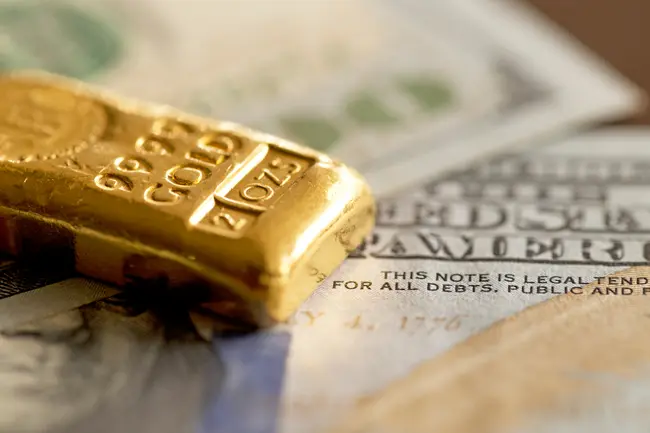
(Kitco News) - The gold market has managed to bounce off its session lows but remains under significant selling pressure, even as the U.S. economy continues to cool and inflation pressures remain relatively muted — conditions analysts say could give the Federal Reserve room to cut interest rates by the end of the year.
The Bureau of Economic Analysis announced the preliminary reading of first-quarter Gross Domestic Product on Thursday, saying the economy grew 1.6% quarter over quarter, down from the initial estimate of 2.0%. The data came in weaker than economists' expectations, as consensus forecasts had called for growth to hold steady at 2.0%.
“Real GDP was revised down 0.4 percentage point from the advance estimate, primarily reflecting downward revisions to investment and consumer spending,” the report said.
“Within investment, the revision primarily reflected a downward revision to private nonfarm inventory investment, led by manufacturing and retail trade, based primarily on revised U.S. Census Bureau inventory book value data,” the report said. “The revision to consumer spending reflected a downward revision to services that was partly offset by an upward revision to goods. Within services, the largest contributor to the downward revision was health care (outpatient services as well as hospital and nursing home services), based primarily on U.S. Census Bureau Quarterly Services Survey data.”
The report noted that first-quarter GDP growth was still stronger than the 0.5% expansion reported in the fourth quarter of 2025.
Weak economic activity appears to be easing inflation pressures. In a separate report, the BEA said its core Personal Consumption Expenditures Index, which excludes volatile food and energy prices and is the Federal Reserve’s preferred inflation gauge, increased 0.2% last month, compared to a 0.3% increase in March.
Economists had expected to see a 0.3% increase.
For the year, core inflation rose 3.3%, in line with economists' expectations. Some economists note that despite slower economic growth, inflation remains well above the central bank’s 2% target.
The gold market is seeing some renewed buying momentum in its initial reaction to the latest economic data. Spot gold last traded at $4,409.10 an ounce, down 1% on the day.
The precious metal suffered significant chart damage overnight as prices fell below initial support at $4,500 an ounce.
Although the economy is slowing, markets continue to focus on evolving inflation risks as the ongoing war in Iran continues to disrupt global energy markets and other critical commodities.
The PCE report said headline inflation rose 0.4% in April, compared to March’s 0.7% increase. For the year, headline inflation climbed 3.8%.
According to the CME FedWatch Tool, markets still see a greater chance of a rate hike by the end of the year than a rate cut. This creates a difficult short-term environment for gold, as higher interest rates increase the opportunity cost of holding the yellow metal, which is a non-yielding asset.
However, analysts note that gold’s long-term fundamental support remains firmly entrenched. Some analysts have pointed out that slower growth and higher inflation leave the Federal Reserve walking a very narrow tightrope.
There is little the U.S. central bank can do because inflation is being driven by supply-side issues. Analysts have pointed out that the Federal Reserve cannot produce more oil through rate cuts, while a rate hike could push the economy into a recession.
Jeffrey Roach, Chief Economist for LPL Financial, said that he expects U.S. growth to stabilize, but inflation pressures will continue to increase through the year.
“Despite the downward revision to Q1 growth, we expect business spending will keep contributing to growth in the near term. Regarding the inflationary environment, supply constraints will cause inflation pressures to seep into both nondurable and durable goods, most likely for the next few months,” he said.
