
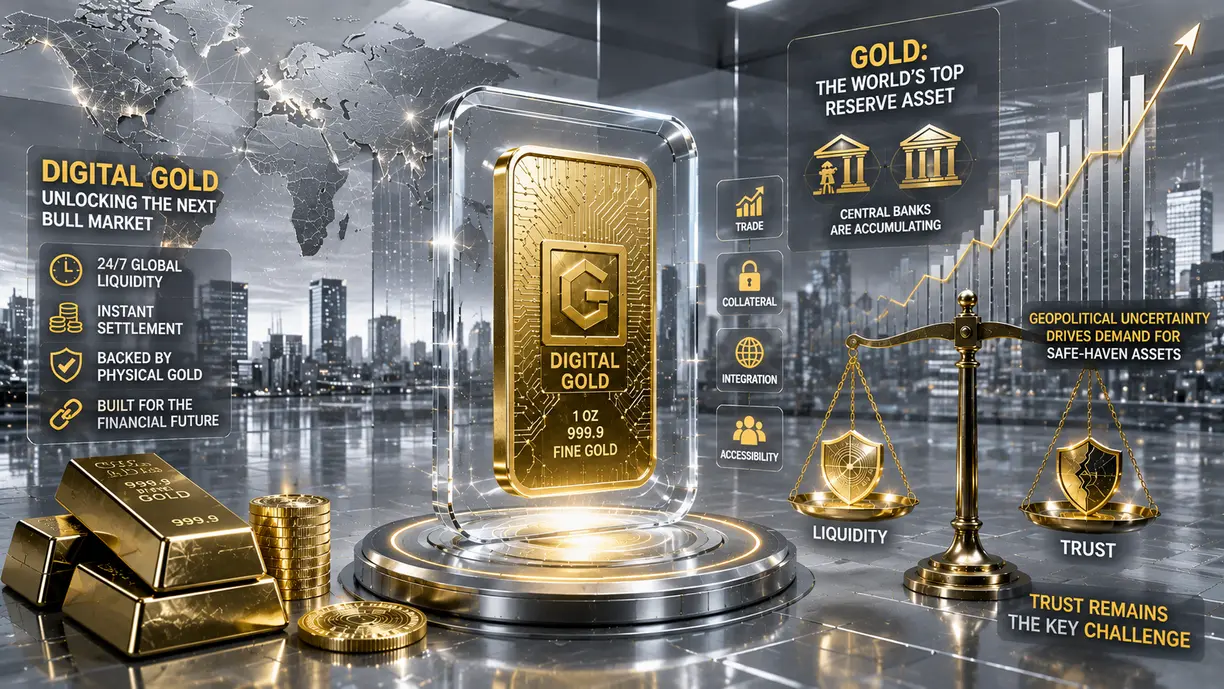
(Kitco News) - Not only has gold surpassed U.S. Treasuries to become the world’s top central bank reserve asset, but the recent global energy crisis provoked by the war in Iran has proven the precious metal’s worth as an important source of liquidity, and according to one market executive, the yellow metal's evolution is just beginning.
In an interview with Kitco News, Kurt Hemecker, CEO of Gold Token SA, the tokenization arm of MKS PAMP, said digital gold has the potential to transform bullion from a largely static reserve asset into a far more liquid financial instrument that can be traded around the clock, used as collateral and further integrated into the broader global financial system.
"The thesis for gold hasn't changed," Hemecker told Kitco News. "The correction was normal after the market got a little ahead of itself. The macro drivers—currency debasement, geopolitical uncertainty and diversification—are all still there."
While gold's long-term investment case remains intact, Hemecker said tokenization creates an entirely new structural tailwind for the precious metals market.
Unlike traditional bullion markets, which largely operate during business hours, tokenized gold can trade 24 hours a day, seven days a week, providing investors with continuous liquidity and accessibility.
However, Hemecker argued that the real opportunity extends well beyond retail trading.
He believes digital representations of physical bullion could eventually help solve one of the gold market's longstanding limitations: liquidity.
Today, physical gold already receives favorable regulatory treatment under Basel III banking rules, but it is not recognized as a High-Quality Liquid Asset (HQLA), limiting its broader use within the banking system.
Hemecker said tokenization strengthens the case for that status to eventually change.
"I think tokenization gives the argument that it could be considered a high-quality liquid asset," he said. "In that case, why not use it in repo transactions or for settling interbank obligations?"
If regulators ultimately recognize tokenized bullion as sufficiently liquid, gold could play a much larger role within modern financial markets, allowing institutions to mobilize holdings without physically moving bars between vaults.
The implications could also extend to central banks.
During this year's financial market disruptions, several central banks actively monetized portions of their gold reserves through swaps and other liquidity operations, reinforcing bullion's role as a monetary asset rather than simply a reserve sitting idle on a balance sheet.
Tokenization, Hemecker said, could make those transactions significantly more efficient by allowing ownership of vaulted bullion to change hands digitally.
However, that vision still faces major obstacles.
"The biggest question mark is trust," Hemecker said.
Unlike government bonds or bank deposits, tokenized gold depends on confidence in the underlying physical metal, the custodian, the legal ownership structure and the jurisdiction where the bullion is stored.
"Not all gold tokens are created equal," he said. "People will increasingly look at what is backing the token, the property rights, the jurisdiction, the quality of the gold, the sourcing and the provenance."
Those issues become even more important if central banks or large financial institutions ever participate in the market.
Many official institutions insist on maintaining custody of their own gold, meaning any future tokenization framework would require standardized custody agreements, robust legal protections and industry-wide operational standards.
"There would probably have to be some pretty strict service-level agreements and standardization across the industry," Hemecker said.
That lack of standardization remains one of the biggest challenges facing digital gold today. Hemecker said the market eventually needs interoperable standards that allow trusted tokenized gold to move freely between platforms, jurisdictions and financial institutions.
"For such an old industry, tokenization is still very nascent," he said. "It's getting that standardization across the physical layer that allows you to get liquidity on the digital layer."
Although the sector faces some difficult hurdles, for now, Hemecker said that the recent correction in gold prices is an opportunity rather than a setback.
"I love building during a down market because you can get all the rails in place before things take off again," he said. "The thesis for gold hasn't changed. This is a great accumulation opportunity, and we're seeing people starting to come back into the market."
