(Kitco News) - Mining equities remain under pressure despite gold, silver and copper holding key levels, leaving investors to decide whether the sector’s sharp pullback is a warning sign or a bull-market correction, according to John Feneck, founder and CEO of The Feneck Commodities Report.
Speaking with Kitco Mining’s Digging Deep on July 23, Feneck said summer trading volumes, the Iran conflict, Federal Reserve uncertainty, and capital crowding into technology and AI stocks have weighed on mining shares even as the underlying metals remain resilient.
“We're still in a bull framework here, and the charts aren't broken,” Feneck said.
Feneck said gold has held roughly the $3,800 to $3,900 range, silver has held the $54 to $55 area, and copper has traded near record highs. The disconnect, he said, is that mining equities have not yet attracted the same investor attention as other parts of the market.
That gap is visible as gold producers move through earnings season. Feneck said Newmont and other large-cap miners reported strong results earlier this year, and producer margins remain supported by elevated gold prices. Copper exposure could also help some companies, he said, while higher energy costs may weigh on June-quarter results.
The larger issue is capital allocation. Feneck said mining stocks are competing with technology and AI, where momentum has absorbed capital that might otherwise have moved into resource equities.
“Tech is showing cracks,” he said.
Feneck said weakness in technology, semiconductors, and other growth sectors could eventually support mining equities if investors rotate toward value, hard assets, and critical minerals. He said the Philadelphia Semiconductor Index and small-cap market weakness are important signals to watch.
That rotation has not arrived yet. Feneck said the Iran conflict has been a “huge overhang” on mining sentiment since early March, while Fed meetings, minutes, and commentary remain pressure points for the sector.
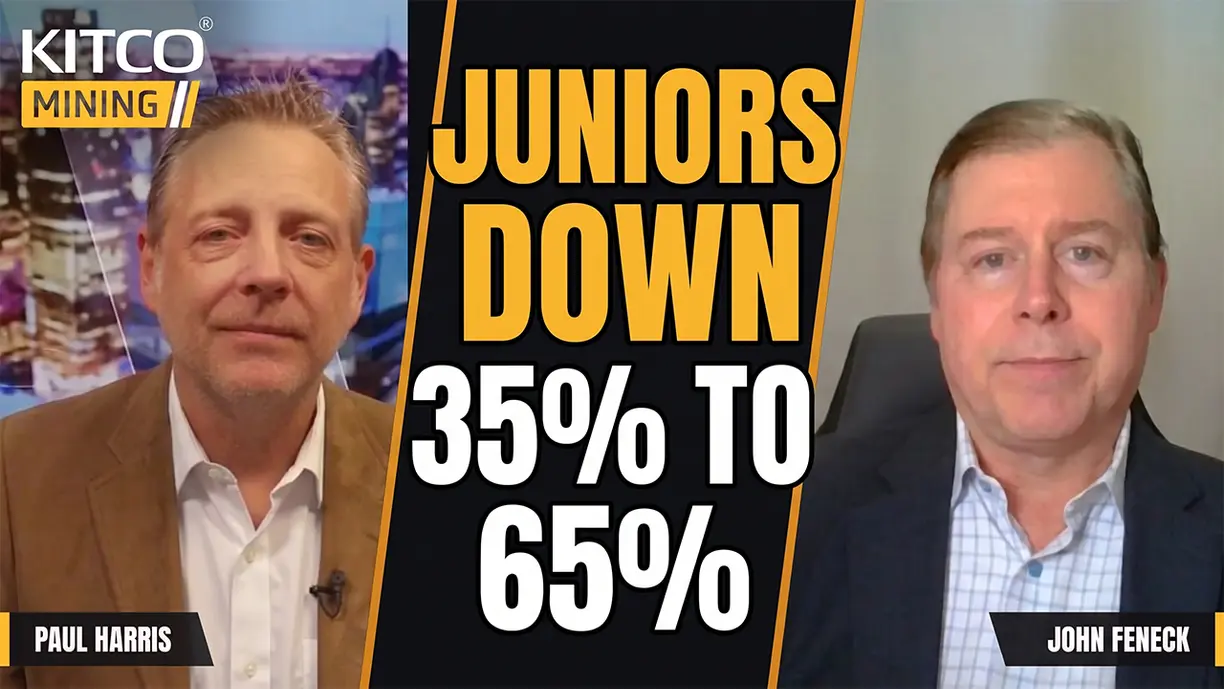
The pressure has been severe. Feneck said the HUI was down about 40% since March 1, while many junior mining stocks were down 35% to 65%. That is more than a typical mining correction, he said, but it does not necessarily mean the bull market has failed.
“This is just a tremendous buying opportunity if you believe what we said at the onset, which is that we're still in a bull framework here,” Feneck said.
Critical minerals policy is one area where Feneck sees a clearer catalyst. He pointed to a July 20 U.S. defense supply-chain order that tightens waivers for critical materials from covered nations. The order includes a Jan. 1, 2027 deadline affecting tungsten imports from China, Russia, North Korea, and Iran.
Asked what the move means for the tungsten sector, Feneck said, “Super bullish.”
Feneck said China produces roughly 80% to 81% of global tungsten, while the U.S. has not produced domestic tungsten since 2015. He said Washington is beginning to recognize the scale of the problem, but remains well behind.
“We are far, far behind China and many other countries,” he said.
The issue is not only mine supply. Feneck said U.S. refining and processing capacity remains a major bottleneck for critical minerals, with companies looking to position around domestic processing, refining, and defense-related supply chains.
The selloff in junior miners is also sharpening the M&A debate. Feneck said major producers should be more active while junior valuations are depressed, particularly given stronger balance sheets at the senior end of the sector.
NovaGold Resources announced July 22 that it agreed to acquire Paulson Advisers’ 40% interest in Donlin Gold, a transaction that would increase its ownership of the Alaska project to 100% through a new U.S.-domiciled company expected to list on the New York Stock Exchange. Barrick Mining announced July 21 that it would invest about C$20.9 million in Kingfisher Metals, giving it about 9.9% of the company on a non-diluted basis.
Feneck said he wants to see more large companies act, but argued that juniors should not accept low-premium deals in the current market.
“We're not interested in you flipping the asset for 20%,” he said.
Feneck said premiums of 50% or more are more appropriate in a bull market, especially if majors want access to assets while junior share prices are depressed. He said companies including Barrick, Newmont, Agnico Eagle, and Alamos need to evaluate their development pipelines and determine what they require to maintain future production.
The interview also touched on New Pacific Metals’ updated preliminary economic assessment for the Carangas project in Bolivia, released July 16. Feneck said the added gold component improves the project, but said jurisdiction concentration remains a key risk when a company’s assets are all located in one country.
For Feneck, the sector is being tested rather than broken. Metals are holding support, U.S. policy is moving toward domestic critical minerals, and junior valuations have been reset sharply lower. The next question is whether capital rotates out of technology, geopolitical risk eases, and major miners begin paying up for the assets they need.
More information on Feneck’s conference is available here.