

(Kitco NewsWire) - Spot gold and silver prices are lower in late-afternoon U.S. trading Friday, as a firmer U.S. dollar, elevated Treasury yields and rising oil prices outweighed support from Thursday’s softer PCE inflation data. At the time of writing, spot gold was trading near $4,050.70 an ounce, down 1.27%, while spot silver was trading near $57.75, down 1.93% on the session.
Gold’s session range was $4,018.20 to $4,112.80, leaving the metal above the $4,000 area but below Thursday’s $4,101 breakout level and the $4,114 resistance level identified in the latest short-term technical setup. Silver’s session range was $56.86 to $59.30, with the metal holding above $56.86 but failing to sustain a move through the $59.00 to $60.03 resistance band.
North American equities closed higher, led by Amazon and large-cap technology, even as Apple weakness and higher oil prices limited broader risk appetite. The S&P 500 rose 0.7% to 7,489.72, the Nasdaq Composite gained 1.0% to 25,373.85 and the Dow Jones Industrial Average climbed 0.5% to 52,485.03. The Russell 2000 fell 0.5% to 2,931.34. In Canada, the S&P/TSX Composite fell 279.70 points, or 0.79%, to 35,226.14.
European equities finished higher as technology shares recovered and lower earlier oil prices supported risk appetite. The STOXX Europe 600 rose 0.8% to a record high, Germany’s DAX gained 0.7%, France’s CAC 40 rose 0.7% and London’s FTSE 100 climbed 0.6%, while Italy’s FTSE MIB added 0.6%.
Positioning after Wednesday’s FOMC decision, Thursday’s GDP and PCE data and Friday’s sentiment report remains two-sided, but still restrictive for metals. The Fed held rates steady in the 3.50% to 3.75% range by a 9-3 vote, with three officials favoring a 25-basis-point hike. Thursday’s data showed real GDP rose at a 1.5% annualized rate in the second quarter, down from 2.1% in the first quarter, while June headline PCE fell 0.1% on the month and slowed to 3.7% year over year. Core PCE rose 0.1% on the month and eased to 3.3% year over year. Initial jobless claims rose to 197,000, still low by historical standards, and Friday’s final consumer-sentiment reading rose to 55.2 while one-year inflation expectations eased. The data support the case for a Fed hold, but they do not remove September hike risk. The 10-year Treasury yield remained near the 4.7% area, leaving gold exposed to real-rate pressure despite softer inflation.
The Strait of Hormuz situation is best characterized as open but highly stressed transit under active military, shipping and diplomatic pressure. Oil prices rose more than 1% Friday and logged their strongest month since March as the Iran war continued to disrupt key shipping routes and keep a war-risk premium in crude. Brent crude was near $90.12 a barrel after gaining more than 20% in July, while WTI held in the mid-$80s. For gold, the impact remains two-sided: geopolitical risk supports defensive demand, but higher oil prices keep inflation risk alive, support yields and limit the upside for non-yielding bullion. For broader markets, the Friday trade was equities higher, oil firmer, yields elevated, the dollar firm and precious metals under pressure.
Traders are watching follow-through in September Fed-rate pricing, next week’s U.S. labor data, the market’s reaction to the final July inflation-expectations readings and any fresh disruption to Hormuz or Red Sea shipping lanes. A sustained hold above $4,018.20 would keep gold’s $4,000 support structure intact, while a break below that level would put $3,995.20 and $3,959.80 back in focus.
The key outside markets see Nymex WTI crude oil prices firmer and trading in the mid-$80s a barrel, while Brent crude was near $90.12. The U.S. dollar index is firmer and holding above 101.00. The yield on the benchmark 10-year U.S. Treasury note is trading near the 4.7% area.
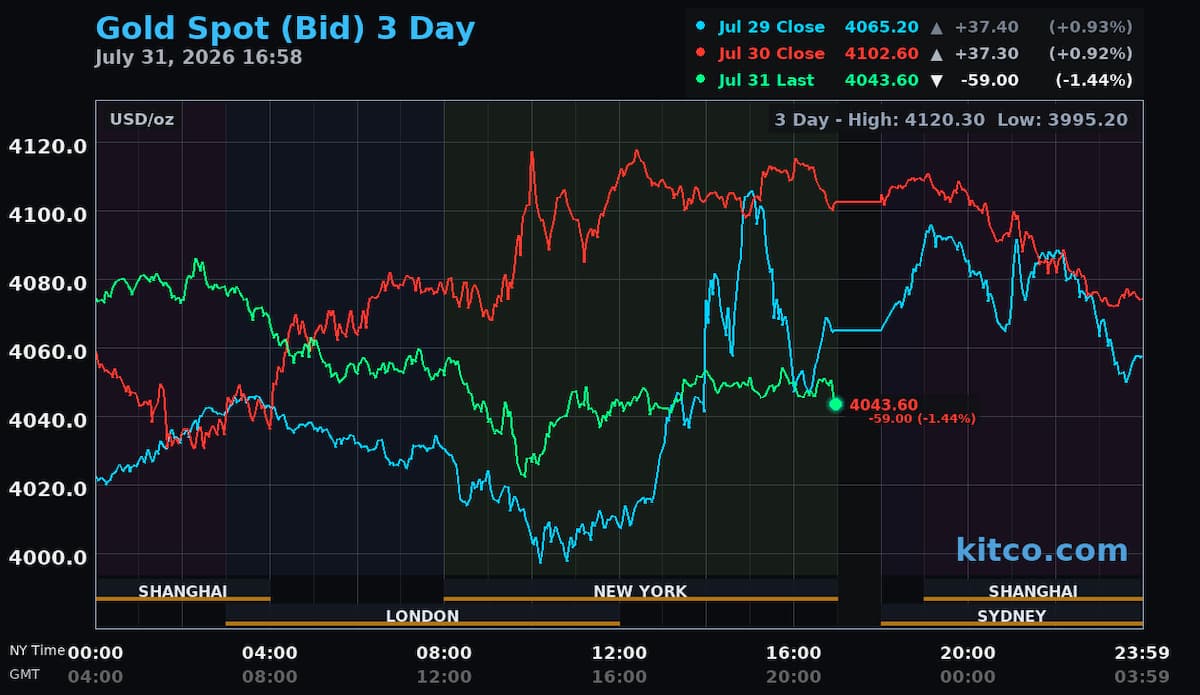
Technically, spot gold bears have the overall near-term technical advantage as prices remain below the 50-period moving average near $4,058 and the 100-period moving average near $4,071, while the metal failed to hold Thursday’s push above $4,101.10. Bulls' next upside price objective is to push prices back above $4,101.10, with a sustained move targeting $4,114 and then $4,166. Bears' next near-term downside price objective is a break below $4,018.20, with deeper downside targets at $3,995.20 and then $3,959.80. First resistance is seen at $4,101.10 and then at $4,114. First support is seen at $4,018.20 and then at $3,995.20.
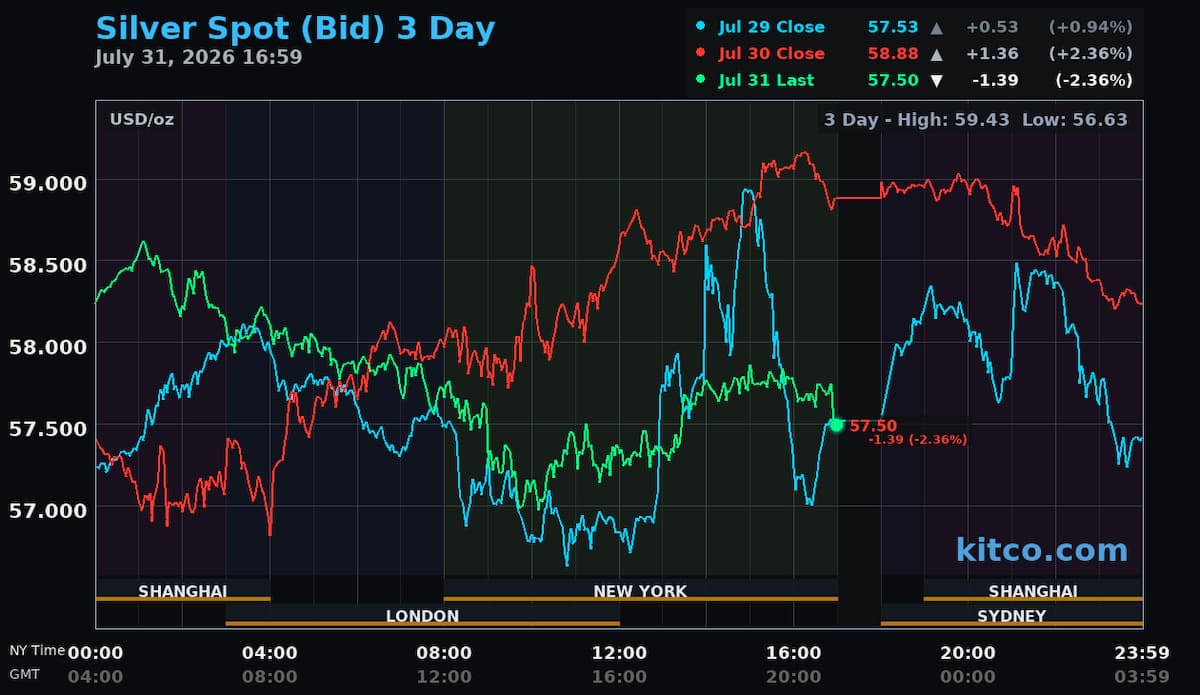
Spot silver bears have the overall near-term technical advantage as prices remain below the 50-period moving average near $58.11 and the 100-period moving average near $58.78, while the metal failed to hold Friday’s move toward $59.30. Silver bulls' next upside price objective is to drive prices back above $59.00, with a move above that level targeting $60.03 and then $61.03. The next downside price objective for the bears is a break below $56.86, with deeper downside targets at $56.11 and then $54.84. First resistance is seen at $59.00 and then at $60.03. Next support is seen at $56.86 and then at $56.11.
