
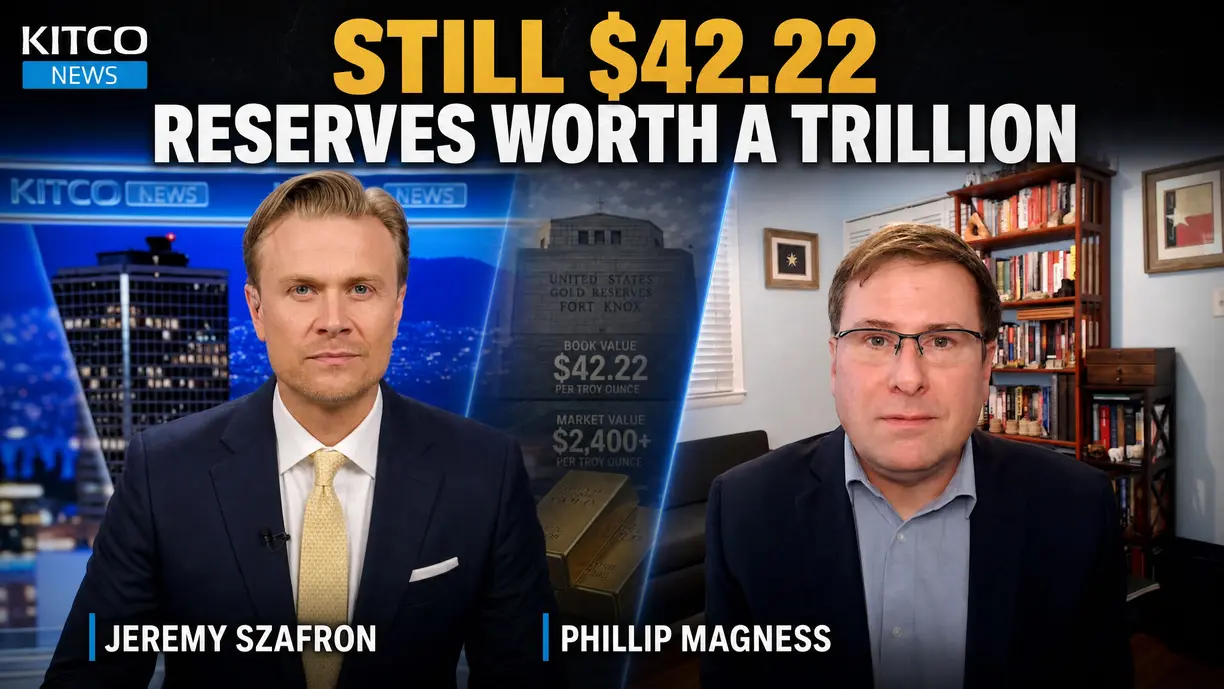
(Kitco News) - America's gold is still valued at $42.22 an ounce on the federal books, more than $1 trillion below market. The fund built from the last revaluation was buying yen on Friday.
The United States values its gold at $42.2222 an ounce.
Not close to that. Exactly that. The figure is fixed by statute; it was set in 1973, but nobody has been able to buy an ounce of gold at that price since Richard Nixon was in office.
The government reports holding 261,498,926 fine troy ounces, roughly 8,133 metric tons. At the statutory price, which comes to about $11.04 billion, according to Treasury's Fiscal Data disclosures. Gold was bid at $4,051.50 an ounce late Monday afternoon, about 96 times the official number. The same metal is worth more than $1 trillion at market.
A gap that size has a way of attracting attention, and every few years someone in Washington proposes closing it.
Economic historian Phillip Magness has a suggestion for anyone wondering who would collect the money. Look at what happened the last time.
"It's always the private sector that gets the bad end of it," Magness told Kitco News.
Asked whether there is any version in which the person holding coins participates, he did not elaborate much. "Not really."
What the last one looked like
Franklin Roosevelt ordered Americans to surrender their monetary gold in April 1933, with limited exemptions for jewelry and collections. The Treasury paid the official price of $20.67 an ounce.
Magness described the order as one improvisation among many.
"He entered into office not really knowing what to do, and it was kind of like throwing things at the wall to see what stuck," he said. Roosevelt inherited an economy Magness argues had already been damaged by tight money, the Smoot-Hawley tariff of 1930 and a 1932 income tax increase. "These are just one, two, three steps of how to make a recession into a great depression."
Breaking the gold link did more than loosen credit, in his reading.
"It unchained the U.S. federal government from a gold-backed dollar," Magness said. "That also allows you to effectively revalue the dollar, to engage in kind of a backdoor inflationary scheme, and use that to sustain all sorts of government spending."
Very little of the metal had to be collected door to door. Most of it was already sitting in banks, and the banks did the work.
"Part of the enforcement comes about by the government ordering those financial institutions to hand over the gold and convert the assets," Magness said.
Then came the part that pays.
Congress passed the Gold Reserve Act on Jan. 30, 1934. Roosevelt fixed the official price at $35 an ounce the next day. The official gold price rose about 69%. The dollar's official gold value fell about 41%.
The Treasury booked a gain of roughly $2.8 billion on the difference, according to Federal Reserve historical records. In 1934 money. Two billion of it capitalized the Exchange Stabilization Fund, giving the Treasury a pool it could use in gold, currency and securities markets without going through the Federal Reserve.
The Americans who had handed in gold at $20.67 nine months earlier received none of it.
They also could not simply buy it back. The Supreme Court upheld the cancellation of gold clauses in private contracts on Feb. 18, 1935, and private ownership stayed restricted for four decades. Public Law 93-373, signed by President Gerald Ford in August 1974, took effect on Dec. 31 of that year. Ford revoked Roosevelt's order the same day.
A few people found the door before it reopened, Magness said, by buying gold where it was still legal to own.
"A wise investor, someone who read the gold market and then noticed what was afoot in the U.S. government and moved some of their assets into physical gold holdings, they made bank on that relative to the dollar," he said.

The 1934 fund is still trading
The Exchange Stabilization Fund is not a museum piece. The Treasury's currency operations still run through it, and it was in the market last week.
On Friday, the Federal Reserve Bank of New York bought yen on the Treasury's behalf while Japanese authorities intervened on their own account. It was the first coordinated yen-buying operation by the two governments since 1998, and it came with the yen near its weakest level against the dollar in close to four decades. The dollar closed at 157.40 yen in New York, having traded above 162 before the intervention.
Ninety-two years after the revaluation that paid for it, the fund was buying currency on a Friday afternoon.
Why the number survived, and why the idea returns
The $42.22 is a leftover from a system that no longer exists.
The Smithsonian Agreement of December 1971 set the official price at $38. A second devaluation in February 1973 moved it to $42.2222. Then the fixed-rate system collapsed, currencies floated, the Bretton Woods obligations were formally ended in 1976, and the number simply stayed where it was. It has outlived the arrangement that produced it by half a century.
"This is one of the great mysteries that comes out of the Nixon era," Magness said. "It's really another hodgepodge of policies."
In practice, revaluing would mean marking up the gold certificates the Treasury has issued to the Federal Reserve against that metal, crediting the Treasury with the difference without selling an ounce. The proposal surfaces periodically and does not advance. One current instance sits in a bitcoin reserve bill introduced in May by Rep. Nick Begich, R-Alaska, which lists revaluing those certificates as one of five mechanisms the government might study for funding bitcoin purchases without adding to the deficit. It directs a study rather than a revaluation, and has had no action since it was referred to committee.
Asked whether replacing the number with the market price would accomplish anything, Magness was unimpressed by the accounting entry.
"It's almost entirely on the market side, because the accounting figure is just a number on paper, and you cannot confuse markets through accounting gimmicks," he said. "If you put a fixed number on paper but the market is actually valuing this at something very differently than the fixed number, as soon as the market is allowed to operate, the price will change."
As for why the idea keeps resurfacing at all, he pointed at the alternatives.
"Taxes are extremely unpopular. A great way to get yourself defeated in the next election is to raise taxes," Magness said. "So one way to work around this, though, is currency manipulation, is to take on massive amounts of debt."
Total public debt outstanding reached $39.84 trillion on July 30, according to Treasury. Magness, who put it "right on the verge of $40 trillion," argues that debts of that size get serviced partly through the slow erosion of what the currency is worth.
He sees the same pattern in the growth of the central bank's authorities, which widened in the 1930s, again after 1971, and again in 2008.
"It's like a one-way ratchet," Magness said. "The new power claimed by the Federal Reserve never goes away."
Asked when the nation's gold was last independently audited, he declined to guess. "I actually don't know the exact final last date of an audit, other than there has not been one in a long time."
Central banks, meanwhile, are still buying. They took in 288.9 metric tons in the second quarter, up 62% from a year earlier and a record for a second quarter, according to the World Gold Council. First-half purchases of 345 tons were still the weakest since 2022.
The condition to watch
Magness does not expect 1933 to happen again, and he was direct about why.
"I don't think we have a risk right now of going back to another 1933, 1934 period where the president of the United States declares on a whim that he's going to confiscate gold," he said. "Some of the aftermath of the statutes that have been put in place are more of a buffer against that, because we have codified and re-legalized gold holdings in the United States."
The protection, in other words, is the law that was passed after the fact.
Asked to name the one condition that made the original action possible, he did not hesitate.
"The sense of emergency," Magness said. "Always be wary when politicians are claiming that there's emergencies afoot."
The rest, he said, is a question of what a holder can put out of reach.
"The more you can insulate yourself from the whims of politicians, the better. Some of the things that are insulated from those pretexts are private holdings of precious metal."
And then the line he closed on, which is the reason the 1934 arithmetic still matters.
"It's a warning from history that this has been done before. So be on the lookout."
Phillip Magness is an economic historian and the David J. Theroux Chair in Political Economy at the Independent Institute.