
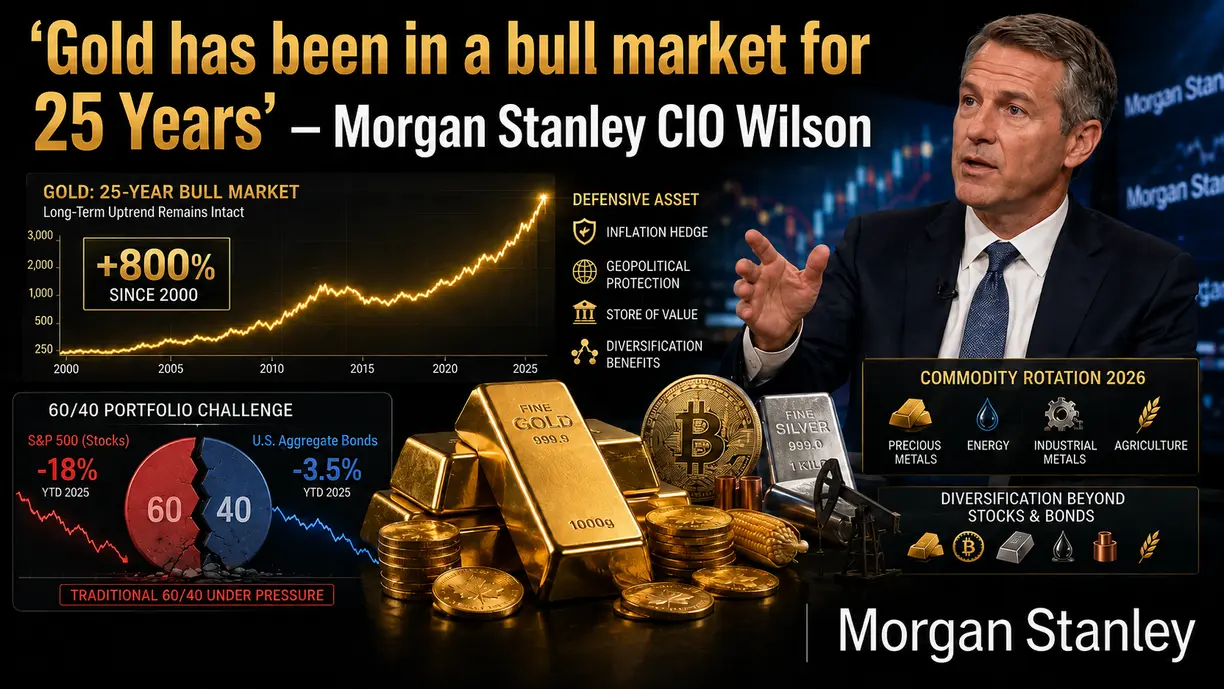
(Kitco News) – Gold and other commodities are ideally suited to environments where the 6040 portfolio is not delivering the performance and security it once did, and the yellow metal has actually been in a quarter-century bull market, according to Mike Wilson, chief US equity strategist and CIO at Morgan Stanley.
In an interview with Bloomberg TV on Friday, Wilson was asked about the challenges to classic portfolio construction in the wake of the 2022 downturn.
“The really challenging thing of 2022 for retirees is that stocks and bonds went down for the first time really in our lifetimes, so there was no hedge,” he said. “Even though the decline in equities wasn't as severe as it was in 2008, or 2001-2002, your 60/40 portfolio was down the same. That was a change, and that was one of the things that made investors apprehensive to step in. It was like, ‘holy smokes, I'm getting hit both on my defensive stuff and on the offensive part of my portfolio!’ I think people froze up.”
“As a person who has their money in the market for retirement, or a long-term investor, you really should avoid being shaken out at both the top and the bottom,” he cautioned. “In other words, chasing stocks is as damaging as selling stocks at the bottom in my view. That's why we like dollar-cost averaging, that's why we still like diversified portfolios. 2022 was a challenge in that, but it ended up working out for people who stayed fully invested.”
Wilson was then asked how investors can shore up the defensive portion of their portfolios in an environment where bonds are underperforming or higher-risk.
“These asset classes are now more closely correlated, so they're just not going to offer that natural diversification benefit that they have historically,” he replied. “That means you need to do other things.”
Wilson mentioned both gold and possibly Bitcoin as examples of assets that can defend against inflation in these environments.
“We've been a very big advocate of gold, not so much as a yielding instrument, but as a defensive asset,” he said. “That doesn't mean you abandon fixed income, but it does mean you reduce your duration. There are things you can do within your fixed income portfolio to make it more valuable and still provide some diversification benefit, without taking too much risk on the duration side.”
Wilson was then asked if he thinks gold could return to the meme-stock-like performance it was delivering earlier this year.
“Gold has been in a bull market for 25 years,” he replied. “People kind of woke up to this idea more recently, at the beginning of the year.”
Wilson said 2026 has featured one giant commodity rotation. “You have to remember that at the end of last year, the Fed started printing money with this reserve management program,” he said. “That led directly to gold and silver stocks taking off. Then we went into rare earths and metal stocks, then energy stocks, and then semiconductors.”
“Now, what do all those have in common? They're all commodities,” he said. “It's kind of interesting to me that that's what's been going on, and that may be exactly what people are doing: They're looking for things that are not stocks, but commodity-like, to offset the risk they have in their portfolio with equity-like risk.”
One June 22, commodity strategists at Morgan Stanley warned that without a meaningful rebound in ETF inflows, gold will have trouble achieving their bullish target of $5,200 per ounce in the second half of 2026.
“While central bank gold buying may resume regardless, ETF flows are more sensitive to changes in rate expectations,” analysts Amy Gower and Martijn Rats wrote in a research note at the time. “The missing piece is ETF demand, which is likely to remain sensitive to the Fed path, real yields and the dollar.”
The investment bank remains bullish on the precious metal’s long-term outlook, as they expect easing tensions in the Middle East and lower oil prices will help reduce inflation expectations. However, the analysts cautioned that Federal Reserve’s hawkish tone at the June meeting raised expectations that interest rates could stay higher for longer, which increases the opportunity cost of holding non-yielding assets such as gold.
On May 6, Gower said that she was seeing renewed momentum in the gold market as she reiterated her call for gold prices to end the year around $5,200 an ounce, adding that she is not surprised the yellow metal has struggled in recent months despite heightened geopolitical uncertainty from the ongoing war in Iran.
“With the conflict triggering an energy supply shock that has reduced hopes for lower U.S. interest rates, it is not surprising that gold has struggled to work as a safe haven this time,” Gower said. “Gold’s sensitivity to monetary policy has taken over as the key price driver. This has overshadowed its safe-haven status and reduced its effectiveness as a hedge against both geopolitical and inflation risks. Gold prices reflect not just the impact of a particular event but, more importantly, the policy response that follows.”
High oil prices, driving inflation pressures, are forcing the Federal Reserve to reevaluate its easing policy stance and, as a result, markets have started to price out rate cuts this year. At the time, Morgan Stanley was still betting on at least one rate cut this year, which would support higher gold prices.
“Gold is likely to remain sensitive to real yields, but we see room for further upside,” Gower said.
In May, Morgan Stanley saw one rate cut in January followed by another rate cut in March 2027.
“This should benefit gold, with ETF purchasing decisions particularly sensitive to policy signals and gold now realigning with real rates,” she said.
Gower added that the longer the Iran conflict continues, the greater the risks are for gold.
“Gold prices may suffer if markets begin to anticipate prolonged rate holds or even hikes,” Gower warned. “At the same time, upside in a resolution scenario could be limited, as already elevated prices may constrain demand from ETFs, central banks and consumers.”
See live precious metals prices for gold, silver, platinum and palladium — in USD, CAD and 12 more currencies.
