
(Kitco News) – Gold prices are getting a boost from falling rate hike expectations, but Asian investors and central banks never abandoned the yellow metal, and prices will gain an additional 11% between now and year-end, according to strategists at Wells Fargo Investment Institute.
“After a challenging five months, gold is regaining momentum, supported by hopes for progress toward negotiations in the Middle East and by investors scaling back expectations for Fed rate hikes,” the strategists wrote in their latest report. “Gold prices rose more than 7% during the first week of August, marking the strongest weekly gain since January. ETF flows also improved, with outflows stabilizing and even beginning to reverse higher.”
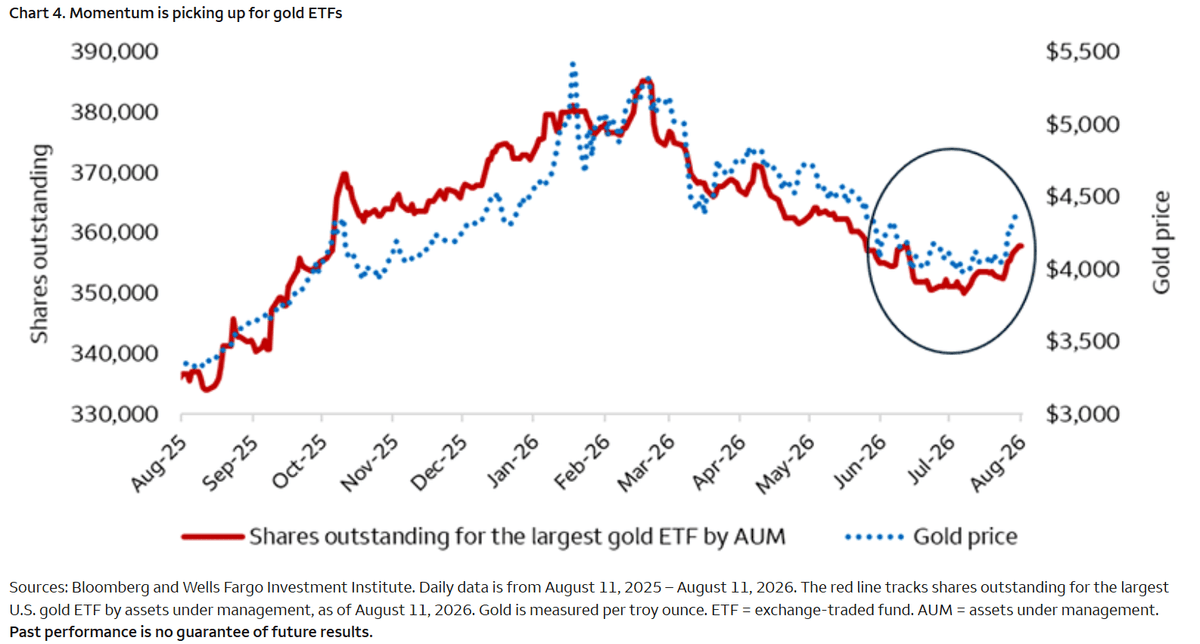
“Undoubtedly, gold has struggled since March 2026, as rising U.S. inflation-adjusted yields and concerns that inflation could pressure the Fed to raise interest rates make gold, which does not pay its holders interest, relatively less attractive against interest bearing assets,” they acknowledged. “However, despite gold’s weak performance we believe we continue to see several underlying strengths.”
Wells Fargo pointed to resilient global demand through the first half of 2026 as a reason for optimism. “International investors have been especially constructive amid heightened geopolitical and market uncertainties, inflation risks, and relatively low interest rates in select key markets — such as China,” the analysts said. “While gold’s global spot price was down 5% through the first half of the year, Asian investors have actually been persistent purchasers, and when measuring gold’s performance during Asia’s trading hours the yellow metal is up 13%."
"We believe these same geopolitical and market uncertainties reinforced gold’s role and supported the rebound in central bank purchases during the second quarter.”
Looking ahead, Wells Fargo sees these strengths supporting continued gains for gold, and the firm reiterated their favorable outlook for the precious metals complex as a whole.
“That said, we believe gold’s path higher will be uneven, as international demand is challenged by U.S. monetary headwinds,” they cautioned. “For these reasons, we remain favorable but revised our 2026 and 2027 year-end gold targets lower to 4,900–5,100 and 5,400–5,600 per troy ounce, respectively.”
In a recent interview with Kitco News, Sameer Samana, Wells Fargo’s Head of Global Equities and Real Assets Strategy, said gold has now reached a point where the downside risks are becoming increasingly limited while the long-term upside remains compelling.
"I think the risk-reward has flipped quite a bit since the peak," he said. "If the Fed funds futures market is embedding two to three hikes, then I think the price of gold is embedding two to three hikes."
Samana said that after gold's more than 20% correction from its January record high, investors should shift their focus away from short-term volatility and instead evaluate the metal's longer-term risk-reward profile. He added that regardless of whether oil prices remain elevated or the Federal Reserve ultimately delivers additional rate hikes, much of that risk has already been reflected in gold prices.
Samana believes investors now need to ask a different question: "What are the odds of something greater than two to three hikes? Inflation isn't that much of a problem where you would need significantly more tightening."
Gold has struggled for months as renewed Middle East tensions have pushed oil prices higher, which in turn have fueled expectations that the Federal Reserve may be forced to tighten monetary policy. Rising real yields have increased the opportunity cost of holding non-yielding assets like gold.
However, Samana argued that markets have likely become overly pessimistic.
"The real question is whether the risk-reward is favorable for an exposure in your portfolio that's very hard to replicate elsewhere,” he said. “I think so.”
Downside risk remains, but long-term trend is intact
Samana acknowledged that the technical picture has yet to improve and warned investors against assuming the correction has fully run its course.
“It’s hard to argue that gold has bottomed," he said. "In the near term, I think you probably have risk to the downside to $3,500,"
At the same time, he also noted that technical resistance is also likely to emerge between $4,500 and $4,900 as investors who bought near the highs look to exit losing positions.
Despite those risks, Samana emphasized that investors should not lose sight of the bigger macroeconomic cycle.
"When the dust settles, you'll be back to much of the same," he said. "Higher oil prices and higher interest rates are going to slow the economy, which will then cause central banks and fiscal authorities to come back in and do what they always do."
That eventual slowdown, he said, would likely lead policymakers to cut interest rates again and potentially provide additional monetary support.
"Could you see $3,500 before $4,500? It's possible," he said. "But unless you believe that longer-term cycle is over, then it really is just a matter of time before gold prices are higher."
Gold remains valuable portfolio insurance
Samana noted that gold has historically held up relatively well during economic downturns.
Looking at recent recessions and periods of aggressive monetary tightening, he pointed out that gold's declines have generally been modest compared with many other asset classes. Even during the 2020 recession and the Fed's tightening cycle in 2018, gold experienced drawdowns of roughly 15%, while the 2008 financial crisis produced a decline closer to 34%. More importantly, prolonged bear markets in gold typically unfold over several years rather than in sharp collapses.
Because gold has already corrected nearly 30% from its peak, Samana believes much of the potential damage has already been absorbed.
"I think a lot of the pain has already been discounted in the price," he said.
He added that gold continues to provide valuable diversification because it often performs well when traditional assets struggle.
"This is an asset that does not work in every environment," he said. "But when stocks don't work and bonds don't work, there's a really good chance that gold is working."
See live precious metals prices for gold, silver, platinum and palladium — in USD, CAD and 12 more currencies.
