
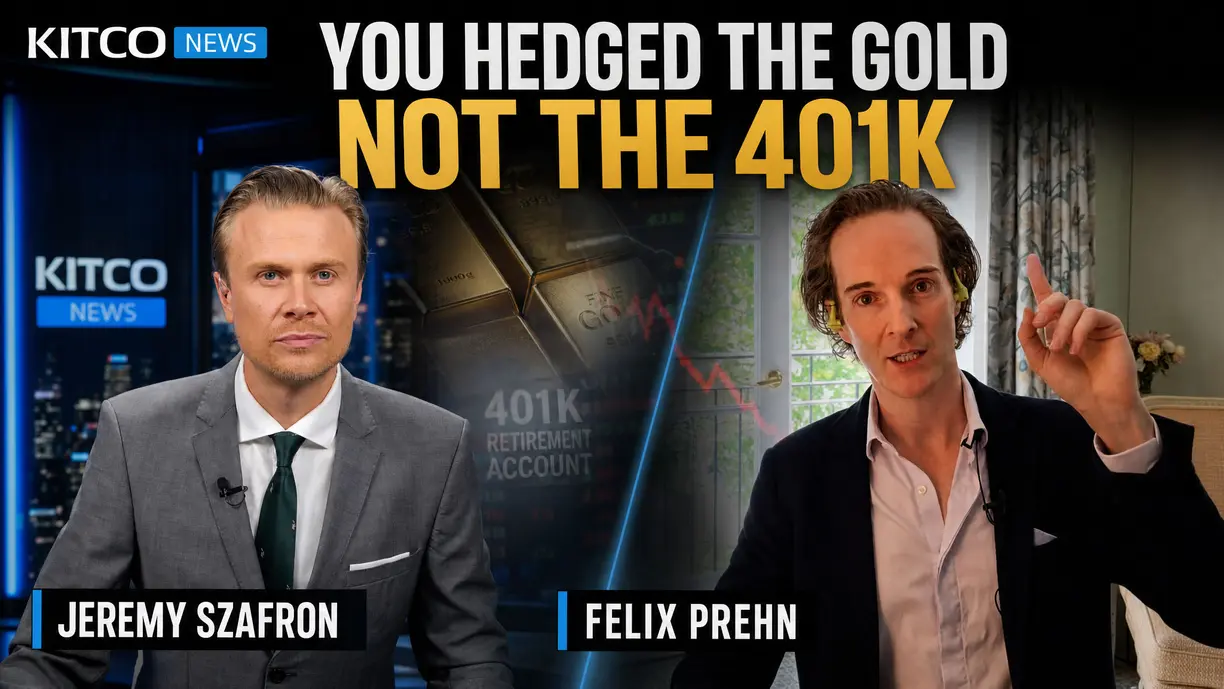
(Kitco News) - Five up weeks. On pace for the best month since 1999. And at around $4,650, gold is still nowhere near the record it set in late January.
That's the setup Felix Prehn walked into on Tuesday.
The rest of the picture: a 30-year Treasury yield that touched 5.34% last week, close to a 20-year high. Federal debt over $40 trillion. And on September 9 the Treasury doubles the size of its buybacks of long-dated bonds, from $2 billion an operation to at least $4 billion. Buying its own bonds props up the price, which pushes down the interest rate the government pays on the next lot.
Treasury calls that liquidity support.
Prehn spent years inside an investment bank before he left and started teaching retail investors. He has a translation.
"They're saying to the bankers, it's end of year bonus support. We're going to pump some money into the market, and it's going to be glorious for the people who understand it."
I asked whether that was too cynical.
"They don't want to be seen as printing money because people remember what happened after COVID. So they're coming up with these alternative names for it. It's just pulling the wool over the eyes."
To be clear about what's his view and what isn't: Treasury says new issuance replaces whatever it buys back, so the programme shouldn't materially reduce privately held debt. A buyback doesn't create money on its own. Prehn's version depends on the Federal Reserve eventually absorbing the replacement paper, and the announcement doesn't say that.
The part I found harder to argue with came next.
The concentration nobody chose
Prehn's team reviews thousands of real portfolios. So he sees what people own, not what they think they own.
"Most people are about 60, 70% AI exposure. The S&P is about 50%, so your 401k likely is about half AI."
Those are his figures. The independent numbers point the same direction. The ten biggest companies in the S&P 500 are roughly 40.8% of the index now. In 1990 they were about 19%. At the top of the tech bubble, 26.6%.
Households are loaded the same way. Fed data puts equities at about 41.6% of household financial assets as of early 2024, and that measure doesn't count the house. The dot-com high was 38.4%.
Which is the thing that's been nagging at me all week. Somebody buys physical gold because they don't trust the system, and the bigger pot of their money is sitting in one of the most concentrated markets ever recorded.
Then they make it worse, he says, by adding the same handful of companies on top of an index that already owns them.
"Sort of La La Land. We have valuations beyond anything we've seen. Dotcom, 2008, 1929."
He didn't oversell it. "It doesn't mean the crash is coming tomorrow. I'm not one of those doomsayers."

What gold is actually for
He's bullish. "I think we've turned a bullish corner again here."
But he wouldn't let the metal be something it isn't.
"I always say gold doesn't go up, the dollar goes down. So it protects us, but it doesn't actually make us wealthy."
"That's your insurance. It's like your car insurance. You can fall back on that, and it's going to make you feel better and sleep better at night."
He also has no patience for people who are certain about anything, including himself. "I always say a conviction is a bit like an STD. It's not something you actually want to have."
I asked him about January, because a lot of people watching bought near the top and have spent seven months waiting to get back to even.
"Shouldn't gold go up when you have a war? And no, actually, it shouldn't. It doesn't."
His reading: the Iran war pushed oil up, then inflation, then bond yields, and institutional money left a metal that pays nothing for government paper that pays five and a bit.
"It scared people because they bought in January and they're underwater by 20, 30%, so they're waiting to go back to zero. And it's unfortunately just where we are as retail investors, because we've never been taught how this actually works."
Silver he split. Gold over a five-year hold because it's calmer. Silver for the bigger number, if you can stomach it. And the industrial case, he thinks, is genuine: "all the AI stuff couldn't be done without silver at present."
Fifteen years
Newmont did a record $2.2 billion of free cash flow last quarter. Agnico Eagle just over $1.3 billion. That's the cash left after running the business and spending on the mines, and it's the best the producers have looked in years.
The shares have started catching up. GDX is up roughly 14% since closing just under $91 on August 12. It's still about 11% below where it traded in February.
Prehn's argument for the sector has nothing to do with the gold price.
"The cycle for putting a mine out is very long. It's like 15 years plus. So all this cash now isn't going to increase supply, and that's why I think this gold and silver story in the miners has longer legs than most people think."
On permitting: "You need approval for every frog and bird that lives in the vicinity."
He drew one line I'd want every viewer to hear. "You don't hold a miner forever. You could arguably hold gold or even silver forever. So it's a very different beast."
Where the fees go
The banker came out when we got onto private markets. Buyout firms are sitting on something like $3.8 trillion of companies they can't sell, and average holding periods have stretched to about seven years, according to Bain.
"They get paid fees. They take very little risk, so they just get paid in fees. They don't really care."
And when investors want out?
"They can basically lock up these funds. They're just not paying out. You want your money back and they say, sorry, read the terms and conditions."
What he'd tell a 70-year-old
The Conference Board's confidence index hit a seven-month low this week. Expectations for the next six months are the weakest since January. So this isn't a hypothetical question.
"Cash is not neutral. Cash feels safe."
After that it was arithmetic. Big portfolio, stay in the index, because a 30% or 40% drawdown is survivable if you can still live on 4% of it. Smaller portfolio, move some into short-term Treasury bills and accept the worse return.
Then he said the thing I keep coming back to.
"That's the unfair world we live in. The later you figure this out in life, you've got a little bit less options. The earlier you figure this out, and literally every five years makes a tremendous amount of difference."
See live precious metals prices for gold, silver, platinum and palladium — in USD, CAD and 12 more currencies.