
(Kitco News) - Gold’s dramatic rise over the last several years may have pushed prices to levels that once appeared unimaginable. Still, according to one market strategist, investors shouldn’t get distracted by price targets.
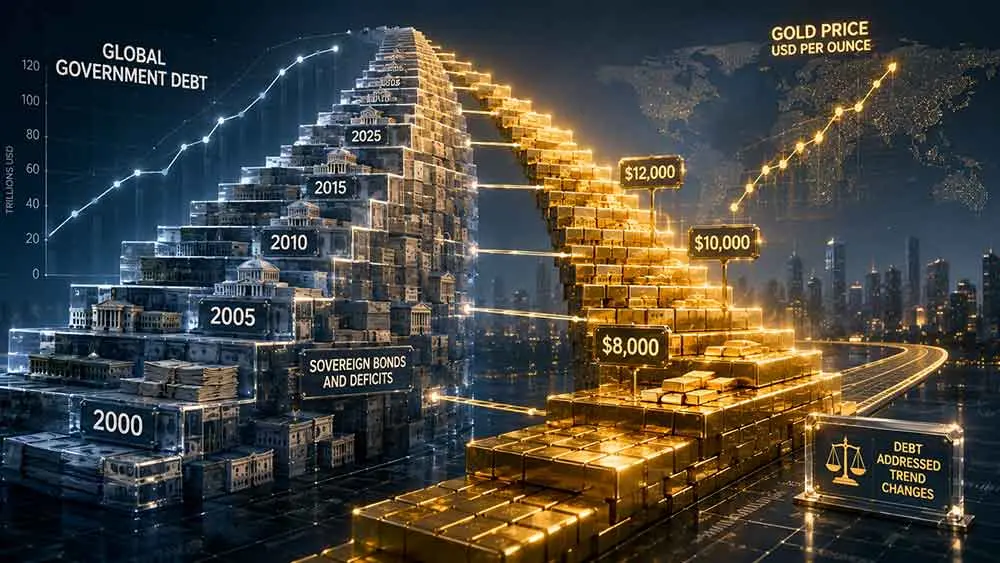
In an interview with Kitco News, John LaForge, Chief Alternative Strategist at Ned Davis Research, said the gold trade remains extremely simple: the precious metal’s long-term trend remains higher until governments around the world finally confront their mounting debt burdens.
“I think prices peak when we learn how to deal with the debt situation,” LaForge said. “The longer we let it go and we don’t pay this stuff back and we keep piling all these debts up, the higher gold prices can go.”
Asked whether investors should be looking toward $8,000, $10,000 or even $12,000 an ounce, LaForge said those levels aren’t particularly important to his outlook.
“To me, it’s not like there’s this point that it’s, ‘Oh, it’s 8,000, oh, it’s 12,’” he said. “All I know is the trend is up until we deal with government debt. I think we can still see multiple years of higher prices because I don’t get the sense at all that, globally, politicians and leaders want to deal with it,” LaForge said.
Although gold has risen from around $1,500 an ounce to more than $4,000 over the last decade, LaForge said the precious metal still has plenty of room to run. He sees the market roughly six or seven years into a broader commodity supercycle, with no evidence that the long-term trend is nearing exhaustion.
“We have plenty of room for this thing,” he said.
LaForge described the current environment as potentially one of the strongest fundamental backdrops gold has ever experienced. The critical difference in this cycle, he said, is that central banks have emerged as an important source of structural demand as they reconsider the security of traditional reserve assets.
That shift accelerated following Russia’s invasion of Ukraine in 2022 and the subsequent freezing of Russian foreign reserves. According to LaForge, the episode forced central banks to recognize that assets held within the global credit system ultimately remain exposed to government control.
Gold, by comparison, remains one of the few globally recognized “bearer assets” that can be physically owned outside that credit system.
“There just aren’t many bearer assets that you as a central bank can hold where everyone in the world pretty much agrees, if you sent them a bar of gold, they’d say, ‘All right, I’ll take payment for that,’” he said.
At the same time, LaForge said the enormous expansion of sovereign debt is creating an increasingly powerful tailwind for hard assets.
With governments continuing to pile on debt, he sees few politically palatable ways out other than eventually resorting to currency debasement.
“There’s no way to pay this thing beyond just debasing everything,” he said. “This is the biggest tailwind gold has had.”
While the U.S. economic situation has garnered significant attention in recent weeks as the nation’s sovereign debt has pushed beyond $40 trillion, LaForge said Japan could offer an important warning for other heavily indebted developed economies.
LaForge said policymakers in the West had hoped Japan could demonstrate that governments could suppress borrowing costs indefinitely through yield-curve control despite enormous debt loads. Instead, rising Japanese yields and the unwinding of decades of ultra-loose monetary policy are demonstrating the limitations of that strategy.
“A lot of the West, we’ve gotta figure out how to deal with our debt the same way,” he said. “The last thing … the powers that be want is to show that yield curve control won’t work.”
LaForge said he remained bullish on gold through its months-long correction as government debt continued to grow. He added that the debasement trade was reignited by the Treasury Department’s intervention in markets. He explained that he saw gold’s selloff as a market simply waiting for another catalyst.
One important signal is gold’s long-term momentum. Despite prices reaching record highs this year, LaForge said none of the indicators he watches produced the kind of blow-off-top signals normally associated with the end of a commodity supercycle.
“None of them gave blow-off top signs,” he said. “Zero.”
He added that gold’s current momentum looks more like a “middle-cycle” move than the speculative excess seen near the 2011 peak.
That backdrop is also shaping LaForge’s portfolio strategy. He said investors should look to build at least a 10% allocation to alternative assets. He explained that roughly 5% should currently be allocated to gold, 3% to a broad basket of commodities and 2% to Bitcoin.
Gold deserves the largest weighting because it offers the most direct exposure to the structural debt and monetary pressures driving the current cycle.
“Gold has such a unique time in history,” LaForge said. “This is the time it’s all coming together.”
LaForge said the ultimate end of gold’s bull market is unlikely to be determined by whether prices reach $8,000, $10,000 or any other predetermined level. Instead, investors should watch for governments finally imposing fiscal discipline and restoring confidence in the credit-based monetary system.
Until that happens, he said he sees little reason for gold’s structural trend to change.
“It’s not completely off the tracks yet, but it’s almost like the train has gone from moving 40 miles an hour to 120,” he said. “We gotta slow this thing down, or we’re not gonna stay on the track.”
See live precious metals prices for gold, silver, platinum and palladium — in USD, CAD and 12 more currencies.
