
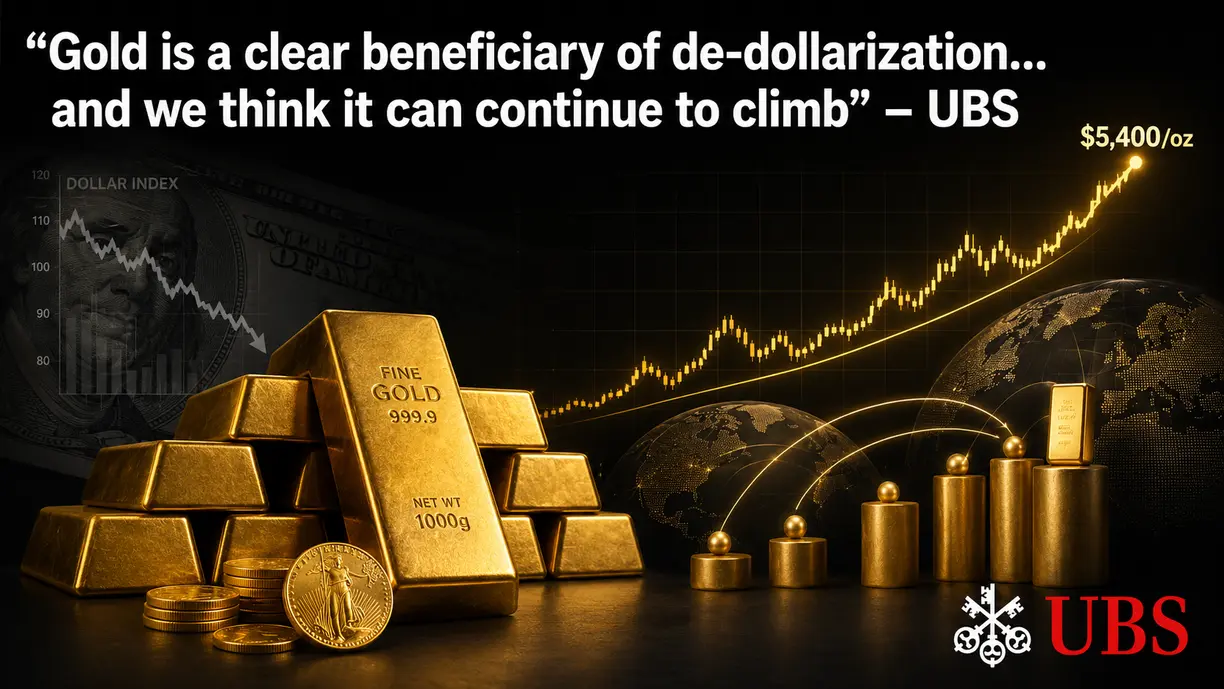
(Kitco News) – Gold is benefiting from a reinvigorated de-dollarization trade, and the monumental fiscal challenges facing the United States could push the yellow metal’s price above $5,400 by next summer, according to commodity and currency analysts at UBS.
“Investors’ focus on the long-term shift away from the US dollar, known as de-dollarization, has increased recently amid renewed concerns about the US fiscal outlook,” the Swiss banking giant’s Chief Investment Office wrote in a note on Tuesday. “Over the past month, the DXY dollar index has fallen 2.4%.”
(Kitco Global Index shows how much of today's gold move is the dollar versus the gold market itself.)
UBS believes that the dollar might receive some near-term support from the conflict in the Middle East and high oil prices. “But we think that gradual diversification away from the US dollar—and a depreciation trend over the medium to longer term—will remain intact, underpinned by continued concerns over the US fiscal trajectory, uncertainty around trade policy, and growing evidence that many countries are diversifying their reserve holdings away from the US currency,” the analysts said, adding that investors should consider exposure to gold, broad commodities, and certain global currencies to benefit from diversification.
UBS highlighted gold’s potential in the current environment, saying the yellow metal’s current rally has room to run higher.
“Gold is a clear beneficiary of de-dollarization, as investors consider bullion a reliable store of value and an alternative to traditional reserve currencies,” the CIO wrote. “The gold price has risen around 15% this month, and we think it can continue to climb amid further pressure on the US dollar.”
UBS also expects markets to scale back their expectations for Federal Reserve rate hikes, which would also be supportive of higher gold prices. “Recent data point to continued demand for the precious metal—investment flows into gold exchange-traded funds (ETFs) have resumed, while central bank purchases remain robust,” the analysts noted. “In July, the People’s Bank of China increased its gold reserves by 20 metric tons, the largest monthly increase since October 2023. We forecast gold prices to reach USD 5,400/oz over the next 12 months.”
UBS also suggested looking beyond gold to the broader commodity complex to benefit from diversification. “Gold is not the only asset that can hold its value when traditional currencies lose purchasing power,” they wrote. “A broad allocation to commodities can provide an additional source of long-term returns and help protect portfolios if rising inflation expectations challenge equities and bonds. Oil demand remains strong, and we expect it to continue growing over the coming years, particularly in emerging markets. Industrial metals should also benefit from long-term demand linked to electrification, the energy transition, and the ongoing global buildout of AI infrastructure.”
The CIO also suggested diversifying into other currencies. “[W]e think the current environment is supportive of selective exposure to higher-yielding currencies, including the British pound and the Norwegian krone, they said. “We also like the New Zealand dollar given the hawkish policy bias of the country’s central bank, and the Chinese yuan amid strong export-driven FX inflows. Select emerging market currencies may also offer carry opportunities.”
“[A]s the long-term shift away from the US dollar continues, we think exposure to gold, broad commodities, and select currencies can help support returns and manage portfolio risks,” they added.
In mid-August, UBS strategists said that falling real rates will drive investors back into gold this year, with a weaker dollar and strong central bank demand helping to propel prices back toward $5,000 per ounce in the first half of 2027.
In a client note, the Swiss banking giant pointed out that prices successfully broke out of their recent $100 trading channel to rise above the $4,250 resistance area for the first time in two months. “Reported Chinese institutional buying and inflows into exchange-trade funds (ETFs) have supported the latest price movement, while recent joint government efforts by the US and Japan to stabilize the yen may also have helped reduce the risk of a sell-off in US Treasuries,” they wrote.
“Near-term risks remain, especially if US data stay firm, oil prices keep inflation concerns alive, or markets continue to price in a more hawkish Federal Reserve rate path,” the strategists warned. “But while the immediate backdrop may remain volatile, the medium- to long-term case for gold still looks supported by several durable drivers. We expect gold prices to rise toward USD 5,000/oz in the first half of 2027.”
UBS expects lower real interest rates will help to reignite investment demand for the yellow metal. “[W]e expect inflation to gradually moderate, allowing the Fed to hold interest rates steady this year before resuming easing in 2027,” they said. “This should create a more favorable backdrop for gold, as a shift toward lower policy-rate expectations would likely reduce real yields, weigh on the US dollar, and help boost investment demand for gold.”
A softening U.S. dollar and ongoing diversification flows are also powerful medium-term tailwinds for the gold price. “The US dollar may stay resilient in the near term, but structural challenges including large US fiscal and external deficits and already elevated investor allocations to US dollar assets mean there is scope for renewed weakness,” the strategists wrote. “A weaker dollar has historically been a powerful tailwind for gold, while a renewed focus on diversification away from the US dollar should benefit the precious metal.”
Meanwhile, sovereign gold purchases continue to provide a firm price floor beneath the market. “Central bank demand has remained an important pillar of support, even when private investment demand has been lackluster,” they said. “We expect annual central bank purchases to remain elevated, supported by a long-term desire to reduce exposure to USD assets.”
UBS noted that central banks bought 289 tonnes of gold in Q2, and their in-house estimates project full-year purchases to total between 750-1,000 tonnes in 2026. “While these flows may not be enough to drive prices sharply higher on their own, they can help stabilize the market and offset weaker areas such as jewelry demand.”
The Swiss bank advised investors to separate gold’s near-term trading risk from its longer-term investment case.
“[P]eriods of weakness toward USD 4,000/oz or below may ultimately prove to be opportunities to build strategic exposure,” they said. “For investors with an affinity for real assets, we continue to view a mid-single-digit gold allocation as appropriate within a well-diversified portfolio.”
On May 26, UBS cut its year-end 2026 gold price forecast from $5,900 to $5,500 per ounce, citing risks of persistent headwinds from elevated Treasury yields and sustained U.S. dollar strength.
UBS analysts Dominic Schnider and Wayne Gordon wrote at the time that investors are shying away from the yellow metal as yields stay high.
“Markets are rediscovering the concept of opportunity cost, with gold’s non-yielding characteristics once again becoming a more important consideration as real rates remain elevated,” they wrote.
See live precious metals prices for gold, silver, platinum and palladium — in USD, CAD and 12 more currencies.
