
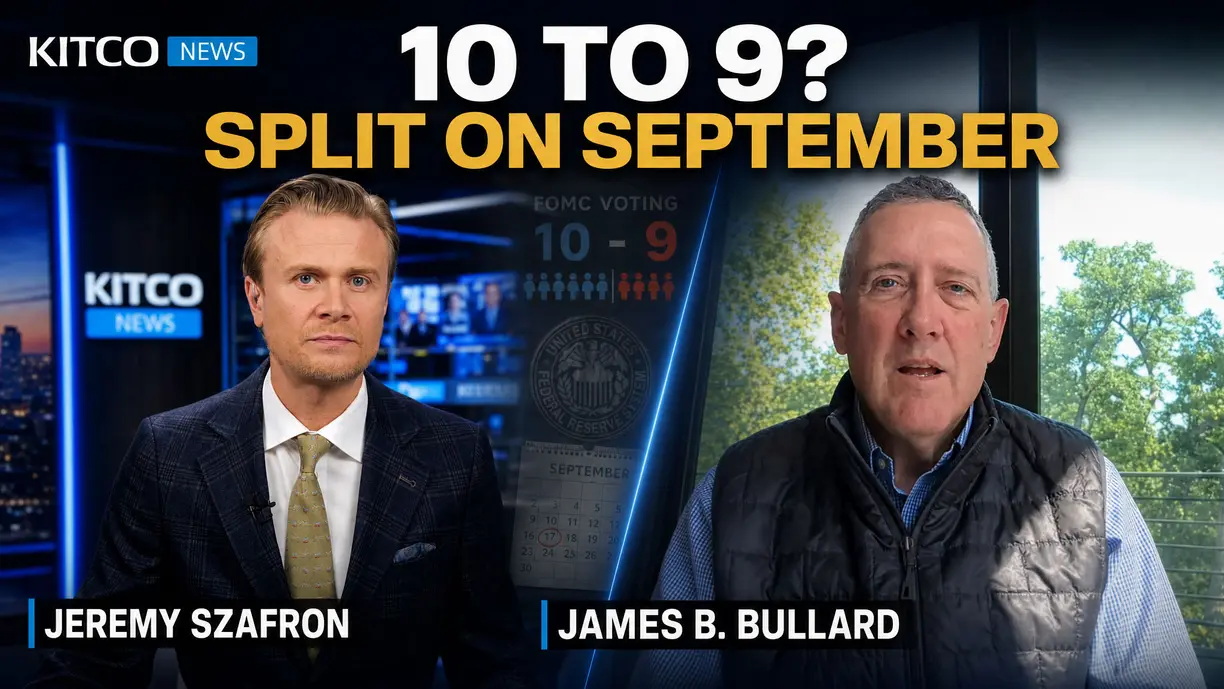
(Kitco News) - Jim Bullard says a hold next month could still be hawkish, foreign central banks found physical gold more desirable than Bitcoin this year, and gold’s run-up may signal eroding faith in the Fed, something he says is "on the radar screen."
The Federal Open Market Committee is divided almost exactly in half over whether to raise interest rates next month, according to a man who sat in that room for 15 years.
"I think the committee is split pretty much down the middle, so 10-9 one way or the other," former St. Louis Fed President Jim Bullard told Kitco News on Friday. "A lot of people that are sitting on the fence could be convinced to go either way."
This is the closest thing to an insider headcount anyone has put on the record this week, and it arrives on a day markets decided the argument was already over.
After Fed Chair Kevin Warsh told the Kansas City Fed's Jackson Hole symposium that "the responsibility for 65 months of sustained elevated inflation sits squarely with the central bank, and that is where it belongs," pricing for a September hike climbed from roughly 36% to about 60% on CME's FedWatch tool. The odds of a cut went to almost zero. The two-year Treasury yield, the part of the curve that tracks the Fed's next move, added 9 basis points, or 9 hundredths of a percentage point. The 30-year barely moved, holding near 5.1%. The currency did the heavy lifting, with the euro down 1.6% and the yen sliding toward 160.
The public record made the hawks look like a small faction. The committee held rates on July 29 by a vote of 9 to 3, its fifth consecutive hold, with Cleveland's Beth Hammack, Dallas's Lorie Logan and Minneapolis's Neel Kashkari dissenting in favor of an increase. Kansas City's Jeff Schmid signaled this week he would put himself in the same camp. Bullard's read says the fence is a lot more crowded than the roll call shows.
Bullard ran the Federal Reserve Bank of St. Louis from 2008 to 2023. In March 2022 he dissented against his own committee for moving too slowly, arguing for a half point instead of a quarter while advocating a plan to start shrinking the balance sheet, then published his reasoning so anyone could check his work. He is now Dean of the Daniels School of Business at Purdue University.
The problem with trading September as yes or no
The most useful thing he said is a warning for anyone treating next month's meeting as a binary.
"You could hold, but it could be hawkish nevertheless," Bullard said. "And you could be more or less signaling that you'd move at the October meeting or at the December meeting."
The mechanism is the dot plot, the quarterly chart where every policymaker marks down where they expect rates to finish the year. September is a dot plot meeting, which makes it, in his view, ironic.
"The September meeting is, ironically, the meeting with the most forward guidance, because that dot plot is saying what you're going to do by the end of 2026 on the funds rate," he said. "That's basically saying what you're going to do at the current meeting and at the next two meetings."
His guess at what those dots show is one increase by year end, possibly two. Which means the committee can sit still next month and still hand markets a tightening path for the rest of the year. Traders are pricing an event. The Fed may be planning a direction.
Bullard had half-expected Warsh to scrap the dot plot outright on Friday and was surprised he didn't. On which risk is bigger – publishing hikes the Fed then fails to deliver, or publishing none after a speech like this morning's – he wouldn't pick a side. "I'd put 50/50 on that one."
He was careful not to paint the chairman as inconsistent on guidance. Warsh's objection, in Bullard's reading, is to the very explicit kind. "If he had come out today and said, ‘for sure we're moving in September,’ or ‘for sure we're not moving in September,’ that's overly prescriptive about what the committee will actually do. And at times that has gotten the committee into trouble." Bullard fought calendar guidance himself the entire time he was on the committee, for the same reason. "Sometimes the data doesn't go your way, and now you get into a bind."
What he does think is that the case for tightening no longer hinges on the next data release.
"The committee is already saying that at the end of this year, the best they're going to be able to do on core PCE inflation is something very close to 3%," he said. "And that's going to be very similar to where it's been in 2023 in December, in 2024 in December, in 2025 in December. So [they] really made no progress across those years."
Three years running in place. The headline PCE index is up 3.7% over 12 months, and the six-month annualized pace is 4.1%, which means the more recent stretch is hotter than the year as a whole.

Gold is a scorecard, and the Fed reads it
Warsh spent Friday morning conceding that the central bank owns the inflation. Bullard explained where that concession shows up in a price.
"Gold still is an indicator of maybe lack of faith in the Fed," he said. "Normally you'll get gold running up if that credibility is being eroded. So I think in that sense there is some signal there, and that's certainly something that is on the radar screen."
A former voting member saying the metal is a signal, and that the people being graded are paying attention to it, is no small thing. It is an argument gold holders have made for years while being told it was sentiment.
He also mapped out who is actually buying, and it isn't Washington. Central banks have been net buyers for the better part of two decades and now hold well over a billion ounces between them.
"It doesn't come up very much in the US," Bullard said. "But it is a bigger issue overseas, because you could say the foreign central bank might want to hold the gold instead of US treasuries. There certainly have been banks that have been diversifying away from treasuries."
He framed that as portfolio management rather than politics. Reserve managers have to hold something liquid, a lesson he traces to the Asian currency crisis of the late 1990s, and gold now clears that bar for more of them than it used to.
Then he raised, unprompted, the asset that was supposed to replace it.
"You've got Bitcoins sitting out there wanting to be virtual gold, and one of the things that happened in the last year is that physical gold turned out to be more desirable from these foreign central banks' perspective than the Bitcoin," he said. "So they've got a ways to go if they want to compete in this dimension."
"Why not mark to market"
The United States holds roughly 261 million ounces of gold, carried on the government's books at a statutory price of $42.22 an ounce that only Congress can change. That values the entire hoard near $11 billion. At Friday's price the same metal is worth well over $1 trillion.
The revaluation question usually gets an institutional brush-off. It didn't here.
"Why not mark to market? Everybody knows what the market price is. You see it every day," Bullard said. "It's pretty much always better to mark to market and not have the book value misrepresenting what's really going on."
His one condition is that the discipline has to run both ways. If the price falls hard, you mark it down too. Beyond that, "I suppose it would take an action of Congress. They can make that decision."
Nobody moves the long end
On the fiscal side, his message is that pressure on long-term yields is structural, and the tools being pointed at it are not going to work.
From September 9, Treasury roughly doubles its buyback operations in the 10 to 30 year sectors, going to $4 billion per operation from $2 billion. The program was built in 2024 to support trading in older, thinly-traded bonds. Treasury Secretary Scott Bessent has pointed instead at the level of yields, describing them as having gotten out of whack.
Bullard gives Treasury full authority to run its own debt program. "You have to let the Treasury manage the debt portfolio the way they think is most efficient, and the Fed would just have to take that as input." He simply doesn't believe it will accomplish much, and he lined up with investor Stan Druckenmiller, who came out against the plan this week.
"It's really been very hard to try to intervene in this gigantic global market where you've got a lot of foreign buyers," he said. "Those are tactical moves, and the markets are pricing fundamental policy, not the tactics day to day. I don't think it'll disrupt the long-run trend."
You can move the tape for a day. You cannot move the trend.
The fundamentals he means are unattended, in his telling.
"It's really the Congress and the president that are borrowing a lot of money. You've got 6% deficits as far as the eye can see," Bullard said. "There seems to be no concern at all in the political system to curb those deficits."
Gross federal debt crossed $40 trillion this month. Debt held by the public, the portion actually borrowed from investors, sits near $32.3 trillion. Bullard's projected path, in his own words, heads "to 120% of debt held by the public or 150% of debt held by the public."
On whether protecting Fed independence eventually means raising rates even when it makes Washington's interest bill materially worse, he needed three words. "Oh yeah. Absolutely."
Then he added the line that explains how the Fed building sees the political class.
"Every politician I've ever met thinks the nominal interest rate, whatever it is on that day, should be lower," he said. "Even when we were at zero we had people lobbying us to move it lower."
Two numbers he throws out
The Fed is making these decisions on data Bullard says is partly broken.
Start with payrolls. At the moment Warsh began speaking, the Bureau of Labor Statistics published its annual benchmark revision to last year's job counts. 79,000 fewer positions than previously reported, about a tenth of a percent. Underneath that, private payrolls were cut by 178,000 while government payrolls were revised up 99,000.
"You can't trust the non-farm payroll employment number the way you could trust it in the decades in the past, because the immigration policy has changed dramatically," Bullard said. "That has made the read of the non-farm payrolls run rate, instead of being 100,000 or 150,000, it's more like zero. You're going to have to accept some negative numbers some months even though that's consistent with a good labor market."
Read that twice, because it reframes every jobs-report Friday from here on out: A negative print may not mean anything is breaking. He points instead to broader aggregates such as the Kansas City Fed's labor market index, which he says shows an economy "basically in equilibrium."
Then consumer surveys. The University of Michigan reported the same morning that households expect 4% inflation over the next year and 3.3% over the next five to 10 years, with sentiment falling to 51.7. Warsh called expectations well anchored. He was reading market prices when he said it.
Bullard takes the market's side, and he isn't gentle about the alternative.
"I would listen to the market here. They've got money on the line. They're actually pricing inflation risk directly," he said. The Michigan survey "has eroded its credibility in recent years, as it's become more and more clear that the respondents are saying something about the political climate and less about inflation directly. They don't have their own money on the line."
What it adds up to
Warsh also used Friday's speech to put the quantity of money back into the conversation, a position the Fed effectively shelved years ago. Bullard thinks Warsh means it, pointing to M2 growth that "skyrocketed in 2020, 2021, and then collapsed thereafter" and telegraphed the inflation that followed.
Put the pieces together and you get a central bank that has now admitted the last five and a half years were its own doing, cannot agree internally on the fix, distrusts two of the data series it steers by, and sits downstream of a deficit nobody in Washington intends to touch.
Metals took the hawkish repricing on the chin. Gold was bid at $4,450.90 in afternoon trade, down $148.60 or 3.23% on the day and well off a morning high of $4,629.10, a $178 round trip inside a single session. Silver fared worse, off 4.21% at $66.21 after touching $71.23, surrendering the $70 handle it had held all week. Platinum eased 1.08% to $1,824. Palladium went the other way entirely, up 4.95% to $1,400.
That is the short-run arithmetic of a higher expected policy rate doing what it does to a non-yielding asset.
The longer-run question is the one Bullard put on the table himself: If the gold price is the market's running grade on confidence in the central bank, and the people being graded are watching that grade, then the meeting on the calendar matters a good deal less than what the scorecard reads a year from now.
Watch the full Kitco News exclusive with former St. Louis Fed President Jim Bullard above.
See live precious metals prices for gold, silver, platinum and palladium — in USD, CAD and 12 more currencies.