(Kitco News) - The debt paying for the artificial intelligence buildout is being written with 30-year maturities. The equipment it buys has a working life closer to three.
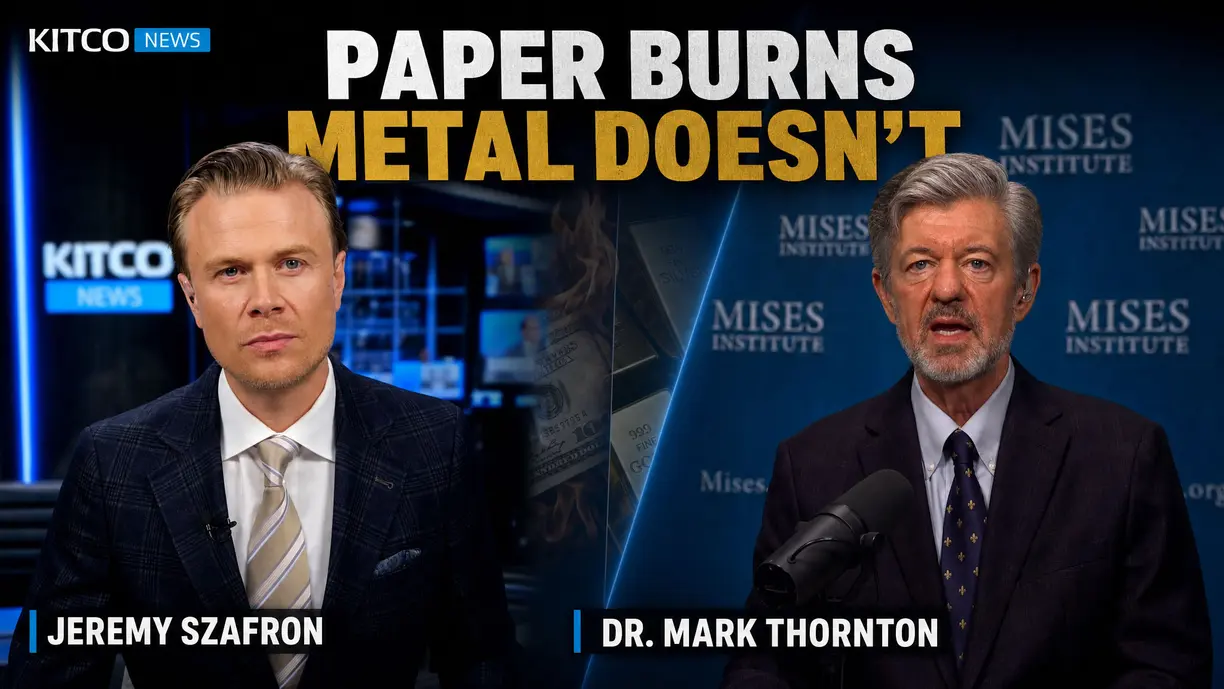
That gap is the part that worries Mark Thornton, a senior fellow at the Ludwig von Mises Institute who called the U.S. housing bubble in 2004 and then spent four years being told he was wrong.
"I'll buy a 100-year bond from this company or a 30-year bond from this company, even though the bond is financing an asset that's only gonna last three years," Thornton told Kitco News, describing how he thinks buyers are reasoning. "Bad things have come from this kind of financial chicanery in the past."
It is no longer a small corner of the market. Tech companies and hyperscalers now make up more than 20% of the investment-grade bond index maturing in 10 years or longer, according to Guggenheim Investments. Apollo Global Management puts AI-related borrowing at close to 40% of all new corporate bond supply. Debt tied to the buildout has passed 400 billion dollars this year, according to Bloomberg.
"The amount of money is really out of pace with any historical norm," said Thornton, author of "The Skyscraper Curse." "So we know this is very abnormal."
Monday brought another example. SoftBank started testing investor appetite for more than 11 billion dollars of junk-rated debt to put more money into OpenAI, at yields between 9% and 10%. It would be one of the largest high-yield bond sales ever done by a single company.
Asked whether that debt now reaches beyond technology shareholders, Thornton went further than the sector.
"All paper, dollar-denominated assets are facing a very difficult future," he said.
The tower and the server hall
Thornton's book makes an argument about skyscrapers that he now applies to data centers. Record-breaking towers tend to be started near the top of a cycle, he says, not because the buildings cause anything but because cheap money produces both the tower and the bust that follows it.
A data center, he argues, is the same animal in a different shape.
"Skyscrapers are location-dependent in central business districts, and so they have to go up, up, up as land prices go up," he said. "But with data centers, they can go out in the middle of nowhere, so they spread out."
Amazon, Microsoft, Alphabet and Meta are on track to spend roughly 725 billion dollars between them this year, up 77%, according to estimates compiled from their first quarter earnings. Most of it is going into AI infrastructure.
What changed, Thornton said, is that the money is no longer spare.
"These were all companies that were generating so much cash, they almost didn't know what to do with it," he said. "So now they've had to cut back their traditional expenditures in order to funnel all of their cash into this area."

Somebody pays for the power
Utilities are signing long contracts and building new generation to serve these sites. So who eats it if the tenants stop paying?
Thornton doesn't think the bill stays with the companies that ordered the power.
"A lot of the data centers are not directly owned by the hyperscalers themselves," he said. "In a market economy, the burden would all fall on the companies themselves. I suspect that a lot of the arrangements that have been made are ultimately gonna make a lot of this fall unfairly on the taxpayer and the customer, the utility customers."
The demand is already showing up in the data. Federal Reserve figures released last week had U.S. factory output falling 0.3% in August, the first drop of the year, while utility production rose 1.8% on higher electricity use.
It is showing up at the Fed too. Chicago Fed President Austan Goolsbee, speaking in London on Monday, said business contacts in his district are describing something that sounds like old-fashioned overheating. "Up until recently I had thought mostly the AI data center part was staying in its lane," he told reporters.
The pipeline nobody defended
Thornton said the attack that shut Saudi Arabia's East-West pipeline was written into the way the line was built.
"That pipeline that they considered a lifeline for Saudi Arabia and the world oil market was a sitting duck," he said. "It's in a perfectly straight line crossing the desert with no possible defense against drones and missiles, and it goes for hundreds and hundreds of miles."
The line has been down since a Sept. 10 attack that damaged pumping stations, with repairs estimated to take as long as six weeks. Saudi Aramco has told European refiners they will get no crude next month under long-term contracts. Crude slipped below 100 dollars a barrel Monday as U.S. Central Command reported Strait of Hormuz flows at a six-month high.
Fixing it, Thornton said, does not close the exposure. "If the Saudis fix it, the Houthis can go right back in and blow it back up again."
Rates, and what he sees in gold
The Fed raised rates on Sept. 16 for the first time in three years, and Chair Kevin Warsh called it removing a dose of accommodation rather than tightening. Thornton agreed with him.
"I think Chairman Warsh is absolutely correct. They're not really tightening relative to market conditions," he said, pointing out the policy rate now sits only marginally above the rate of price inflation.
Futures put the odds of another quarter point increase on Oct. 28 at 50.9%, with 49.1% expecting no change and nothing priced for a cut, according to the CME FedWatch tool. A month ago the same market gave a 46.8% chance that rates would be lower than they are today. That possibility is now off the board entirely.
The best sign Thornton has seen for sound money, though, has nothing to do with rates or the price.
"I do take it as a good sign that central banks no longer trust other central banks," he said. "A lot of countries are looking for alternative paths away from the dollar monopoly that's been in existence since World War II. The G7 is totally out to lunch."
Spot gold traded at 4,339.70 dollars an ounce Monday morning, down 38.80 dollars or 0.89% on the day, after trading as high as 4,384.30. Silver was at 65.92 dollars, off 0.36%.
Asked what survives if the price of money ever becomes honest again, he didn't hedge.
"With honest money, the world economy grows and thrives," Thornton said. "And with honest money, the central banks die."
See live precious metals prices for gold, silver, platinum and palladium — in USD, CAD and 12 more currencies.