
(Kitco News) – Gold prices survived another difficult week as early attempts to stabilize above $4,350 were overwhelmed by higher Treasury yields, hawkish Federal Reserve expectations, and persistent inflation concerns tied to energy prices and the U.S.-Iran conflict.
Spot gold kicked off the week trading at $4,383.44 per ounce on Sunday evening, and the yellow metal briefly pushed higher as traders continued to monitor Middle East diplomacy and the risk premium around the Strait of Hormuz. The move quickly stalled, however, with gold setting its weekly high at $4,387.51 per ounce on Sunday evening before sellers regained control.
The metal came under renewed pressure Monday and Tuesday as a rally in equities, higher yields, and a firmer dollar reduced demand for safe-haven assets. Gold attempted to stabilize midweek, but hawkish Fed commentary and sticky inflation concerns kept traders focused on the likelihood of additional rate hikes after last week’s 25-basis-point increase.
Selling accelerated Wednesday and Thursday as Treasury yields continued to rise, increasing the opportunity cost of holding non-yielding bullion. Spot prices broke below $4,300 and ultimately set their weekly low of $4,244.63 per ounce on Thursday before bargain-hunting emerged near the lower end of the week’s range.
Gold recovered modestly on Friday as oil prices eased on renewed hopes for a U.S.-Iran deal that could reopen the Strait of Hormuz, while the dollar slipped and dip-buyers stepped back into metals markets. But the rebound remained capped by elevated rate-hike expectations, and spot gold failed to reclaim the $4,300 per ounce level ahead of the weekly close.
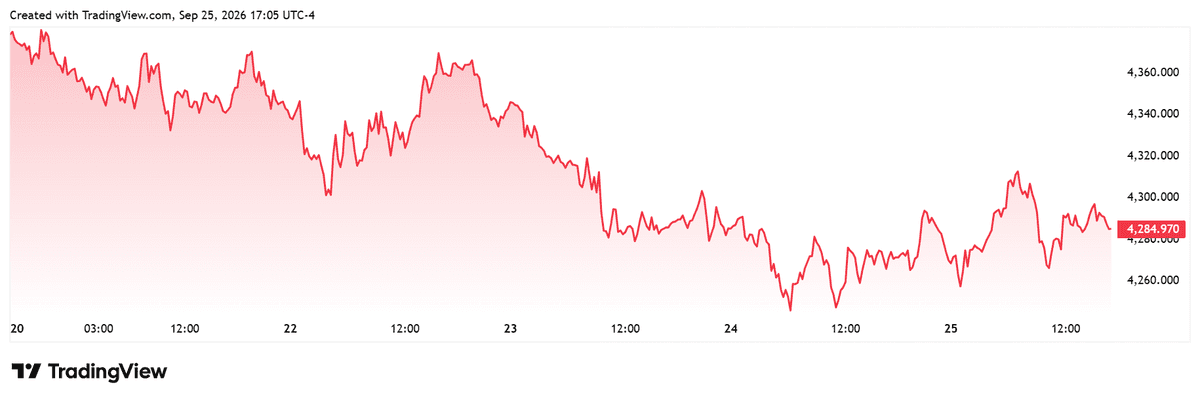
The latest Kitco News Weekly Gold Survey showed Wall Street with no clear conviction on gold’s near-term direction, while Main Street maintained its bullish majority despite gold’s weak weekly performance.
“I like gold next week on ideas that the pendulum of Fed expectations has swung as far or nearly as far as they will, and the next batch of important US data will reinforce that,” said Marc Chandler, managing director at Bannockburn Global Forex. “Next week, U.S. reports August PCE deflator that will include a methodological adjustment that will shave some inflation off, and September jobs growth looks weaker than in August. Still, gold needs to rise above $4400 to be anything noteworthy.”
“Up,” said Darin Newsom, senior market analyst at Barchart.com. “Technically, the Dec gold futures contract is oversold on its short-term daily chart, but as the old saying goes, a market can stay overbought (or oversold) longer than most of us can remain solvent. (A take on Keynes view of irrational behavior in a market.) Based on Game Theory - and after all this is nothing more than a game of how algorithms will be triggered these days - this will be my third consecutive week of saying Up, with one correct (two weeks ago) and one incorrect (this past week). This makes the coming week the Rubber Match for the best two out of three.”
“For the record, fundamentally nothing has changed,” Newsom added. “US Treasury yields continue to go higher because of inflation while central banks continue to buy gold.”
“Up,” said Rich Checkan, president and COO of Asset Strategies International. “Investors are starting to come around to the fact that there is only so far the FED can raise rates… since we cannot afford the current debt servicing of $1.6 trillion per annum (4% of $40 trillion). And since Congress will never stop overspending, gold will go higher. This is a no-brainer.”
“For the coming week I am neutral on Gold,” said Colin Cieszynski, chief market strategist at SIA Wealth Management. “I just don’t see many major catalysts.”
“Down,” said James Stanley, senior market strategist at Forex.com. “The issue with yields isn’t going away anytime soon and bonds seem fragile, so I’m looking for a spike in yields that I think could possibly bring a tradable low in gold. As long as we’re above 4k, I think there’s still rationale for a bullish long-term bias and 4100 would be even more ideal for support given how well that showed as resistance before the breakout in August.”
Adam Button, head of currency strategy at investingLive, believes much of gold’s recent weakness can be chalked up to peaking yields.
“You saw the clear correlation when it broke at five percent again,” he said. “It shot higher; gold went down. Gold is a bit of a risk asset too, so that's the drag. It was rough there yesterday and the day before. Seasonals kick in really in November, so you're looking for a dip to buy at any point.”
“The dollar's going up again. It hasn't been a great week for gold, but it's holding in there okay.”
Button sees 2026 as a two-part story, and he says we’re still in the consolidation phase after gold’s remarkable run above $5,000 in the early months.
“$4,000 proved to be pretty strong [support],” he said. “Now we've got yields over 5%, and we're still at $4,300. It might just take a while to consolidate that huge run from $2,000 to $5,000. And if we're doing that up in the $4,500 to $4,700 range, it's not bad. All the long-term gold drivers are as good as ever.”
And just as marginal buyers were a big part of gold’s run to all-time highs earlier in 2026, Button said they’re also jumping on these multi-decade high yields now.
“There's always the marginal buyer out there,” he said. “A gold bug is going to buy on anything, and someone who's committed to gold is already pretty well loaded up. But it's the guy who is faced with either a, let's call it, five percent risk-free return or gold. I think everyone has a price on the curve, and you're just finding out where it is. I think it does get difficult for gold to compete.”
Going forward, Button expects the markets will be very focused on the data, and that’s what he will be doing as well – but he’s less interested in the jobs report than he is in some of the leading employment indicators.
“[Nonfarm payrolls] is such a lagging indicator,” he said. “These survey data are probably the best ones. ISM services is probably the number-one circled on my calendar, because I think if jobs is strong, I don't know if anyone's going to believe it. But again, maybe I'm overthinking it. Strong jobs report, strong economy, sell more bonds, pricing a good economy, pricing more hikes. It probably wouldn't convince me, but it would convince the market that we're headed in the right direction.”
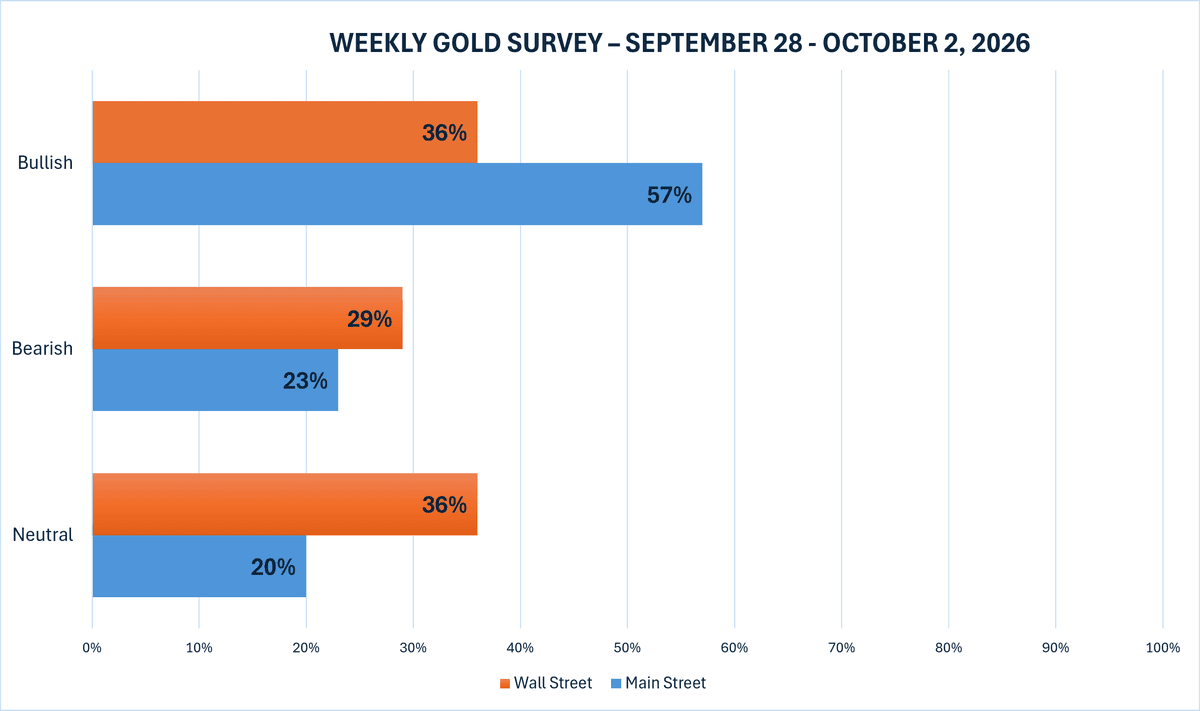
This week, 14 analysts participated in the Kitco News Gold Survey, with Wall Street fairly evenly trisected between bulls, bears and the fence-sitters following last week’s unanimous bullish bias. Five experts, or 36%, expected to see gold prices gain ground during the week ahead, while four others, representing 29%, saw the yellow metal falling further. The remaining five analysts, 36% of the total, expected the yellow metal to move in a volatile sideways channel next week.
Meanwhile, 152 votes were cast in Kitco’s online poll, with Main Street investors maintaining their bullish majority virtually unchanged. 86 retail traders, or 57%, looked for gold prices to rise next week, while 35 others, or 23%, predicted the yellow metal would lose ground. The remaining 31 investors, representing 20% of the total, expected to see sideways price action during the week ahead.
Next week will feature a raft of employment data, along with snapshots of the manufacturing sector and the health of the American consumer.
Early Tuesday morning, the Reserve Bank of Australia will issue its monetary policy decision, with U.S. Consumer Confidence and JOLTS job openings being released early in the North American session. Then Wednesday morning will see the release of ADP Nonfarm Payrolls, along with Final Q2 U.S. GDP and the PCE index.
Then on Thursday, traders will pay attention to the ISM Manufacturing PMI for September, along with weekly jobless claims..
The economic news week wraps up Friday morning with the publication of the Nonfarm Payrolls report for September.
Kevin Grady, president of Phoenix Futures and Options, said he’s not looking to the price charts for clues to gold’s direction, but to the Middle East and the Federal Reserve.
“I get that when they look at the charts and say, ‘Oh, it's breaking out,’ that's great,” he said. “But I don't look at it that way. It's a rally, and there's a lot of things behind it that are pushing it, and we’re starting to see open interest come in, which is big. But until we get this Iran situation taken care of… and also interest rates, we haven't had a lot of clarity.”
“I'm following the bond market and Iran. That's what I'm following.”
Grady said there’s truth to the idea that high yields won’t necessarily restrain gold’s upside as much as they have in the past.
“I agree with it, because there's a lot that's going on in the bond market, and it's not just about Iran,” he said. “If you look at what's going on in the bond market, I think a lot of it has to do with the debt. I also think the AI trade has a lot to do with what's going on in the bond market. When you have Google offering a ten-year bond at 6.4%, it's very difficult to compete. That's competition for the Treasury market. And also, when you see Microsoft has a higher debt rating than the U.S. government.”
“What's happening now is gold's trying to find its footing,” he said. “This is a new era for gold. ‘Wait a minute, higher rates, and it means that we can still rally? What is the meaning behind why this is?’ People are trying to determine why the yields are rallying.”
Grady said he expects gold prices to fall further in this high-rates, high-yields environment, and he thinks this will actually be good for the yellow metal in the longer term.
“I do want to see gold pressured,” he said. “I think the best way to see how strong a market is is to sell it. That's what happened with gold last time. They push it down under $4,000, and what's going to happen? All of a sudden, the support came in. And the support came in droves, and it just really drives the market.”
“Right now, I think you're going to see some support down there,” Grady said. “This is a knee-jerk reaction where it's just the old-school thinking ‘interest rate hikes, gold's going lower. It's just like A equals B, and that's what it is. I think there's a new dynamic in the market because there's a lot more going on, and I think as the market digests that, I think that you're going to start seeing some higher prices. I'd like to see gold down here. I think the next two hundred dollars, I think there's some support here. And the m—
“We used to say on the floor, the market right now is eating its vegetables. It has to do its work. It’s not easy, nobody wants to do it. But you have to eat your vegetables.”
Alex Kuptsikevich, senior market analyst at FxPro, said gold is ending the week on the back foot after falling back below $4,300.
“During the week, the price per ounce dipped below $4,250 and rebounded from this support level, as it did the previous week,” he said. “Despite rebounding from this horizontal support level, the price has settled below its 50-day moving average and the uptrend support line in place since July. Fundamentally, the pressure stems from a tighter monetary policy outlook in the foreseeable future. Over the week, the market’s weighted average expectation for the rate in a year rose to 4.77% and, on Thursday, exceeded 4.80%, compared with 4.68% a week earlier and 4.05% a month ago. The main scenario (>50%) is now for four rate rises over the next 12 months. The Fed kept rates above these levels between March 2023 and September 2024, when it was doing its utmost to curb inflation, and also between May 2006 and August 2007, when it was combating an overheating economy.”
“A couple of years ago, higher interest rates did not curb the rise in gold prices, whilst before the financial crisis, the price remained more or less flat throughout that period,” Kuptsikevich noted. “Judging by stock market cycles, the situation bears a closer resemblance to what we saw two decades ago. There is also a third historical example: the period from 1994 to 2001, when gold was under pressure for most of the time whilst the Fed rate exceeded 5%. However, this is not a representative example, as at that time the US did not have a budget deficit large enough to require the creation of a massive government bond market.”
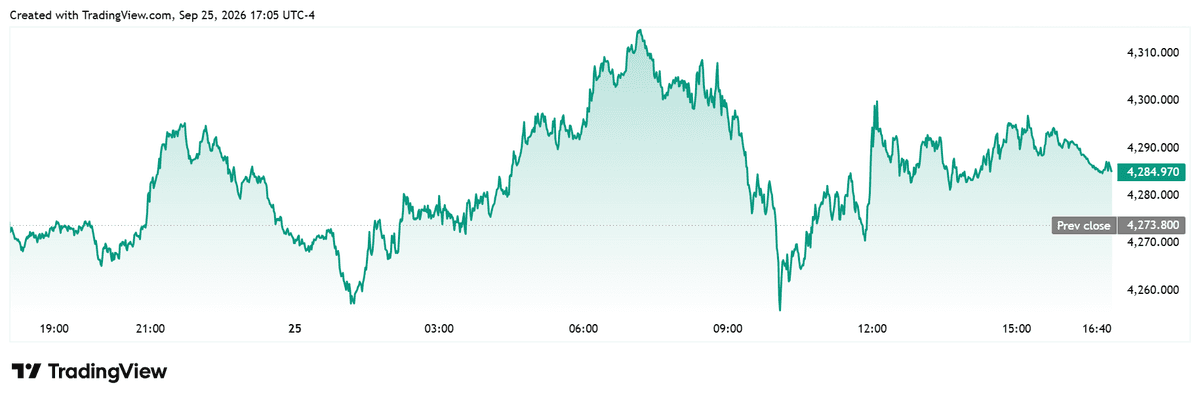
At the time of writing, spot gold last traded at $4,284.97 per ounce for a loss of 2.17% on the week but a gain of 0.26% on the day.
See live precious metals prices for gold, silver, platinum and palladium — in USD, CAD and 12 more currencies.
