
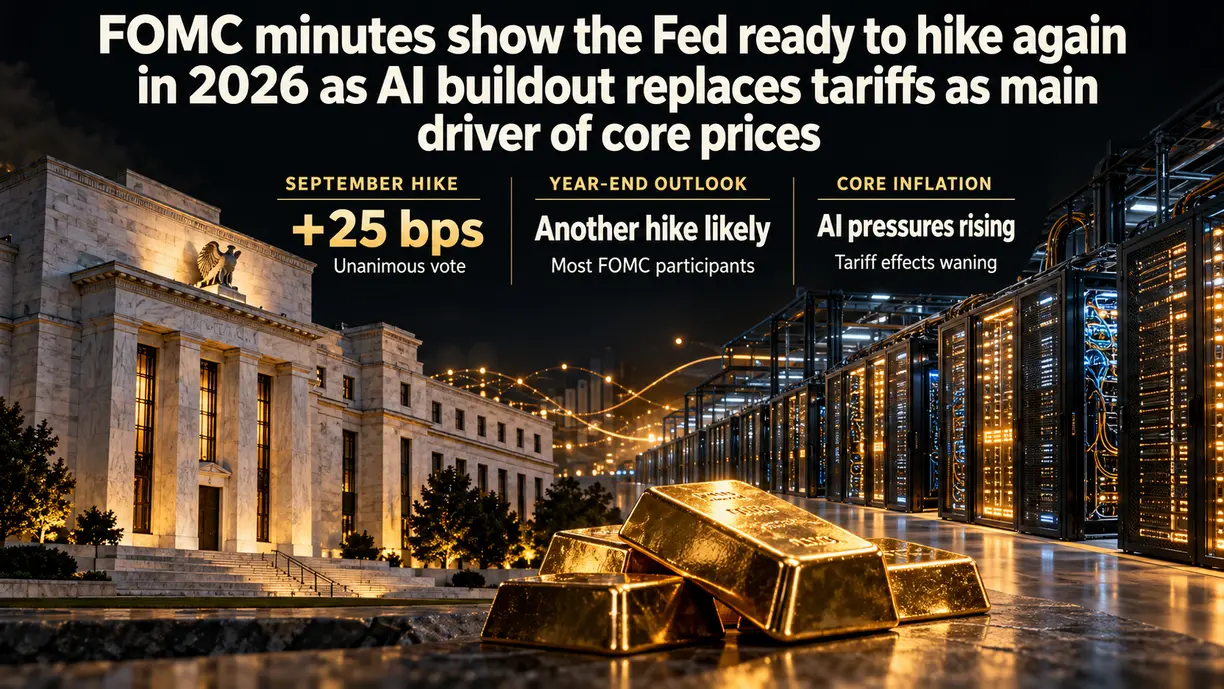
(Kitco News) – The minutes from the September 15-16 Federal Open Market Committee (FOMC) meeting showed Fed members acknowledging the need to respond to persistent inflation, with most expecting that another rate hike would be necessary before year-end, while several saw the effects of the AI buildout on core inflation increasing while the effects tariffs waned.
In the staff review of financial conditions, they noted that “the market-implied path for monetary policy had risen notably over the intermeeting period and that both market prices and market outreach indicated that investors placed high odds on a 25 basis point increase in the target range for the federal funds rate at the September meeting. They also noted that responses to the Desk survey “indicated that a considerable probability was placed on at least 25 basis points of policy firming by the end of the year.”
“The shift in expectations was attributable in part to FOMC communications as well as to the incoming inflation data,” they said. “The manager also observed that considerable uncertainty remained about the path of policy at longer horizons.”
In the staff review of the economic situation, they wrote that “information available at the time of the meeting indicated that inflation remained elevated,” while labor market conditions “continued to be broadly stable with some signs of gradual tightening,” and real GDP “was expanding at a solid pace.”
“Economic growth abroad stepped up in the second quarter, as most foreign economies continued to demonstrate resilience despite heightened geopolitical tensions and elevated energy prices,” the staff wrote. “By contrast, indicators of economic activity in China through August suggested that the country's domestic demand growth remained weak.”
They noted that total inflation abroad “remained above central banks' target levels in many foreign economies, reflecting higher consumer energy and food prices due to disruptions stemming from geopolitical developments,” adding that “most foreign central banks remained focused on inflation risks.”
In the staff’s review of the economic outlook, they wrote that inflation was expected to decline over the remainder of the year, with gas prices projected to move lower and core inflation forecast to edge down. “The staff's inflation forecast was somewhat higher for 2026 through 2028 than the one prepared for the July meeting,” they said.
“Real GDP growth was projected to pick up over the second half of this year and to outpace potential through 2028, reflecting strong business investment, solid consumer spending, and supportive financial conditions,” they noted. “The staff's outlook for economic activity and the labor market was stronger than the one prepared for the July meeting, mostly in response to incoming information.”
They warned, however, that the uncertainty around their projections was “substantial, considering the unknowns related to persistently elevated inflation, the potential economic effects of AI investment and adoption, and geopolitical developments.” They said the risks around the forecasts for employment and real GDP growth were “roughly balanced,” but risks to the inflation forecast were “skewed to the upside, given the possibility that inflation could prove to be more persistent than the staff anticipated.”
Turning to FOMC members’ deliberations, the minutes noted that participants “noted that inflation remained elevated and that they had not seen sufficient progress on lowering inflation in recent months.” They said that “ongoing geopolitical developments, which had pushed up prices for crude oil and refined fuel products, and surging AI-related investments were contributing to inflation pressures.” Several FOMC members “observed that the rate of price increases in the core goods category also remained elevated, as effects of the AI buildout appeared to increase while the effects of tariff increases waned.”
Participants “generally expected that inflation would remain elevated in the near term and then decline toward 2 percent over the medium term under appropriate monetary policy.” FOMC members “generally assessed inflation risk as skewed to the upside; some participants remarked that those risks had become more skewed to the upside in recent months,” the minutes said. “Many participants assessed that the longer energy prices remained elevated, the greater the risk that cost increases in certain sectors could lead to broader price pressures,” while some participants “expressed concerns that, after more than five years of inflation above 2 percent, elevated inflation rates could begin to affect inflation expectations and wage- and price-setting decisions.”
Regarding the labor market, participants “judged that labor market conditions were stable and generally viewed the labor market as close to maximum employment,” and a majority of participants “assessed that the labor market had strengthened a bit recently, pointing to developments such as employment gains modestly outpacing labor force growth.”
Participants “generally expected labor market conditions to remain stable, with the unemployment rate staying close to current levels,” the minutes said. “Participants generally viewed the upside and downside risks to the labor market as broadly balanced.”
In their consideration of monetary policy, “all participants supported raising the target range for the federal funds rate 1/4 percentage point,” and FOMC members “generally emphasized that inflation remained elevated while the labor market appeared to be near full employment, with some signs of strengthening, and that economic activity was expanding at a solid pace.”
“Based on the outlook and the changing balance of risks, all participants viewed a higher target range for the federal funds rate as appropriate,” the minutes said. “Many participants emphasized that a higher path for the target range would be prudent on risk-management grounds, providing insurance against inflation remaining persistently above target due to stronger-than-expected demand or further adverse supply shocks. A number of participants viewed a higher path for the target range as necessary based on their modal outlooks rather than on risk-management grounds.”
“Several participants stated that they viewed the current policy rate as not restrictive or only mildly restrictive,” they added.
Regarding the outlook for monetary policy, “most participants assessed that another increase in the target range for the federal funds rate would likely be appropriate by year end,” but they emphasized that “decisions at future meetings would depend on incoming information and its implications for the outlook and the balance of risks.”
The vote for the 25-basis-point rate hike was unanimous.
Gold prices continued to trade near the bottom of their daily range following the 2 pm ET release.
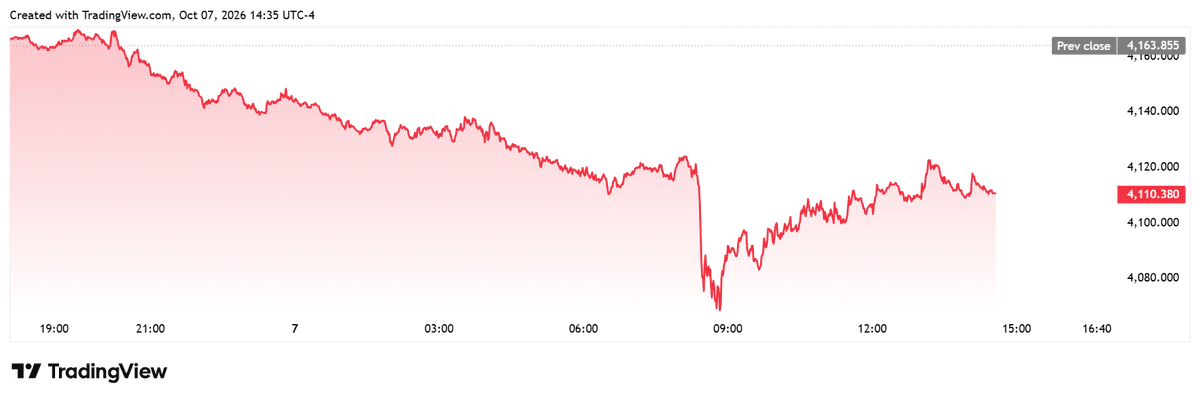
Spot gold last traded at $4,110.38 for a loss of 1.28% on the session.
